

chaPter 12 the Broader context
522
concerns are a significant driver. Costs are always relevant, but
achieving minimum possible costs is rarely a driver. Environmental
and other issues are currently by and large less significant than in
other industries. (Arguments largely promoted by the industry for
not having a high priority placed on these concerns include the
basic notion that overall material quantities produced are low compared to products associated with other industries.)
In general, many qualities sought after in materials for the sports
industry have to do in one way or another with the mechanical
properties of materials. By and large, light weight is desirable—
especially so in many products such as highend racing bicycles.
Reduced weight typically means reduced energy expenditure on the
part of the sports user, and this available energy can be captured for
increased performance by the user. Utilizing highstrength materials
is commonly one way to achieve reduced weight, and nanocomposite materials can clearly be appropriate for use here. High stiffness
might or might not be a desirable characteristic. It certainly is in
some circumstances but is a design variable in others. Depending on
the specific golf club type being designed as well as user characteristics, for example, varying degrees of stiffness are usually needed.
Thermal properties can be important in many materials—certainly
for outdoor trekking and camping gear. Light weights can be also be
important in this area. Clothing and coats that have high insulative
capabilities while allowing “breathing” in the material fabrics already
use hightechnology material products (e.g., various materials that
are waterproof but allow breathability, or materials that control body
temperatures by use of phasechange phenomena). Nanoporous
materials such as aerogels are starting to find uses in outdoor coats
because of their thermal properties combined with lightness. Depending on the sport, many other qualities can be important.
While the reality of potentially improved performances via the
use of sports equipment based on nanotechnologies is positively
there, there are also fewer areas that have contributed so much to
the hype surrounding nanomaterials. The promise of improved
performance via nanomaterials is a common advertising theme
for products that might or might not have actually benefited from
the use of nanobased materials and technologies. Understanding
exactly what is meant can be surprisingly difficult. A material can
be advertised as a nanocomposite and highly touted, but finding
out the relative percentage by weight of nanomaterials present or
what weight or stiffness reductions have been achieved can be virtually impossible and can easily cause informed customers to become
suspicious.
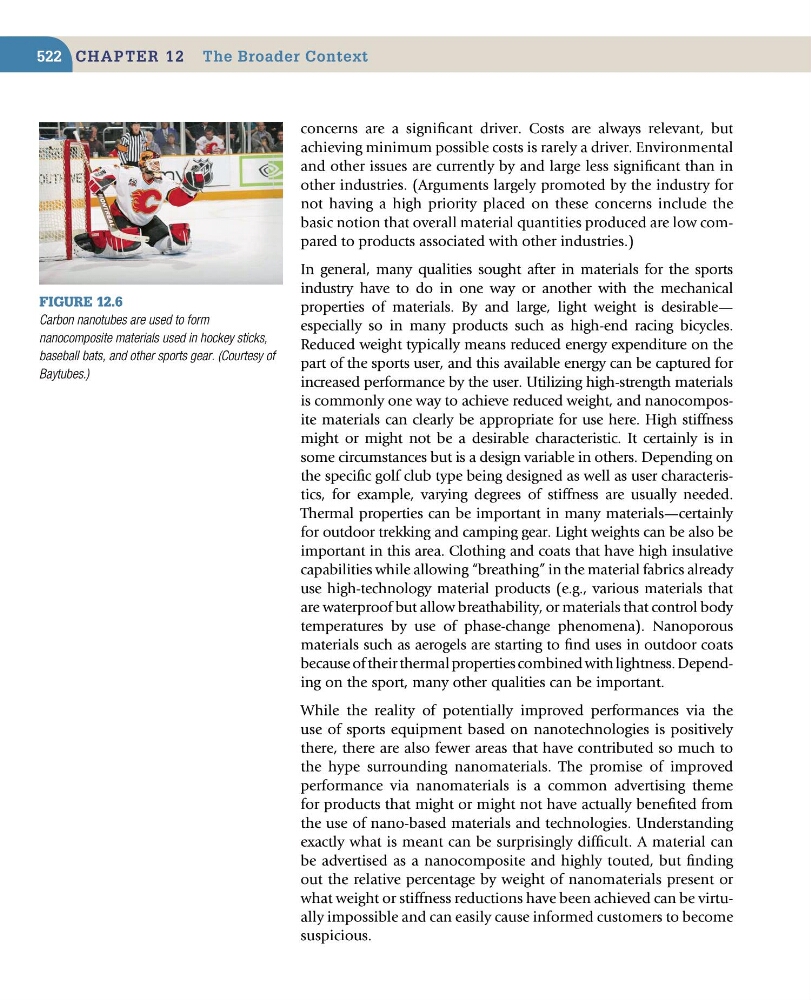
Figure 12.6
Carbon nanotubes are used to form
nanocomposite materials used in hockey sticks,
baseball bats, and other sports gear. (Courtesy of
Baytubes.)
522
concerns are a significant driver. Costs are always relevant, but
achieving minimum possible costs is rarely a driver. Environmental
and other issues are currently by and large less significant than in
other industries. (Arguments largely promoted by the industry for
not having a high priority placed on these concerns include the
basic notion that overall material quantities produced are low compared to products associated with other industries.)
In general, many qualities sought after in materials for the sports
industry have to do in one way or another with the mechanical
properties of materials. By and large, light weight is desirable—
especially so in many products such as highend racing bicycles.
Reduced weight typically means reduced energy expenditure on the
part of the sports user, and this available energy can be captured for
increased performance by the user. Utilizing highstrength materials
is commonly one way to achieve reduced weight, and nanocomposite materials can clearly be appropriate for use here. High stiffness
might or might not be a desirable characteristic. It certainly is in
some circumstances but is a design variable in others. Depending on
the specific golf club type being designed as well as user characteristics, for example, varying degrees of stiffness are usually needed.
Thermal properties can be important in many materials—certainly
for outdoor trekking and camping gear. Light weights can be also be
important in this area. Clothing and coats that have high insulative
capabilities while allowing “breathing” in the material fabrics already
use hightechnology material products (e.g., various materials that
are waterproof but allow breathability, or materials that control body
temperatures by use of phasechange phenomena). Nanoporous
materials such as aerogels are starting to find uses in outdoor coats
because of their thermal properties combined with lightness. Depending on the sport, many other qualities can be important.
While the reality of potentially improved performances via the
use of sports equipment based on nanotechnologies is positively
there, there are also fewer areas that have contributed so much to
the hype surrounding nanomaterials. The promise of improved
performance via nanomaterials is a common advertising theme
for products that might or might not have actually benefited from
the use of nanobased materials and technologies. Understanding
exactly what is meant can be surprisingly difficult. A material can
be advertised as a nanocomposite and highly touted, but finding
out the relative percentage by weight of nanomaterials present or
what weight or stiffness reductions have been achieved can be virtually impossible and can easily cause informed customers to become
suspicious.
Figure 12.6
Carbon nanotubes are used to form
nanocomposite materials used in hockey sticks,
baseball bats, and other sports gear. (Courtesy of
Baytubes.)