

521
right but also an attractive highvalue product line—but have useful
side effects such as reducing needs for frequent washing and cleaning, which in turn would increase material longevity and decrease
environmental impacts. (These types of products are already available, but efficacies could be improved.)
The role of textiles visàvis health promotion and delivery is still
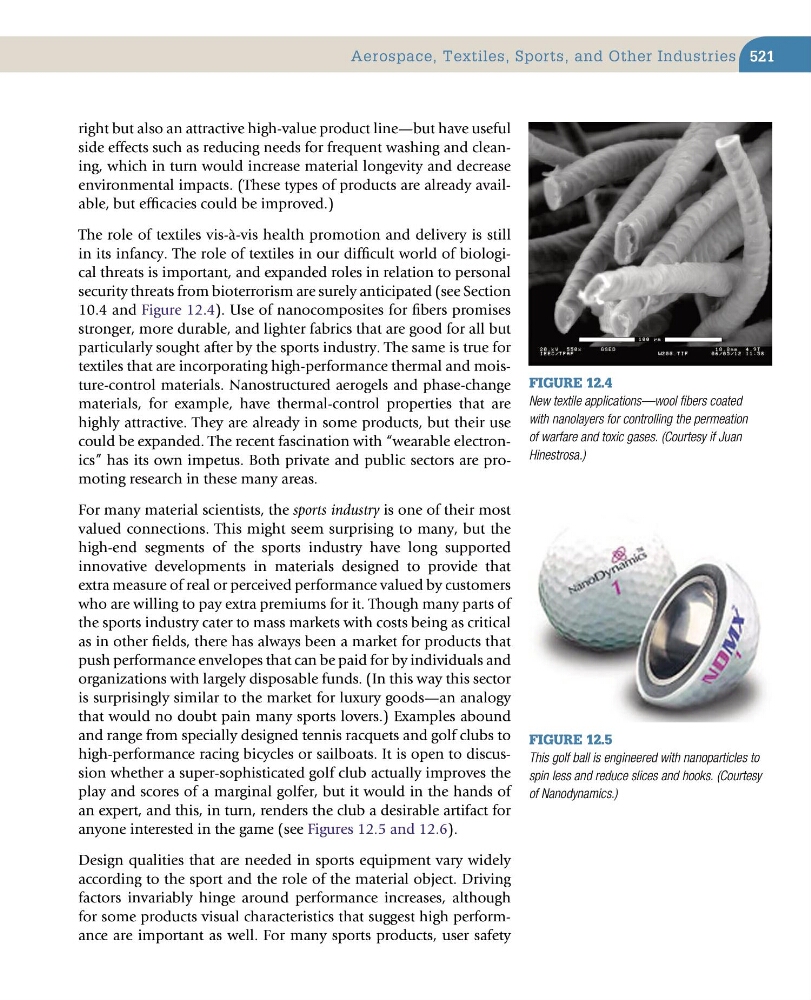
in its infancy. The role of textiles in our difficult world of biological threats is important, and expanded roles in relation to personal
security threats from bioterrorism are surely anticipated (see Section
10.4 and Figure 12.4). Use of nanocomposites for fibers promises
stronger, more durable, and lighter fabrics that are good for all but
particularly sought after by the sports industry. The same is true for
textiles that are incorporating highperformance thermal and moisturecontrol materials. Nanostructured aerogels and phasechange
materials, for example, have thermalcontrol properties that are
highly attractive. They are already in some products, but their use
could be expanded. The recent fascination with “wearable electronics” has its own impetus. Both private and public sectors are promoting research in these many areas.
For many material scientists, the sports industry is one of their most
valued connections. This might seem surprising to many, but the
highend segments of the sports industry have long supported
innovative developments in materials designed to provide that
extra measure of real or perceived performance valued by customers
who are willing to pay extra premiums for it. Though many parts of
the sports industry cater to mass markets with costs being as critical
as in other fields, there has always been a market for products that
push performance envelopes that can be paid for by individuals and
organizations with largely disposable funds. (In this way this sector
is surprisingly similar to the market for luxury goods—an analogy
that would no doubt pain many sports lovers.) Examples abound
and range from specially designed tennis racquets and golf clubs to
highperformance racing bicycles or sailboats. It is open to discussion whether a supersophisticated golf club actually improves the
play and scores of a marginal golfer, but it would in the hands of
an expert, and this, in turn, renders the club a desirable artifact for
anyone interested in the game (see Figures 12.5 and 12.6).
Design qualities that are needed in sports equipment vary widely
according to the sport and the role of the material object. Driving
factors invariably hinge around performance increases, although
for some products visual characteristics that suggest high performance are important as well. For many sports products, user safety
Figure 12.4
New textile applications—wool fibers coated
with nanolayers for controlling the permeation
of warfare and toxic gases. (Courtesy if Juan
Hinestrosa.)
Figure 12.5
This golf ball is engineered with nanoparticles to
spin less and reduce slices and hooks. (Courtesy
of Nanodynamics.)
Aerospace, Textiles, Sports, and Other Industries
right but also an attractive highvalue product line—but have useful
side effects such as reducing needs for frequent washing and cleaning, which in turn would increase material longevity and decrease
environmental impacts. (These types of products are already available, but efficacies could be improved.)
The role of textiles visàvis health promotion and delivery is still
in its infancy. The role of textiles in our difficult world of biological threats is important, and expanded roles in relation to personal
security threats from bioterrorism are surely anticipated (see Section
10.4 and Figure 12.4). Use of nanocomposites for fibers promises
stronger, more durable, and lighter fabrics that are good for all but
particularly sought after by the sports industry. The same is true for
textiles that are incorporating highperformance thermal and moisturecontrol materials. Nanostructured aerogels and phasechange
materials, for example, have thermalcontrol properties that are
highly attractive. They are already in some products, but their use
could be expanded. The recent fascination with “wearable electronics” has its own impetus. Both private and public sectors are promoting research in these many areas.
For many material scientists, the sports industry is one of their most
valued connections. This might seem surprising to many, but the
highend segments of the sports industry have long supported
innovative developments in materials designed to provide that
extra measure of real or perceived performance valued by customers
who are willing to pay extra premiums for it. Though many parts of
the sports industry cater to mass markets with costs being as critical
as in other fields, there has always been a market for products that
push performance envelopes that can be paid for by individuals and
organizations with largely disposable funds. (In this way this sector
is surprisingly similar to the market for luxury goods—an analogy
that would no doubt pain many sports lovers.) Examples abound
and range from specially designed tennis racquets and golf clubs to
highperformance racing bicycles or sailboats. It is open to discussion whether a supersophisticated golf club actually improves the
play and scores of a marginal golfer, but it would in the hands of
an expert, and this, in turn, renders the club a desirable artifact for
anyone interested in the game (see Figures 12.5 and 12.6).
Design qualities that are needed in sports equipment vary widely
according to the sport and the role of the material object. Driving
factors invariably hinge around performance increases, although
for some products visual characteristics that suggest high performance are important as well. For many sports products, user safety
Figure 12.4
New textile applications—wool fibers coated
with nanolayers for controlling the permeation
of warfare and toxic gases. (Courtesy if Juan
Hinestrosa.)
Figure 12.5
This golf ball is engineered with nanoparticles to
spin less and reduce slices and hooks. (Courtesy
of Nanodynamics.)
Aerospace, Textiles, Sports, and Other Industries