

491
purification devices based on these principles include developing
ways of increasing the contact area between water flowing through
and the surfaces holding immobilized catalysis particles as well
as ensuring that UV light at the needed intensities bears on these
same surfaces. These approaches naturally lead to the use of thin
immersed multiple surfaces (fins, tubes) that also tend to increase
turbulence, which can also help improve the rate of the pollutionreduction process. At the same time, rate of flow-through problems
remain.
There are several types of so-called electronic water purifiers based on
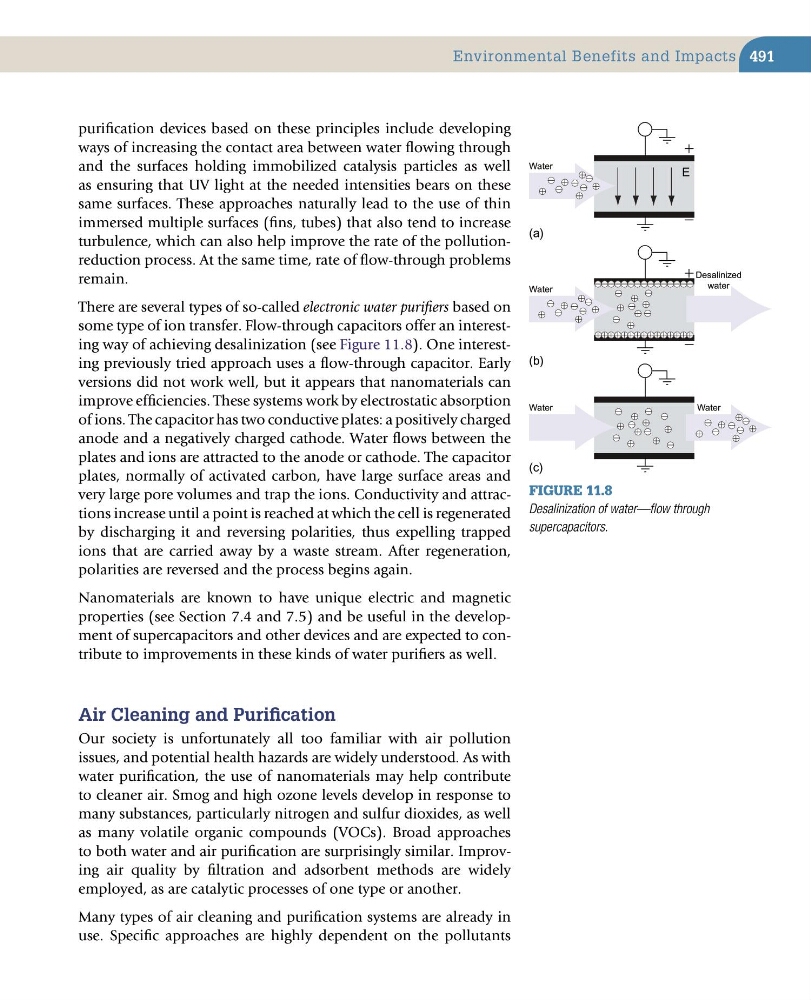
some type of ion transfer. Flow-through capacitors offer an interesting way of achieving desalinization (see Figure 11.8). One interesting previously tried approach uses a flow-through capacitor. Early
versions did not work well, but it appears that nanomaterials can
improve efficiencies. These systems work by electrostatic absorption
of ions. The capacitor has two conductive plates: a positively charged
anode and a negatively charged cathode. Water flows between the
plates and ions are attracted to the anode or cathode. The capacitor
plates, normally of activated carbon, have large surface areas and
very large pore volumes and trap the ions. Conductivity and attractions increase until a point is reached at which the cell is regenerated
by discharging it and reversing polarities, thus expelling trapped
ions that are carried away by a waste stream. After regeneration,
polarities are reversed and the process begins again.
Nanomaterials are known to have unique electric and magnetic
properties (see Section 7.4 and 7.5) and be useful in the development of supercapacitors and other devices and are expected to contribute to improvements in these kinds of water purifiers as well.
air Cleaning and purification
Our society is unfortunately all too familiar with air pollution
issues, and potential health hazards are widely understood. As with
water purification, the use of nanomaterials may help contribute
to cleaner air. Smog and high ozone levels develop in response to
many substances, particularly nitrogen and sulfur dioxides, as well
as many volatile organic compounds (VOCs). Broad approaches
to both water and air purification are surprisingly similar. Improving air quality by filtration and adsorbent methods are widely
employed, as are catalytic processes of one type or another.
Many types of air cleaning and purification systems are already in
use. Specific approaches are highly dependent on the pollutants
Figure 11.8
Desalinization of water—flow through
supercapacitors.
Water
Desalinized
water
Water
Water
Water
(a)
(b)
(c)
E
Environmental Benefits and Impacts
purification devices based on these principles include developing
ways of increasing the contact area between water flowing through
and the surfaces holding immobilized catalysis particles as well
as ensuring that UV light at the needed intensities bears on these
same surfaces. These approaches naturally lead to the use of thin
immersed multiple surfaces (fins, tubes) that also tend to increase
turbulence, which can also help improve the rate of the pollutionreduction process. At the same time, rate of flow-through problems
remain.
There are several types of so-called electronic water purifiers based on
some type of ion transfer. Flow-through capacitors offer an interesting way of achieving desalinization (see Figure 11.8). One interesting previously tried approach uses a flow-through capacitor. Early
versions did not work well, but it appears that nanomaterials can
improve efficiencies. These systems work by electrostatic absorption
of ions. The capacitor has two conductive plates: a positively charged
anode and a negatively charged cathode. Water flows between the
plates and ions are attracted to the anode or cathode. The capacitor
plates, normally of activated carbon, have large surface areas and
very large pore volumes and trap the ions. Conductivity and attractions increase until a point is reached at which the cell is regenerated
by discharging it and reversing polarities, thus expelling trapped
ions that are carried away by a waste stream. After regeneration,
polarities are reversed and the process begins again.
Nanomaterials are known to have unique electric and magnetic
properties (see Section 7.4 and 7.5) and be useful in the development of supercapacitors and other devices and are expected to contribute to improvements in these kinds of water purifiers as well.
air Cleaning and purification
Our society is unfortunately all too familiar with air pollution
issues, and potential health hazards are widely understood. As with
water purification, the use of nanomaterials may help contribute
to cleaner air. Smog and high ozone levels develop in response to
many substances, particularly nitrogen and sulfur dioxides, as well
as many volatile organic compounds (VOCs). Broad approaches
to both water and air purification are surprisingly similar. Improving air quality by filtration and adsorbent methods are widely
employed, as are catalytic processes of one type or another.
Many types of air cleaning and purification systems are already in
use. Specific approaches are highly dependent on the pollutants
Figure 11.8
Desalinization of water—flow through
supercapacitors.
Water
Desalinized
water
Water
Water
Water
(a)
(b)
(c)
E
Environmental Benefits and Impacts