

C hapTer 11 nanomaterials and nanotechnologies
490
importance. Conventional techniques typically rely on evaporation
processes and various kinds of activated carbons used in filtration
or surface absorption processes. Reverse osmosis processes force
seawater under pressure through a membrane. Some fresh water
gets through, but salts are stopped. In electrodialysis processes, ions
are transferred through membranes because of electric potential
differences. All these processes work, but they have either limited
flux capabilities or are expensive. Reverse osmosis and electrodialysis processes consume large amounts of energy. Nano-based
membrane technologies again suggest promising approaches that
are less energy intensive. Selective use of filter gradients can restrict
the passage of some particles and allow others to pass through.
Carbon nanotubes have also been explored for use with desalinization processes, where reports have suggested reduced energy use
of some 100 times less than distillation processes and 10 less than
reverse-osmosis processes.
Nano-based photocatalytic processes are also emerging as potentially
strong means of water purification. As described in more detail in
Section 10.2, in photocatalytic oxidation processes a semiconductor
material such as titanium dioxide (TiO 2 ) is exposed to ultraviolet
light. On absorption of photons, the material acts as a catalyst, generating reactive hydroxyl radicals that can oxidize organic pollutants
and completely change them. Organic molecules are decomposed
to form carbon dioxide, water, and mineral acids. Many organic
molecules found in pesticides, herbicides, and surfactants can be
transformed in this way to less harmful products. Bacteria and
viruses can also be killed.
Photocatalytic processes for larger-scale applications currently
have limitations. Catalysis particles can either be immobilized on
surfaces within the reactor vessel or suspended in the water. For
normal flow-through processes, the latter approach has many
difficulties with recovering the particles themselves, and surface
approaches seem advantageous. Contact areas between pollutants
and catalysis particles, however, can then be more limited. The UV
light must also reach or penetrate the water and reach contact areas
so that the photons can activate the catalysis particles. Penetration
depths can be limited by absorption caused by the pollutant particles themselves.
Still, the increased catalytic efficiencies of nanosized catalytic particles because of their increased surface areas makes the approach
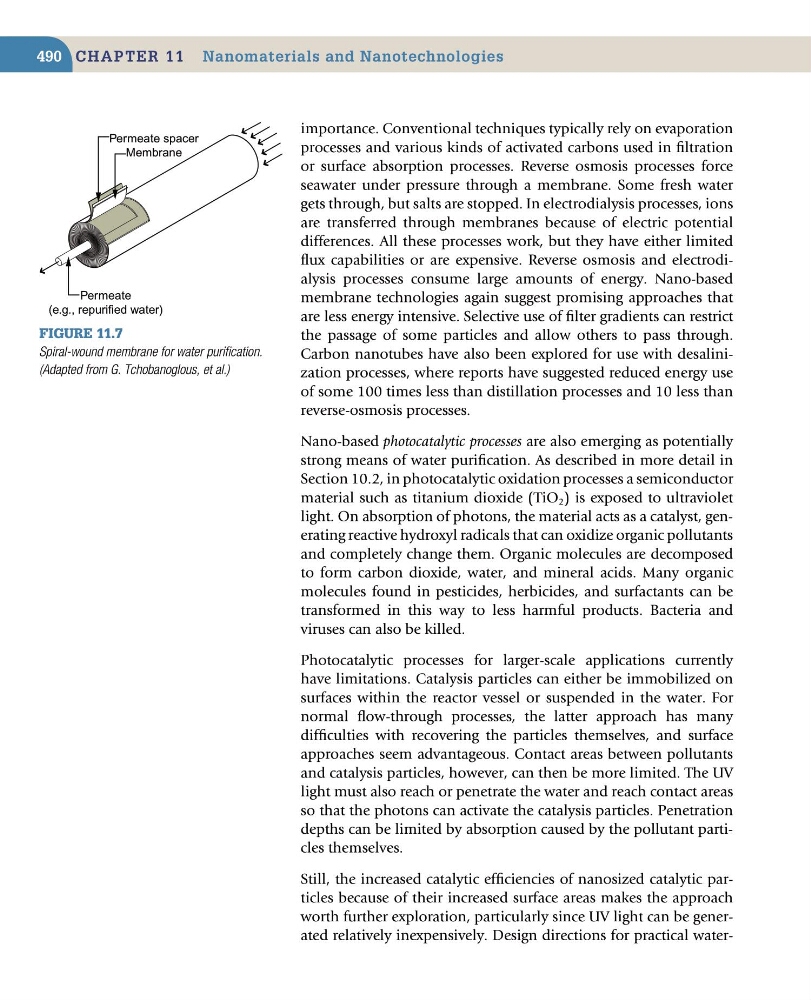
worth further exploration, particularly since UV light can be generated relatively inexpensively. Design directions for practical waterPermeate spacer
Membrane
Permeate
(e.g., repurified water)
Figure 11.7
Spiral-wound membrane for water purification.
(Adapted from G. Tchobanoglous, et al.)
490
importance. Conventional techniques typically rely on evaporation
processes and various kinds of activated carbons used in filtration
or surface absorption processes. Reverse osmosis processes force
seawater under pressure through a membrane. Some fresh water
gets through, but salts are stopped. In electrodialysis processes, ions
are transferred through membranes because of electric potential
differences. All these processes work, but they have either limited
flux capabilities or are expensive. Reverse osmosis and electrodialysis processes consume large amounts of energy. Nano-based
membrane technologies again suggest promising approaches that
are less energy intensive. Selective use of filter gradients can restrict
the passage of some particles and allow others to pass through.
Carbon nanotubes have also been explored for use with desalinization processes, where reports have suggested reduced energy use
of some 100 times less than distillation processes and 10 less than
reverse-osmosis processes.
Nano-based photocatalytic processes are also emerging as potentially
strong means of water purification. As described in more detail in
Section 10.2, in photocatalytic oxidation processes a semiconductor
material such as titanium dioxide (TiO 2 ) is exposed to ultraviolet
light. On absorption of photons, the material acts as a catalyst, generating reactive hydroxyl radicals that can oxidize organic pollutants
and completely change them. Organic molecules are decomposed
to form carbon dioxide, water, and mineral acids. Many organic
molecules found in pesticides, herbicides, and surfactants can be
transformed in this way to less harmful products. Bacteria and
viruses can also be killed.
Photocatalytic processes for larger-scale applications currently
have limitations. Catalysis particles can either be immobilized on
surfaces within the reactor vessel or suspended in the water. For
normal flow-through processes, the latter approach has many
difficulties with recovering the particles themselves, and surface
approaches seem advantageous. Contact areas between pollutants
and catalysis particles, however, can then be more limited. The UV
light must also reach or penetrate the water and reach contact areas
so that the photons can activate the catalysis particles. Penetration
depths can be limited by absorption caused by the pollutant particles themselves.
Still, the increased catalytic efficiencies of nanosized catalytic particles because of their increased surface areas makes the approach
worth further exploration, particularly since UV light can be generated relatively inexpensively. Design directions for practical waterPermeate spacer
Membrane
Permeate
(e.g., repurified water)
Figure 11.7
Spiral-wound membrane for water purification.
(Adapted from G. Tchobanoglous, et al.)