

489
Polymeric membranes are a particular focus of research. In the early
1960s polymeric membranes designed for reverse osmosis were
introduced and have since been used widely for various filtration
and separation applications. Reverse osmosis is a process by which
water or another liquid is purified of solute impurity particles by
being forced under pressure through a semipermeable membrane.
The liquids can pass, but not the solutes. Nanoporous materials can
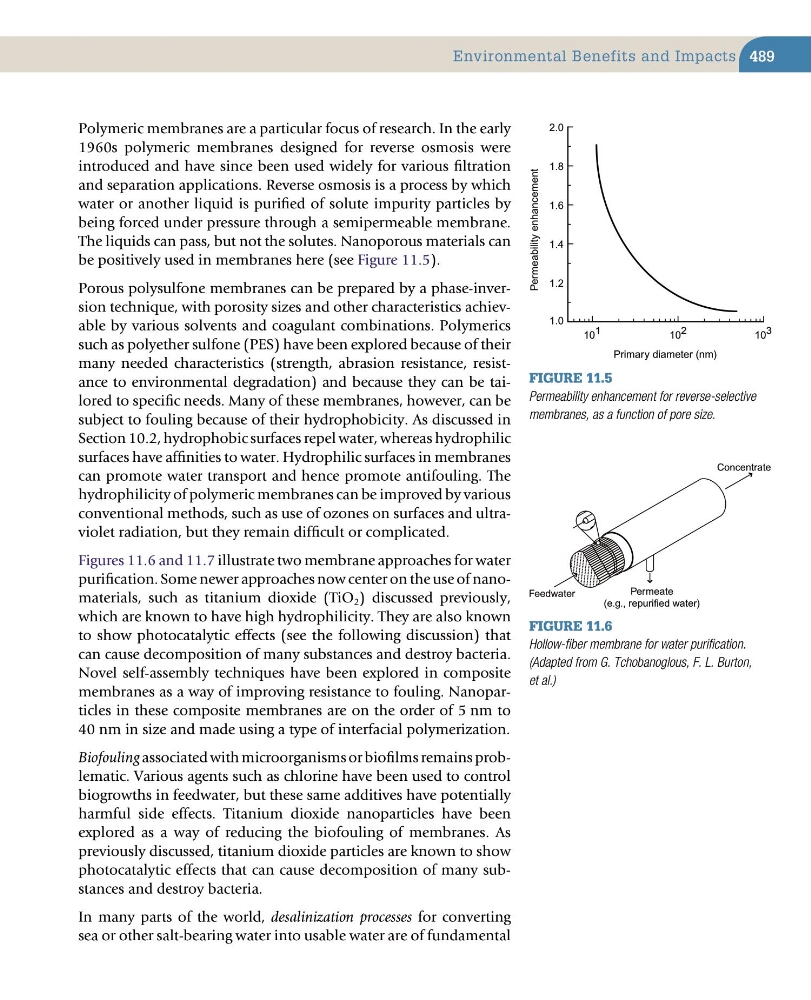
be positively used in membranes here (see Figure 11.5).
Porous polysulfone membranes can be prepared by a phase-inversion technique, with porosity sizes and other characteristics achievable by various solvents and coagulant combinations. Polymerics
such as polyether sulfone (PES) have been explored because of their
many needed characteristics (strength, abrasion resistance, resistance to environmental degradation) and because they can be tailored to specific needs. Many of these membranes, however, can be
subject to fouling because of their hydrophobicity. As discussed in
Section 10.2, hydrophobic surfaces repel water, whereas hydrophilic
surfaces have affinities to water. Hydrophilic surfaces in membranes
can promote water transport and hence promote antifouling. The
hydrophilicity of polymeric membranes can be improved by various
conventional methods, such as use of ozones on surfaces and ultraviolet radiation, but they remain difficult or complicated.
Figures 11.6 and 11.7 illustrate two membrane approaches for water
purification. Some newer approaches now center on the use of nanomaterials, such as titanium dioxide (TiO 2 ) discussed previously,
which are known to have high hydrophilicity. They are also known
to show photocatalytic effects (see the following discussion) that
can cause decomposition of many substances and destroy bacteria.
Novel self-assembly techniques have been explored in composite
membranes as a way of improving resistance to fouling. Nanoparticles in these composite membranes are on the order of 5 nm to
40 nm in size and made using a type of interfacial polymerization.
Biofouling associated with microorganisms or biofilms remains problematic. Various agents such as chlorine have been used to control
biogrowths in feedwater, but these same additives have potentially
harmful side effects. Titanium dioxide nanoparticles have been
explored as a way of reducing the biofouling of membranes. As
previously discussed, titanium dioxide particles are known to show
photocatalytic effects that can cause decomposition of many substances and destroy bacteria.
In many parts of the world, desalinization processes for converting
sea or other salt-bearing water into usable water are of fundamental
Figure 11.5
Permeability enhancement for reverse-selective
membranes, as a function of pore size.
2.0
Permeability enhancement
Primary diameter (nm)
1.8
1.6
1.4
1.2
1.0
10 1
10 2
10 3
Figure 11.6
Hollow-fiber membrane for water purification.
(Adapted from G. Tchobanoglous, F. L. Burton,
et al.)
Permeate
(e.g., repurified water)
Concentrate
Feedwater
Environmental Benefits and Impacts
Polymeric membranes are a particular focus of research. In the early
1960s polymeric membranes designed for reverse osmosis were
introduced and have since been used widely for various filtration
and separation applications. Reverse osmosis is a process by which
water or another liquid is purified of solute impurity particles by
being forced under pressure through a semipermeable membrane.
The liquids can pass, but not the solutes. Nanoporous materials can
be positively used in membranes here (see Figure 11.5).
Porous polysulfone membranes can be prepared by a phase-inversion technique, with porosity sizes and other characteristics achievable by various solvents and coagulant combinations. Polymerics
such as polyether sulfone (PES) have been explored because of their
many needed characteristics (strength, abrasion resistance, resistance to environmental degradation) and because they can be tailored to specific needs. Many of these membranes, however, can be
subject to fouling because of their hydrophobicity. As discussed in
Section 10.2, hydrophobic surfaces repel water, whereas hydrophilic
surfaces have affinities to water. Hydrophilic surfaces in membranes
can promote water transport and hence promote antifouling. The
hydrophilicity of polymeric membranes can be improved by various
conventional methods, such as use of ozones on surfaces and ultraviolet radiation, but they remain difficult or complicated.
Figures 11.6 and 11.7 illustrate two membrane approaches for water
purification. Some newer approaches now center on the use of nanomaterials, such as titanium dioxide (TiO 2 ) discussed previously,
which are known to have high hydrophilicity. They are also known
to show photocatalytic effects (see the following discussion) that
can cause decomposition of many substances and destroy bacteria.
Novel self-assembly techniques have been explored in composite
membranes as a way of improving resistance to fouling. Nanoparticles in these composite membranes are on the order of 5 nm to
40 nm in size and made using a type of interfacial polymerization.
Biofouling associated with microorganisms or biofilms remains problematic. Various agents such as chlorine have been used to control
biogrowths in feedwater, but these same additives have potentially
harmful side effects. Titanium dioxide nanoparticles have been
explored as a way of reducing the biofouling of membranes. As
previously discussed, titanium dioxide particles are known to show
photocatalytic effects that can cause decomposition of many substances and destroy bacteria.
In many parts of the world, desalinization processes for converting
sea or other salt-bearing water into usable water are of fundamental
Figure 11.5
Permeability enhancement for reverse-selective
membranes, as a function of pore size.
2.0
Permeability enhancement
Primary diameter (nm)
1.8
1.6
1.4
1.2
1.0
10 1
10 2
10 3
Figure 11.6
Hollow-fiber membrane for water purification.
(Adapted from G. Tchobanoglous, F. L. Burton,
et al.)
Permeate
(e.g., repurified water)
Concentrate
Feedwater
Environmental Benefits and Impacts