

C hapTer 11 nanomaterials and nanotechnologies
488
Filtering membrane technologies are particularly important. There are
many conventional natural and synthetic membranes in use that
employ fibrous media to filter undesirable particulates from water.
Common filters use various woven and nonwoven types either individually or in layers. Nonwoven types are usually random patterns
made from any of several dry- and wet-laid methods. Dry methods
include air-laid processes such as spinning and melt blowing. In
addition to basic materials, other additives or coatings, such as antimicrobial, may be included during formation processes to provide
various kinds of desired behaviors. Most nonwoven filters are commonly used as prefilters in large-scale water treatment activities to
reduce demands on subsequent filters. They have high surface areas
and can easily trap large quantities of larger particulates. Current
nonwoven filters catch particles as low as 10 microns.
Problems are severalfold. Pore size in relation to the filtering objective is obviously important. Pores are often not small enough
to catch many contaminating particles. The general problem of
fouling—the reduction of flow through a membrane caused by
blockages that build up over time—leads to process inefficiencies.
Cleaning can be very difficult. The several types of fouling include
particulate, colloidal, microbial, organic, and crystalline. Fouling
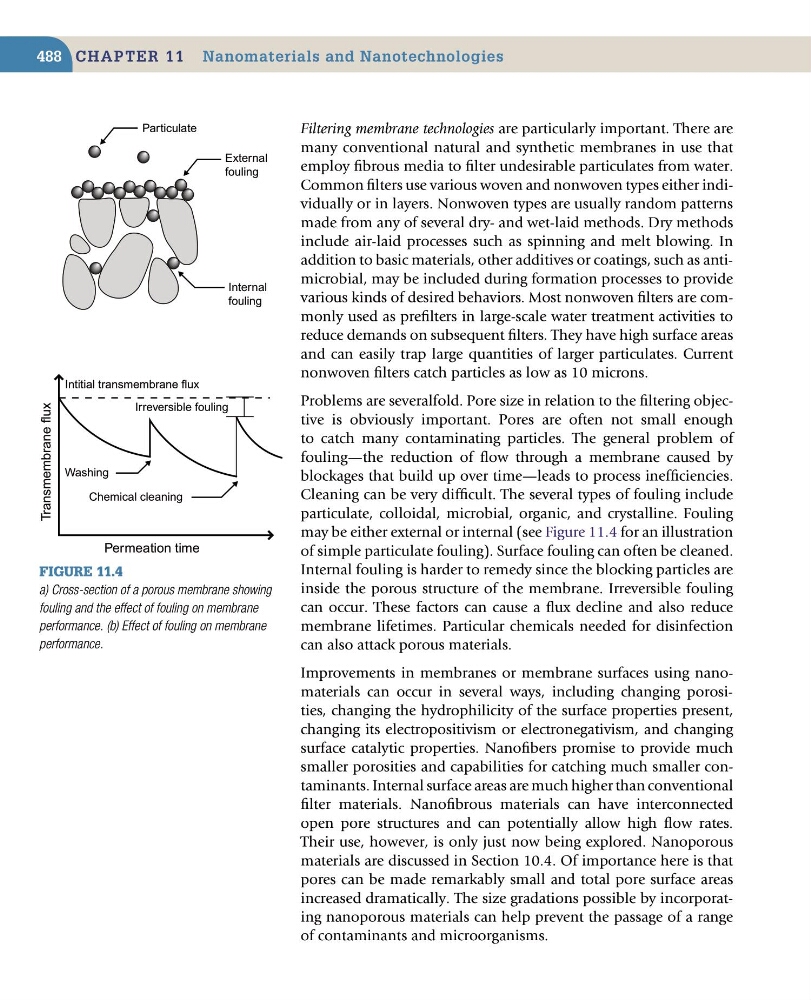
may be either external or internal (see Figure 11.4 for an illustration
of simple particulate fouling). Surface fouling can often be cleaned.
Internal fouling is harder to remedy since the blocking particles are
inside the porous structure of the membrane. Irreversible fouling
can occur. These factors can cause a flux decline and also reduce
membrane lifetimes. Particular chemicals needed for disinfection
can also attack porous materials.
Improvements in membranes or membrane surfaces using nanomaterials can occur in several ways, including changing porosities, changing the hydrophilicity of the surface properties present,
changing its electropositivism or electronegativism, and changing
surface catalytic properties. Nanofibers promise to provide much
smaller porosities and capabilities for catching much smaller contaminants. Internal surface areas are much higher than conventional
filter materials. Nanofibrous materials can have interconnected
open pore structures and can potentially allow high flow rates.
Their use, however, is only just now being explored. Nanoporous
materials are discussed in Section 10.4. Of importance here is that
pores can be made remarkably small and total pore surface areas
increased dramatically. The size gradations possible by incorporating nanoporous materials can help prevent the passage of a range
of contaminants and microorganisms.
Figure 11.4
a) Cross-section of a porous membrane showing
fouling and the effect of fouling on membrane
performance. (b) Effect of fouling on membrane
performance.
External
fouling
Internal
fouling
Particulate
Intitial transmembrane flux
Permeation time
Transmembrane flux
Irreversible fouling
Washing
Chemical cleaning
488
Filtering membrane technologies are particularly important. There are
many conventional natural and synthetic membranes in use that
employ fibrous media to filter undesirable particulates from water.
Common filters use various woven and nonwoven types either individually or in layers. Nonwoven types are usually random patterns
made from any of several dry- and wet-laid methods. Dry methods
include air-laid processes such as spinning and melt blowing. In
addition to basic materials, other additives or coatings, such as antimicrobial, may be included during formation processes to provide
various kinds of desired behaviors. Most nonwoven filters are commonly used as prefilters in large-scale water treatment activities to
reduce demands on subsequent filters. They have high surface areas
and can easily trap large quantities of larger particulates. Current
nonwoven filters catch particles as low as 10 microns.
Problems are severalfold. Pore size in relation to the filtering objective is obviously important. Pores are often not small enough
to catch many contaminating particles. The general problem of
fouling—the reduction of flow through a membrane caused by
blockages that build up over time—leads to process inefficiencies.
Cleaning can be very difficult. The several types of fouling include
particulate, colloidal, microbial, organic, and crystalline. Fouling
may be either external or internal (see Figure 11.4 for an illustration
of simple particulate fouling). Surface fouling can often be cleaned.
Internal fouling is harder to remedy since the blocking particles are
inside the porous structure of the membrane. Irreversible fouling
can occur. These factors can cause a flux decline and also reduce
membrane lifetimes. Particular chemicals needed for disinfection
can also attack porous materials.
Improvements in membranes or membrane surfaces using nanomaterials can occur in several ways, including changing porosities, changing the hydrophilicity of the surface properties present,
changing its electropositivism or electronegativism, and changing
surface catalytic properties. Nanofibers promise to provide much
smaller porosities and capabilities for catching much smaller contaminants. Internal surface areas are much higher than conventional
filter materials. Nanofibrous materials can have interconnected
open pore structures and can potentially allow high flow rates.
Their use, however, is only just now being explored. Nanoporous
materials are discussed in Section 10.4. Of importance here is that
pores can be made remarkably small and total pore surface areas
increased dramatically. The size gradations possible by incorporating nanoporous materials can help prevent the passage of a range
of contaminants and microorganisms.
Figure 11.4
a) Cross-section of a porous membrane showing
fouling and the effect of fouling on membrane
performance. (b) Effect of fouling on membrane
performance.
External
fouling
Internal
fouling
Particulate
Intitial transmembrane flux
Permeation time
Transmembrane flux
Irreversible fouling
Washing
Chemical cleaning