

459
protective clothing is envisioned that can, for example, protect the
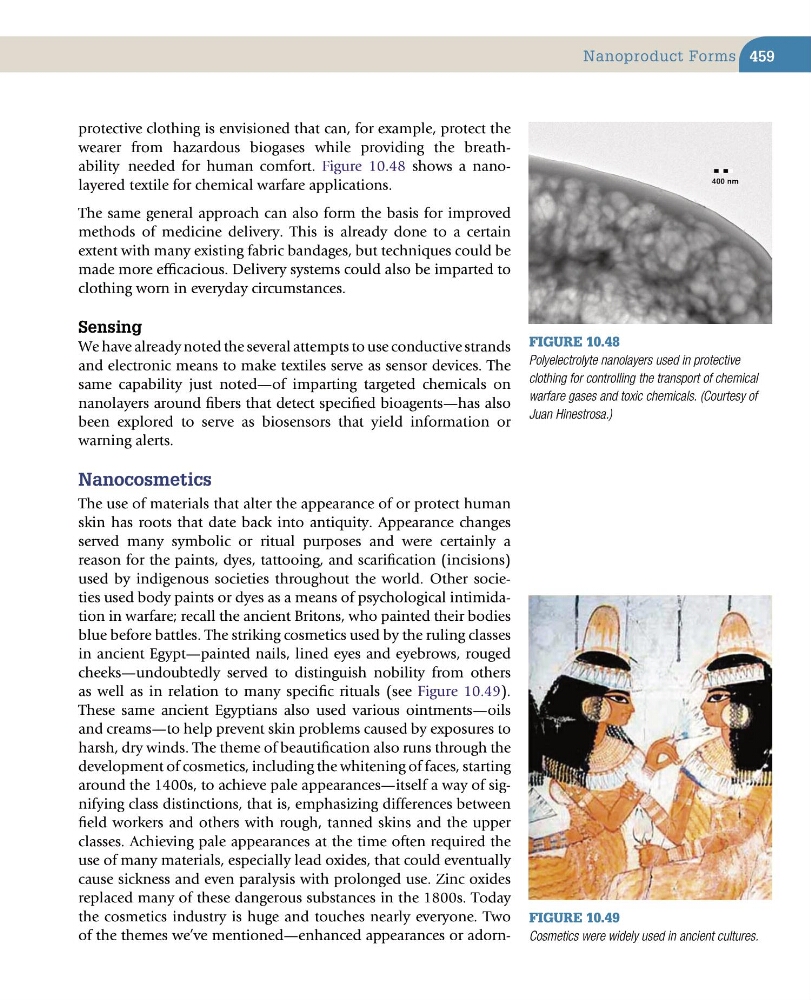
wearer from hazardous biogases while providing the breathability needed for human comfort. Figure 10.48 shows a nanolayered textile for chemical warfare applications.
The same general approach can also form the basis for improved
methods of medicine delivery. This is already done to a certain
extent with many existing fabric bandages, but techniques could be
made more efficacious. Delivery systems could also be imparted to
clothing worn in everyday circumstances.
sensing
We have already noted the several attempts to use conductive strands
and electronic means to make textiles serve as sensor devices. The
same capability just noted—of imparting targeted chemicals on
nanolayers around fibers that detect specified bioagents—has also
been explored to serve as biosensors that yield information or
warning alerts.
nanocosmetics
The use of materials that alter the appearance of or protect human
skin has roots that date back into antiquity. Appearance changes
served many symbolic or ritual purposes and were certainly a
reason for the paints, dyes, tattooing, and scarification (incisions)
used by indigenous societies throughout the world. Other societies used body paints or dyes as a means of psychological intimidation in warfare; recall the ancient Britons, who painted their bodies
blue before battles. The striking cosmetics used by the ruling classes
in ancient Egypt—painted nails, lined eyes and eyebrows, rouged
cheeks—undoubtedly served to distinguish nobility from others
as well as in relation to many specific rituals (see Figure 10.49).
These same ancient Egyptians also used various ointments—oils
and creams—to help prevent skin problems caused by exposures to
harsh, dry winds. The theme of beautification also runs through the
development of cosmetics, including the whitening of faces, starting
around the 1400s, to achieve pale appearances—itself a way of signifying class distinctions, that is, emphasizing differences between
field workers and others with rough, tanned skins and the upper
classes. Achieving pale appearances at the time often required the
use of many materials, especially lead oxides, that could eventually
cause sickness and even paralysis with prolonged use. Zinc oxides
replaced many of these dangerous substances in the 1800s. Today
the cosmetics industry is huge and touches nearly everyone. Two
of the themes we’ve mentioned—enhanced appearances or adornFigure 10.48
Polyelectrolyte nanolayers used in protective
clothing for controlling the transport of chemical
warfare gases and toxic chemicals. (Courtesy of
Juan Hinestrosa.)
Nanoproduct Forms
Figure 10.49
Cosmetics were widely used in ancient cultures.
protective clothing is envisioned that can, for example, protect the
wearer from hazardous biogases while providing the breathability needed for human comfort. Figure 10.48 shows a nanolayered textile for chemical warfare applications.
The same general approach can also form the basis for improved
methods of medicine delivery. This is already done to a certain
extent with many existing fabric bandages, but techniques could be
made more efficacious. Delivery systems could also be imparted to
clothing worn in everyday circumstances.
sensing
We have already noted the several attempts to use conductive strands
and electronic means to make textiles serve as sensor devices. The
same capability just noted—of imparting targeted chemicals on
nanolayers around fibers that detect specified bioagents—has also
been explored to serve as biosensors that yield information or
warning alerts.
nanocosmetics
The use of materials that alter the appearance of or protect human
skin has roots that date back into antiquity. Appearance changes
served many symbolic or ritual purposes and were certainly a
reason for the paints, dyes, tattooing, and scarification (incisions)
used by indigenous societies throughout the world. Other societies used body paints or dyes as a means of psychological intimidation in warfare; recall the ancient Britons, who painted their bodies
blue before battles. The striking cosmetics used by the ruling classes
in ancient Egypt—painted nails, lined eyes and eyebrows, rouged
cheeks—undoubtedly served to distinguish nobility from others
as well as in relation to many specific rituals (see Figure 10.49).
These same ancient Egyptians also used various ointments—oils
and creams—to help prevent skin problems caused by exposures to
harsh, dry winds. The theme of beautification also runs through the
development of cosmetics, including the whitening of faces, starting
around the 1400s, to achieve pale appearances—itself a way of signifying class distinctions, that is, emphasizing differences between
field workers and others with rough, tanned skins and the upper
classes. Achieving pale appearances at the time often required the
use of many materials, especially lead oxides, that could eventually
cause sickness and even paralysis with prolonged use. Zinc oxides
replaced many of these dangerous substances in the 1800s. Today
the cosmetics industry is huge and touches nearly everyone. Two
of the themes we’ve mentioned—enhanced appearances or adornFigure 10.48
Polyelectrolyte nanolayers used in protective
clothing for controlling the transport of chemical
warfare gases and toxic chemicals. (Courtesy of
Juan Hinestrosa.)
Nanoproduct Forms
Figure 10.49
Cosmetics were widely used in ancient cultures.