

C hapter 10 nanomaterial product Forms and Functions
458
embedded into textiles via nanotechnology-based components and
elements. Conductive nanofibers are available for energy distribution and connection purposes. Various kinds of approaches based
on nanocrystalline piezoelectric technologies can be used to provide
sensor or monitoring functions by converting textile bending into
electric signals. The ability afforded by other nanotechnologies to
miniaturize various kinds of sensors and communication elements
while reducing their power demands makes them quite amenable
to inclusion in textiles.
thermal properties
Thermal properties of various textiles can be enhanced by several
different techniques. Nanoporous materials such as aerogels are
being designed to serve as internal layers within multilayered fabrics.
These materials have remarkable insulating qualities. Various forms
of encapsulation of phase-changing materials using nanoparticles
have also been used in fabrics for some time, and commercially
available product lines (coats, gloves) already incorporate phasechange materials. These products make effective use of the release
and absorption of latent heat to modulate heat flow. In architecture, various kinds of coatings that help adjust the emissivity and
reflectivity of surfaces can help here as well.
Biofilters and absorbers
As we’ve mentioned, the properties of porous textiles have always
been attractive in filtering operations of one type or another. Interesting new developments include nano-based textiles that can
potentially serve as biofilters for a range of bacteria and viruses.
One approach explored at Cornell University involves magnetizing nanoparticles and controlling them within a magnetic field
during textile fabrication processes. Various kinds of nanolayers
can be deposited on fiber surfaces to achieve different functionalities. The chemicals used depend on the biological agent of concern.
Similar approaches have been explored for filtering airborne pollution particles or for use in creating biofilters that work on absorption principles as well. The large relative surface areas associated
with nanocoated fibers are useful for both filtering and absorption
effects. A textile developed for use in air purification is shown in
Figure 10.47.
Bioclothing
The approaches we’ve described are very attractive, not only for
filters and absorbers but for a form of bioclothing as well. Here
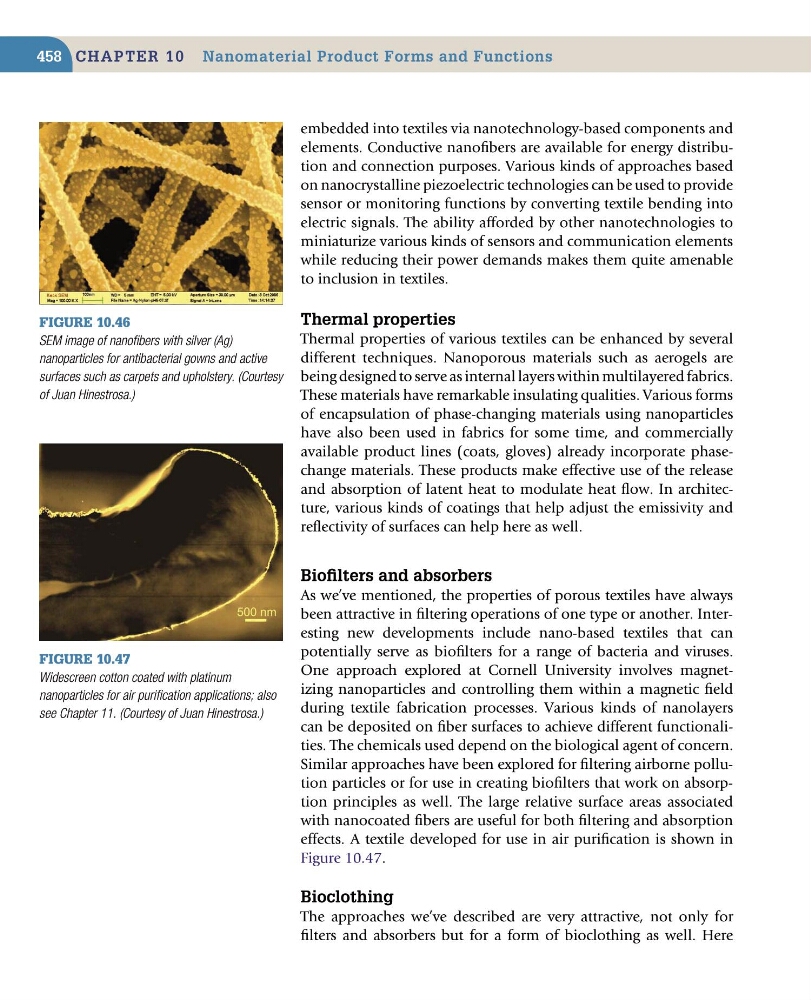
Figure 10.46
SEM image of nanofibers with silver (Ag)
nanoparticles for antibacterial gowns and active
surfaces such as carpets and upholstery. (Courtesy
of Juan Hinestrosa.)
Figure 10.47
Widescreen cotton coated with platinum
nanoparticles for air purification applications; also
see Chapter 11. (Courtesy of Juan Hinestrosa.)
458
embedded into textiles via nanotechnology-based components and
elements. Conductive nanofibers are available for energy distribution and connection purposes. Various kinds of approaches based
on nanocrystalline piezoelectric technologies can be used to provide
sensor or monitoring functions by converting textile bending into
electric signals. The ability afforded by other nanotechnologies to
miniaturize various kinds of sensors and communication elements
while reducing their power demands makes them quite amenable
to inclusion in textiles.
thermal properties
Thermal properties of various textiles can be enhanced by several
different techniques. Nanoporous materials such as aerogels are
being designed to serve as internal layers within multilayered fabrics.
These materials have remarkable insulating qualities. Various forms
of encapsulation of phase-changing materials using nanoparticles
have also been used in fabrics for some time, and commercially
available product lines (coats, gloves) already incorporate phasechange materials. These products make effective use of the release
and absorption of latent heat to modulate heat flow. In architecture, various kinds of coatings that help adjust the emissivity and
reflectivity of surfaces can help here as well.
Biofilters and absorbers
As we’ve mentioned, the properties of porous textiles have always
been attractive in filtering operations of one type or another. Interesting new developments include nano-based textiles that can
potentially serve as biofilters for a range of bacteria and viruses.
One approach explored at Cornell University involves magnetizing nanoparticles and controlling them within a magnetic field
during textile fabrication processes. Various kinds of nanolayers
can be deposited on fiber surfaces to achieve different functionalities. The chemicals used depend on the biological agent of concern.
Similar approaches have been explored for filtering airborne pollution particles or for use in creating biofilters that work on absorption principles as well. The large relative surface areas associated
with nanocoated fibers are useful for both filtering and absorption
effects. A textile developed for use in air purification is shown in
Figure 10.47.
Bioclothing
The approaches we’ve described are very attractive, not only for
filters and absorbers but for a form of bioclothing as well. Here
Figure 10.46
SEM image of nanofibers with silver (Ag)
nanoparticles for antibacterial gowns and active
surfaces such as carpets and upholstery. (Courtesy
of Juan Hinestrosa.)
Figure 10.47
Widescreen cotton coated with platinum
nanoparticles for air purification applications; also
see Chapter 11. (Courtesy of Juan Hinestrosa.)