

457
optical qualities
The reflective optical properties of a textile depend on surface characteristics. Hence, the surface properties of the fibers themselves or
of any coatings that might be used are extremely important. Their
overall reflective properties, however, are also strongly dependent
on the macro-level patterning of interlacing or texture of a bonded
textile. The specific texture of a surface critically affects whether
reflected rays of light are dispersed or not dispersed. Rough textures
naturally lead to dispersal and mattelike finishes. Concentrated
“highlights” normally result from very smooth surfaces. Thus the
material reflectivities and their macro-level patterns both affect
reflectance properties. In previous sections, the significant potential
of nano-based films and coatings was discussed as a way of manipulating light and color properties. Many of these same approaches
can be directly applied to textiles as well (see Section 9.5).
photovoltaic textiles
Energy-generating textiles normally rely on flexible photovoltaic
elements embedded or incorporated in textiles that can in turn be
enhanced via the use of nanotechnologies (see Section 9.7). Photovoltaic approaches naturally benefit from extended surfaces to
capture solar energy and are best thought of as exterior applications
on the exposed sides of textiles. The lack of efficiency of current
photovoltaic films currently makes their use of restricted value due
to the low amount of power generated by fairly large surface areas,
but the potential of nanotechnologies could make a big difference
here. Sensing and communication elements can also be more easily
Figure 10.44
The awning uses a self-cleaning fabric more than
80% covered with a nanoporous layer to provide
a hydrophobic self-cleaning action. (Courtesy of
BASF.)
(a)
(b)
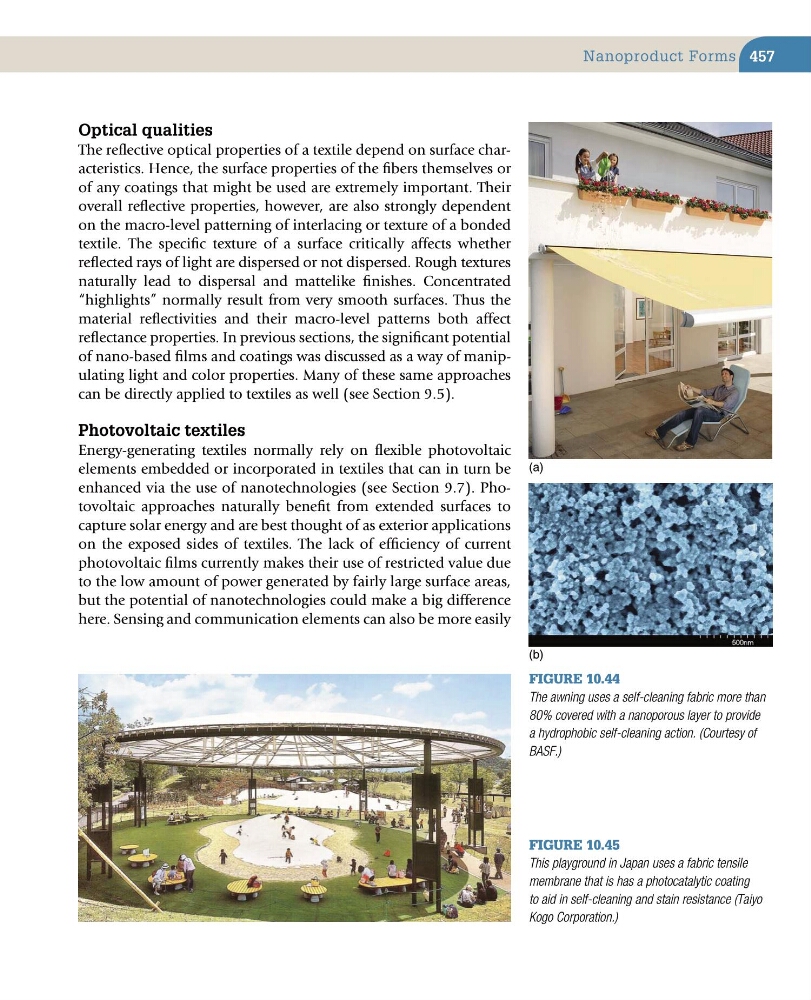
Figure 10.45
This playground in Japan uses a fabric tensile
membrane that is has a photocatalytic coating
to aid in self-cleaning and stain resistance (Taiyo
Kogo Corporation.)
Nanoproduct Forms
optical qualities
The reflective optical properties of a textile depend on surface characteristics. Hence, the surface properties of the fibers themselves or
of any coatings that might be used are extremely important. Their
overall reflective properties, however, are also strongly dependent
on the macro-level patterning of interlacing or texture of a bonded
textile. The specific texture of a surface critically affects whether
reflected rays of light are dispersed or not dispersed. Rough textures
naturally lead to dispersal and mattelike finishes. Concentrated
“highlights” normally result from very smooth surfaces. Thus the
material reflectivities and their macro-level patterns both affect
reflectance properties. In previous sections, the significant potential
of nano-based films and coatings was discussed as a way of manipulating light and color properties. Many of these same approaches
can be directly applied to textiles as well (see Section 9.5).
photovoltaic textiles
Energy-generating textiles normally rely on flexible photovoltaic
elements embedded or incorporated in textiles that can in turn be
enhanced via the use of nanotechnologies (see Section 9.7). Photovoltaic approaches naturally benefit from extended surfaces to
capture solar energy and are best thought of as exterior applications
on the exposed sides of textiles. The lack of efficiency of current
photovoltaic films currently makes their use of restricted value due
to the low amount of power generated by fairly large surface areas,
but the potential of nanotechnologies could make a big difference
here. Sensing and communication elements can also be more easily
Figure 10.44
The awning uses a self-cleaning fabric more than
80% covered with a nanoporous layer to provide
a hydrophobic self-cleaning action. (Courtesy of
BASF.)
(a)
(b)
Figure 10.45
This playground in Japan uses a fabric tensile
membrane that is has a photocatalytic coating
to aid in self-cleaning and stain resistance (Taiyo
Kogo Corporation.)
Nanoproduct Forms