

429
tional behaviors and materials described just previously, such as
self-healing or self-cleaning materials, would in the terminology of
many be called “smart” materials.
The materials listed in Figure 10.27 are well documented and discussed elsewhere, as is the whole field of “smart” materials. Only a few
characteristics are summarized here. It must be emphasized that not
all “smart” materials derive their interesting properties from nanomaterials as defined in a narrow sense. Many films, for example, are
of nano thickness but might not involve nanoparticles.
Color changing
The apparent ability of a material to change color is a light-related
characteristic that is highly sought after in both architecture and
product design. Many existing “smart materials” have this characteristic, including thermochromics, photochromics, chemochromics, and
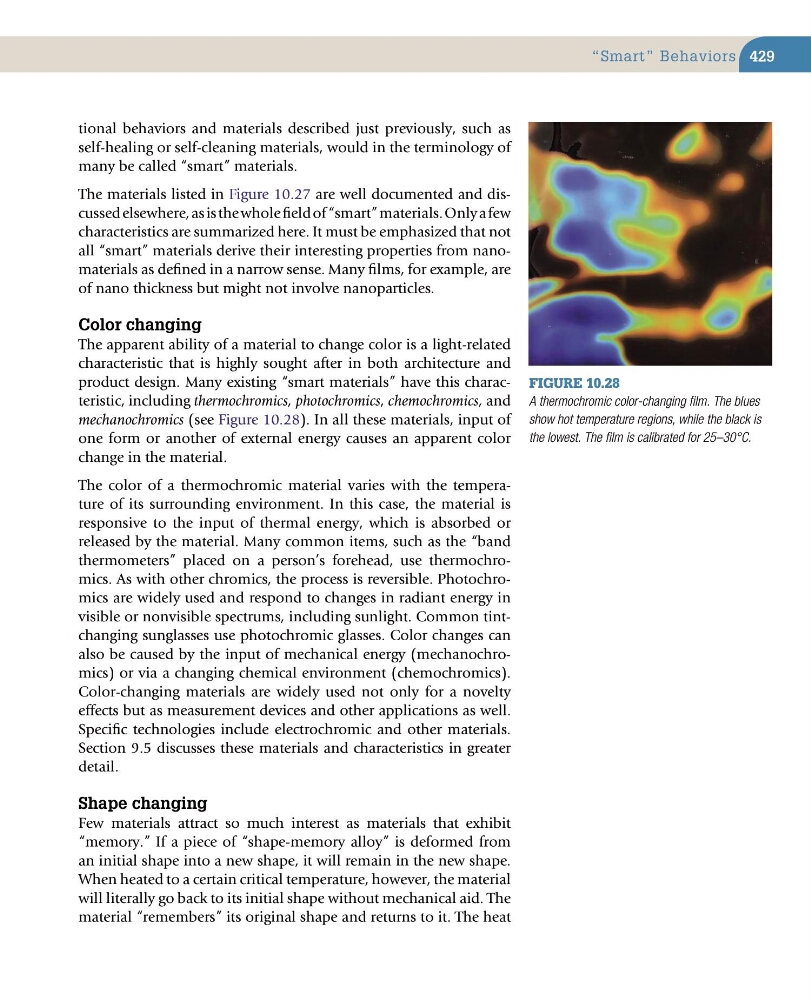
mechanochromics (see Figure 10.28). In all these materials, input of
one form or another of external energy causes an apparent color
change in the material.
The color of a thermochromic material varies with the temperature of its surrounding environment. In this case, the material is
responsive to the input of thermal energy, which is absorbed or
released by the material. Many common items, such as the “band
thermometers” placed on a person’s forehead, use thermochromics. As with other chromics, the process is reversible. Photochromics are widely used and respond to changes in radiant energy in
visible or nonvisible spectrums, including sunlight. Common tintchanging sunglasses use photochromic glasses. Color changes can
also be caused by the input of mechanical energy (mechanochromics) or via a changing chemical environment (chemochromics).
Color-changing materials are widely used not only for a novelty
effects but as measurement devices and other applications as well.
Specific technologies include electrochromic and other materials.
Section 9.5 discusses these materials and characteristics in greater
detail.
shape changing
Few materials attract so much interest as materials that exhibit
“memory.” If a piece of “shape-memory alloy” is deformed from
an initial shape into a new shape, it will remain in the new shape.
When heated to a certain critical temperature, however, the material
will literally go back to its initial shape without mechanical aid. The
material “remembers” its original shape and returns to it. The heat
Figure 10.28
A thermochromic color-changing film. The blues
show hot temperature regions, while the black is
the lowest. The film is calibrated for 25–30°C.
“Smart” Behaviors
tional behaviors and materials described just previously, such as
self-healing or self-cleaning materials, would in the terminology of
many be called “smart” materials.
The materials listed in Figure 10.27 are well documented and discussed elsewhere, as is the whole field of “smart” materials. Only a few
characteristics are summarized here. It must be emphasized that not
all “smart” materials derive their interesting properties from nanomaterials as defined in a narrow sense. Many films, for example, are
of nano thickness but might not involve nanoparticles.
Color changing
The apparent ability of a material to change color is a light-related
characteristic that is highly sought after in both architecture and
product design. Many existing “smart materials” have this characteristic, including thermochromics, photochromics, chemochromics, and
mechanochromics (see Figure 10.28). In all these materials, input of
one form or another of external energy causes an apparent color
change in the material.
The color of a thermochromic material varies with the temperature of its surrounding environment. In this case, the material is
responsive to the input of thermal energy, which is absorbed or
released by the material. Many common items, such as the “band
thermometers” placed on a person’s forehead, use thermochromics. As with other chromics, the process is reversible. Photochromics are widely used and respond to changes in radiant energy in
visible or nonvisible spectrums, including sunlight. Common tintchanging sunglasses use photochromic glasses. Color changes can
also be caused by the input of mechanical energy (mechanochromics) or via a changing chemical environment (chemochromics).
Color-changing materials are widely used not only for a novelty
effects but as measurement devices and other applications as well.
Specific technologies include electrochromic and other materials.
Section 9.5 discusses these materials and characteristics in greater
detail.
shape changing
Few materials attract so much interest as materials that exhibit
“memory.” If a piece of “shape-memory alloy” is deformed from
an initial shape into a new shape, it will remain in the new shape.
When heated to a certain critical temperature, however, the material
will literally go back to its initial shape without mechanical aid. The
material “remembers” its original shape and returns to it. The heat
Figure 10.28
A thermochromic color-changing film. The blues
show hot temperature regions, while the black is
the lowest. The film is calibrated for 25–30°C.
“Smart” Behaviors