

C hapter 10 nanomaterial product Forms and Functions
430
can be directly applied or come via an electric current. Materials
such as TiNi have been developed for this purpose.
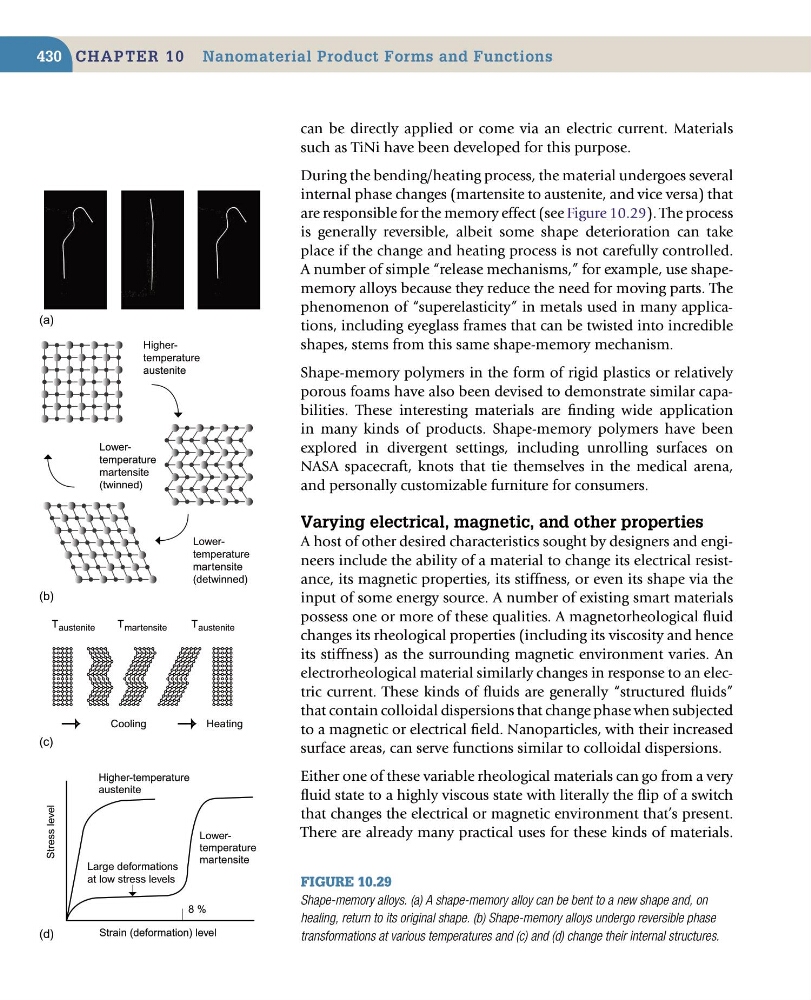
During the bending/heating process, the material undergoes several
internal phase changes (martensite to austenite, and vice versa) that
are responsible for the memory effect (see Figure 10.29). The process
is generally reversible, albeit some shape deterioration can take
place if the change and heating process is not carefully controlled.
A number of simple “release mechanisms,” for example, use shapememory alloys because they reduce the need for moving parts. The
phenomenon of “superelasticity” in metals used in many applications, including eyeglass frames that can be twisted into incredible
shapes, stems from this same shape-memory mechanism.
Shape-memory polymers in the form of rigid plastics or relatively
porous foams have also been devised to demonstrate similar capabilities. These interesting materials are finding wide application
in many kinds of products. Shape-memory polymers have been
explored in divergent settings, including unrolling surfaces on
NASA spacecraft, knots that tie themselves in the medical arena,
and personally customizable furniture for consumers.
varying electrical, magnetic, and other properties
A host of other desired characteristics sought by designers and engineers include the ability of a material to change its electrical resistance, its magnetic properties, its stiffness, or even its shape via the
input of some energy source. A number of existing smart materials
possess one or more of these qualities. A magnetorheological fluid
changes its rheological properties (including its viscosity and hence
its stiffness) as the surrounding magnetic environment varies. An
electrorheological material similarly changes in response to an electric current. These kinds of fluids are generally “structured fluids”
that contain colloidal dispersions that change phase when subjected
to a magnetic or electrical field. Nanoparticles, with their increased
surface areas, can serve functions similar to colloidal dispersions.
Either one of these variable rheological materials can go from a very
fluid state to a highly viscous state with literally the flip of a switch
that changes the electrical or magnetic environment that’s present.
There are already many practical uses for these kinds of materials.
Figure 10.29
Shape-memory alloys. (a) A shape-memory alloy can be bent to a new shape and, on
healing, return to its original shape. (b) Shape-memory alloys undergo reversible phase
transformations at various temperatures and (c) and (d) change their internal structures.
Highertemperature
austenite
Lowertemperature
martensite
(twinned)
Lowertemperature
martensite
(detwinned)
Large deformations
at low stress levels
Stress level
Strain (deformation) level
8 %
Lowertemperature
martensite
Higher-temperature
austenite
Cooling
T austenite
T austenite
T martensite
Heating
(b)
(c)
(d)
(a)
430
can be directly applied or come via an electric current. Materials
such as TiNi have been developed for this purpose.
During the bending/heating process, the material undergoes several
internal phase changes (martensite to austenite, and vice versa) that
are responsible for the memory effect (see Figure 10.29). The process
is generally reversible, albeit some shape deterioration can take
place if the change and heating process is not carefully controlled.
A number of simple “release mechanisms,” for example, use shapememory alloys because they reduce the need for moving parts. The
phenomenon of “superelasticity” in metals used in many applications, including eyeglass frames that can be twisted into incredible
shapes, stems from this same shape-memory mechanism.
Shape-memory polymers in the form of rigid plastics or relatively
porous foams have also been devised to demonstrate similar capabilities. These interesting materials are finding wide application
in many kinds of products. Shape-memory polymers have been
explored in divergent settings, including unrolling surfaces on
NASA spacecraft, knots that tie themselves in the medical arena,
and personally customizable furniture for consumers.
varying electrical, magnetic, and other properties
A host of other desired characteristics sought by designers and engineers include the ability of a material to change its electrical resistance, its magnetic properties, its stiffness, or even its shape via the
input of some energy source. A number of existing smart materials
possess one or more of these qualities. A magnetorheological fluid
changes its rheological properties (including its viscosity and hence
its stiffness) as the surrounding magnetic environment varies. An
electrorheological material similarly changes in response to an electric current. These kinds of fluids are generally “structured fluids”
that contain colloidal dispersions that change phase when subjected
to a magnetic or electrical field. Nanoparticles, with their increased
surface areas, can serve functions similar to colloidal dispersions.
Either one of these variable rheological materials can go from a very
fluid state to a highly viscous state with literally the flip of a switch
that changes the electrical or magnetic environment that’s present.
There are already many practical uses for these kinds of materials.
Figure 10.29
Shape-memory alloys. (a) A shape-memory alloy can be bent to a new shape and, on
healing, return to its original shape. (b) Shape-memory alloys undergo reversible phase
transformations at various temperatures and (c) and (d) change their internal structures.
Highertemperature
austenite
Lowertemperature
martensite
(twinned)
Lowertemperature
martensite
(detwinned)
Large deformations
at low stress levels
Stress level
Strain (deformation) level
8 %
Lowertemperature
martensite
Higher-temperature
austenite
Cooling
T austenite
T austenite
T martensite
Heating
(b)
(c)
(d)
(a)