

C hapter 10 nanomaterial product Forms and Functions
428
erties that result in color changes, and hence the somewhat simplistic description as “property-changing” materials is frequently
used. What is happening is far more complex and a consequence
of a variety of chemical reactions and phase changes that take
place internally in a material as a consequence of an energy input
from an external source that in turn alters the material’s optical,
mechanical, or other properties—that is, the property alone does
not change, rather the material does, resulting in a property
change.
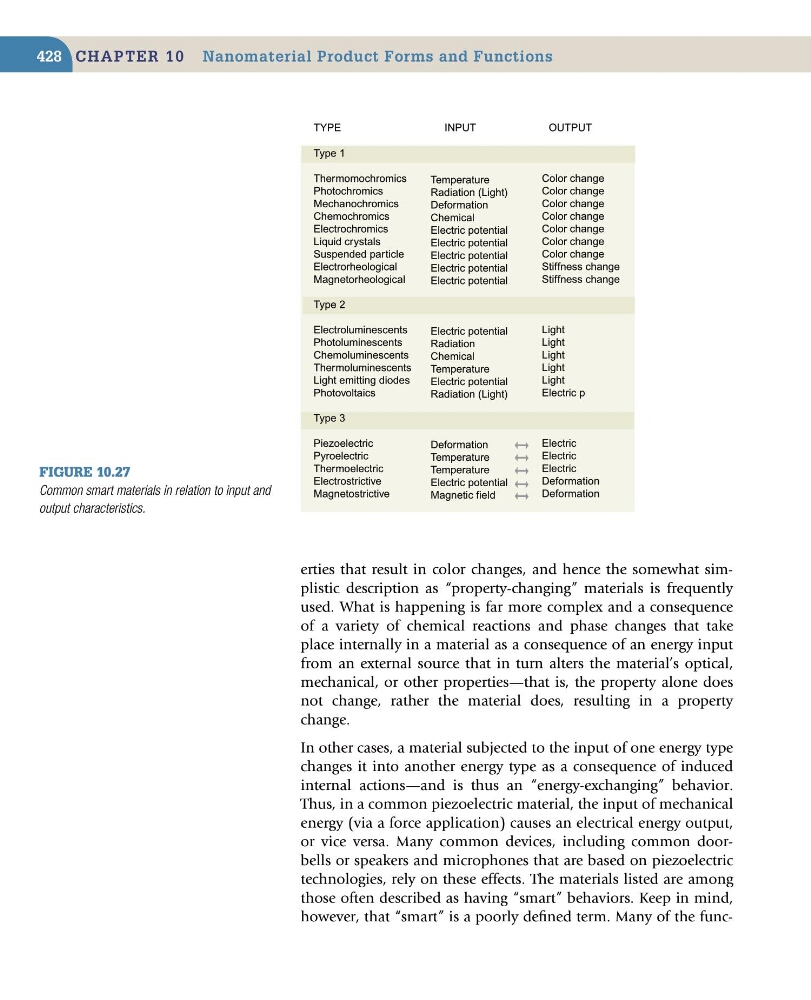
In other cases, a material subjected to the input of one energy type
changes it into another energy type as a consequence of induced
internal actions—and is thus an “energy-exchanging” behavior.
Thus, in a common piezoelectric material, the input of mechanical
energy (via a force application) causes an electrical energy output,
or vice versa. Many common devices, including common doorbells or speakers and microphones that are based on piezoelectric
technologies, rely on these effects. The materials listed are among
those often described as having “smart” behaviors. Keep in mind,
however, that “smart” is a poorly defined term. Many of the funcTYPE
INPUT
OUTPUT
Type 1
Thermomochromics
Photochromics
Mechanochromics
Chemochromics
Electrochromics
Liquid crystals
Suspended particle
Electrorheological
Magnetorheological
Type 2
Electroluminescents
Photoluminescents
Chemoluminescents
Thermoluminescents
Light emitting diodes
Photovoltaics
Type 3
Piezoelectric
Pyroelectric
Thermoelectric
Electrostrictive
Magnetostrictive
Temperature
Radiation (Light)
Deformation
Chemical
Electric potential
Electric potential
Electric potential
Electric potential
Electric potential
Electric potential
Radiation
Chemical
Temperature
Electric potential
Radiation (Light)
Deformation
Temperature
Temperature
Electric potential
Magnetic field
Color change
Color change
Color change
Color change
Color change
Color change
Color change
Stiffness change
Stiffness change
Light
Light
Light
Light
Light
Electric p
Electric
Electric
Electric
Deformation
Deformation
Figure 10.27
Common smart materials in relation to input and
output characteristics.
428
erties that result in color changes, and hence the somewhat simplistic description as “property-changing” materials is frequently
used. What is happening is far more complex and a consequence
of a variety of chemical reactions and phase changes that take
place internally in a material as a consequence of an energy input
from an external source that in turn alters the material’s optical,
mechanical, or other properties—that is, the property alone does
not change, rather the material does, resulting in a property
change.
In other cases, a material subjected to the input of one energy type
changes it into another energy type as a consequence of induced
internal actions—and is thus an “energy-exchanging” behavior.
Thus, in a common piezoelectric material, the input of mechanical
energy (via a force application) causes an electrical energy output,
or vice versa. Many common devices, including common doorbells or speakers and microphones that are based on piezoelectric
technologies, rely on these effects. The materials listed are among
those often described as having “smart” behaviors. Keep in mind,
however, that “smart” is a poorly defined term. Many of the funcTYPE
INPUT
OUTPUT
Type 1
Thermomochromics
Photochromics
Mechanochromics
Chemochromics
Electrochromics
Liquid crystals
Suspended particle
Electrorheological
Magnetorheological
Type 2
Electroluminescents
Photoluminescents
Chemoluminescents
Thermoluminescents
Light emitting diodes
Photovoltaics
Type 3
Piezoelectric
Pyroelectric
Thermoelectric
Electrostrictive
Magnetostrictive
Temperature
Radiation (Light)
Deformation
Chemical
Electric potential
Electric potential
Electric potential
Electric potential
Electric potential
Electric potential
Radiation
Chemical
Temperature
Electric potential
Radiation (Light)
Deformation
Temperature
Temperature
Electric potential
Magnetic field
Color change
Color change
Color change
Color change
Color change
Color change
Color change
Stiffness change
Stiffness change
Light
Light
Light
Light
Light
Electric p
Electric
Electric
Electric
Deformation
Deformation
Figure 10.27
Common smart materials in relation to input and
output characteristics.