

425
found that some portion of the mechanical properties lost due to
microcracking of the composite can be restored. Use has been made
of a vinyl ester resin, which is cured through radical polymerization
initiated by peroxides. One approach in the research development
phase uses the relatively inexpensive monomer dicyclopentadiene
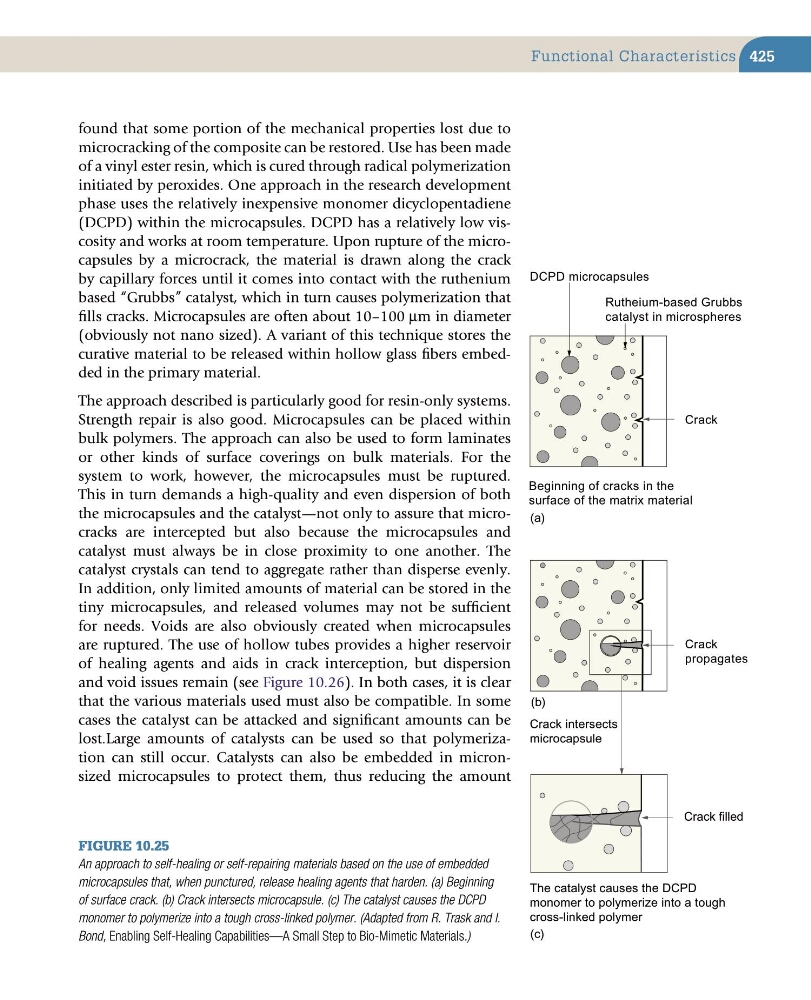
(DCPD) within the microcapsules. DCPD has a relatively low viscosity and works at room temperature. Upon rupture of the microcapsules by a microcrack, the material is drawn along the crack
by capillary forces until it comes into contact with the ruthenium
based “Grubbs” catalyst, which in turn causes polymerization that
fills cracks. Microcapsules are often about 10–100 µm in diameter
(obviously not nano sized). A variant of this technique stores the
curative material to be released within hollow glass fibers embedded in the primary material.
The approach described is particularly good for resin-only systems.
Strength repair is also good. Microcapsules can be placed within
bulk polymers. The approach can also be used to form laminates
or other kinds of surface coverings on bulk materials. For the
system to work, however, the microcapsules must be ruptured.
This in turn demands a high-quality and even dispersion of both
the microcapsules and the catalyst—not only to assure that microcracks are intercepted but also because the microcapsules and
catalyst must always be in close proximity to one another. The
catalyst crystals can tend to aggregate rather than disperse evenly.
In addition, only limited amounts of material can be stored in the
tiny microcapsules, and released volumes may not be sufficient
for needs. Voids are also obviously created when microcapsules
are ruptured. The use of hollow tubes provides a higher reservoir
of healing agents and aids in crack interception, but dispersion
and void issues remain (see Figure 10.26). In both cases, it is clear
that the various materials used must also be compatible. In some
cases the catalyst can be attacked and significant amounts can be
lost.Large amounts of catalysts can be used so that polymerization can still occur. Catalysts can also be embedded in micronsized microcapsules to protect them, thus reducing the amount
Figure 10.25
An approach to self-healing or self-repairing materials based on the use of embedded
microcapsules that, when punctured, release healing agents that harden. (a) Beginning
of surface crack. (b) Crack intersects microcapsule. (c) The catalyst causes the DCPD
monomer to polymerize into a tough cross-linked polymer. (Adapted from R. Trask and I.
Bond, Enabling Self-Healing Capabilities—A Small Step to Bio-Mimetic Materials.)
Beginning of cracks in the
surface of the matrix material
Crack intersects
microcapsule
The catalyst causes the DCPD
monomer to polymerize into a tough
cross-linked polymer
Rutheium-based Grubbs
catalyst in microspheres
DCPD microcapsules
Crack
Crack
propagates
Crack filled
(c)
(b)
(a)
Functional Characteristics
found that some portion of the mechanical properties lost due to
microcracking of the composite can be restored. Use has been made
of a vinyl ester resin, which is cured through radical polymerization
initiated by peroxides. One approach in the research development
phase uses the relatively inexpensive monomer dicyclopentadiene
(DCPD) within the microcapsules. DCPD has a relatively low viscosity and works at room temperature. Upon rupture of the microcapsules by a microcrack, the material is drawn along the crack
by capillary forces until it comes into contact with the ruthenium
based “Grubbs” catalyst, which in turn causes polymerization that
fills cracks. Microcapsules are often about 10–100 µm in diameter
(obviously not nano sized). A variant of this technique stores the
curative material to be released within hollow glass fibers embedded in the primary material.
The approach described is particularly good for resin-only systems.
Strength repair is also good. Microcapsules can be placed within
bulk polymers. The approach can also be used to form laminates
or other kinds of surface coverings on bulk materials. For the
system to work, however, the microcapsules must be ruptured.
This in turn demands a high-quality and even dispersion of both
the microcapsules and the catalyst—not only to assure that microcracks are intercepted but also because the microcapsules and
catalyst must always be in close proximity to one another. The
catalyst crystals can tend to aggregate rather than disperse evenly.
In addition, only limited amounts of material can be stored in the
tiny microcapsules, and released volumes may not be sufficient
for needs. Voids are also obviously created when microcapsules
are ruptured. The use of hollow tubes provides a higher reservoir
of healing agents and aids in crack interception, but dispersion
and void issues remain (see Figure 10.26). In both cases, it is clear
that the various materials used must also be compatible. In some
cases the catalyst can be attacked and significant amounts can be
lost.Large amounts of catalysts can be used so that polymerization can still occur. Catalysts can also be embedded in micronsized microcapsules to protect them, thus reducing the amount
Figure 10.25
An approach to self-healing or self-repairing materials based on the use of embedded
microcapsules that, when punctured, release healing agents that harden. (a) Beginning
of surface crack. (b) Crack intersects microcapsule. (c) The catalyst causes the DCPD
monomer to polymerize into a tough cross-linked polymer. (Adapted from R. Trask and I.
Bond, Enabling Self-Healing Capabilities—A Small Step to Bio-Mimetic Materials.)
Beginning of cracks in the
surface of the matrix material
Crack intersects
microcapsule
The catalyst causes the DCPD
monomer to polymerize into a tough
cross-linked polymer
Rutheium-based Grubbs
catalyst in microspheres
DCPD microcapsules
Crack
Crack
propagates
Crack filled
(c)
(b)
(a)
Functional Characteristics