

C hapter 10 nanomaterial product Forms and Functions
426
(and cost) of the needed catalysts. The use of wax encapsulation
for both agents allows a greater variety of materials to be used in
the self-healing process.
Variants of the hollow-tube approach that have been explored
include using multiple tubes in composite laminates. Tubes could
contain a resin as before with a hardening catalyst in the laminate
material, or even a two-part resin and hardener system within alternating tubes. This would allow more variation in the types of selfhealing materials that are possible and could be accommodated
in many different primary material matrices. Studies have also
been made with the objective of determining whether these same
tubes can serve as structural reinforcement and even be accordingly
aligned.
Other approaches are being developed that require no catalysts or
microcapsules. One avenue of investigation for polymers involves
mixing thermoplastic healing agents that change viscosity with heat
in harder thermoset plastics. Heat is obviously needed. Another
self-healing process occurs directly in a material via a reversible polymerization process. One process explored by a number of researchers uses monomers that are mixed, heated, and cooled slowly (a
reaction of a furan monomer with a maleimide monomer). Thermally reversible Diels-Alder reactions proceed nearly to completion to form a cross-linked material with significant strength and
stiffness (similar to structural epoxies). Under certain conditions,
however, these reactions are reversible. As a crack develops in the
material, necessary chemical groups are regenerated. If the material is clamped and heated, a “retro-Diels-Alder” reaction occurs
again and mends the crack. The material can thus undergo repeated
crack-repair cycles. For this to occur, however, the material must
be heated—in some instances up to around 120°C—a significant problem for many needed applications. Other self-healing
approaches based on silicon carbide (SiC) form protective silica
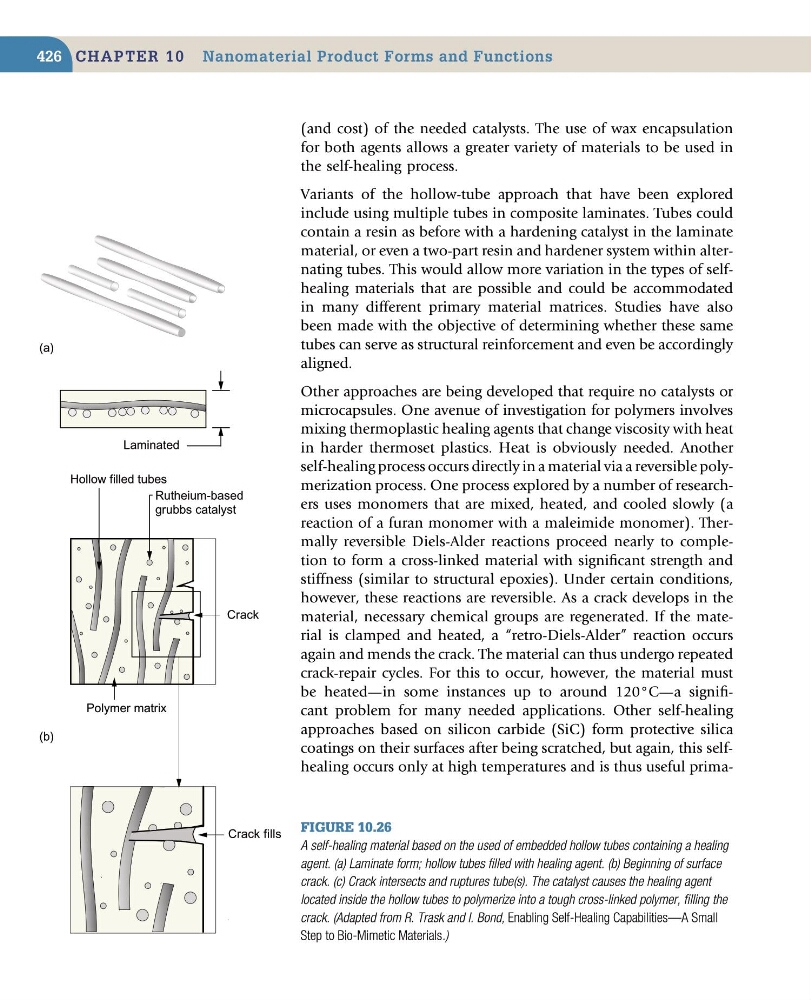
coatings on their surfaces after being scratched, but again, this selfhealing occurs only at high temperatures and is thus useful primaFigure 10.26
A self-healing material based on the used of embedded hollow tubes containing a healing
agent. (a) Laminate form; hollow tubes filled with healing agent. (b) Beginning of surface
crack. (c) Crack intersects and ruptures tube(s). The catalyst causes the healing agent
located inside the hollow tubes to polymerize into a tough cross-linked polymer, filling the
crack. (Adapted from R. Trask and I. Bond, Enabling Self-Healing Capabilities—A Small
Step to Bio-Mimetic Materials.)
Hollow filled tubes
Rutheium-based
grubbs catalyst
Polymer matrix
(b)
(a)
Laminated
Crack fills
Crack
426
(and cost) of the needed catalysts. The use of wax encapsulation
for both agents allows a greater variety of materials to be used in
the self-healing process.
Variants of the hollow-tube approach that have been explored
include using multiple tubes in composite laminates. Tubes could
contain a resin as before with a hardening catalyst in the laminate
material, or even a two-part resin and hardener system within alternating tubes. This would allow more variation in the types of selfhealing materials that are possible and could be accommodated
in many different primary material matrices. Studies have also
been made with the objective of determining whether these same
tubes can serve as structural reinforcement and even be accordingly
aligned.
Other approaches are being developed that require no catalysts or
microcapsules. One avenue of investigation for polymers involves
mixing thermoplastic healing agents that change viscosity with heat
in harder thermoset plastics. Heat is obviously needed. Another
self-healing process occurs directly in a material via a reversible polymerization process. One process explored by a number of researchers uses monomers that are mixed, heated, and cooled slowly (a
reaction of a furan monomer with a maleimide monomer). Thermally reversible Diels-Alder reactions proceed nearly to completion to form a cross-linked material with significant strength and
stiffness (similar to structural epoxies). Under certain conditions,
however, these reactions are reversible. As a crack develops in the
material, necessary chemical groups are regenerated. If the material is clamped and heated, a “retro-Diels-Alder” reaction occurs
again and mends the crack. The material can thus undergo repeated
crack-repair cycles. For this to occur, however, the material must
be heated—in some instances up to around 120°C—a significant problem for many needed applications. Other self-healing
approaches based on silicon carbide (SiC) form protective silica
coatings on their surfaces after being scratched, but again, this selfhealing occurs only at high temperatures and is thus useful primaFigure 10.26
A self-healing material based on the used of embedded hollow tubes containing a healing
agent. (a) Laminate form; hollow tubes filled with healing agent. (b) Beginning of surface
crack. (c) Crack intersects and ruptures tube(s). The catalyst causes the healing agent
located inside the hollow tubes to polymerize into a tough cross-linked polymer, filling the
crack. (Adapted from R. Trask and I. Bond, Enabling Self-Healing Capabilities—A Small
Step to Bio-Mimetic Materials.)
Hollow filled tubes
Rutheium-based
grubbs catalyst
Polymer matrix
(b)
(a)
Laminated
Crack fills
Crack