

C hapter 10 nanomaterial product Forms and Functions
424
and sand mortars slowly harden over time due to carbonation of
the lime. The lime used in historic stone or masonry construction
was normally made from burning limestone containing impurities (included either advertently or inadvertently) of silica and clay.
A “hydraulic” lime resulted that could even set under water. The
resulting mortars were quite porous and allowed moisture to enter.
When normal cracking occurred, carbon dioxide dissolved in water
could still reach free (as yet uncarbonated) lime to form calcium
carbonate crystals that formed and grew in the cracks. A form of
crystalline bridging occurred that filled and sealed even quite large
cracks.
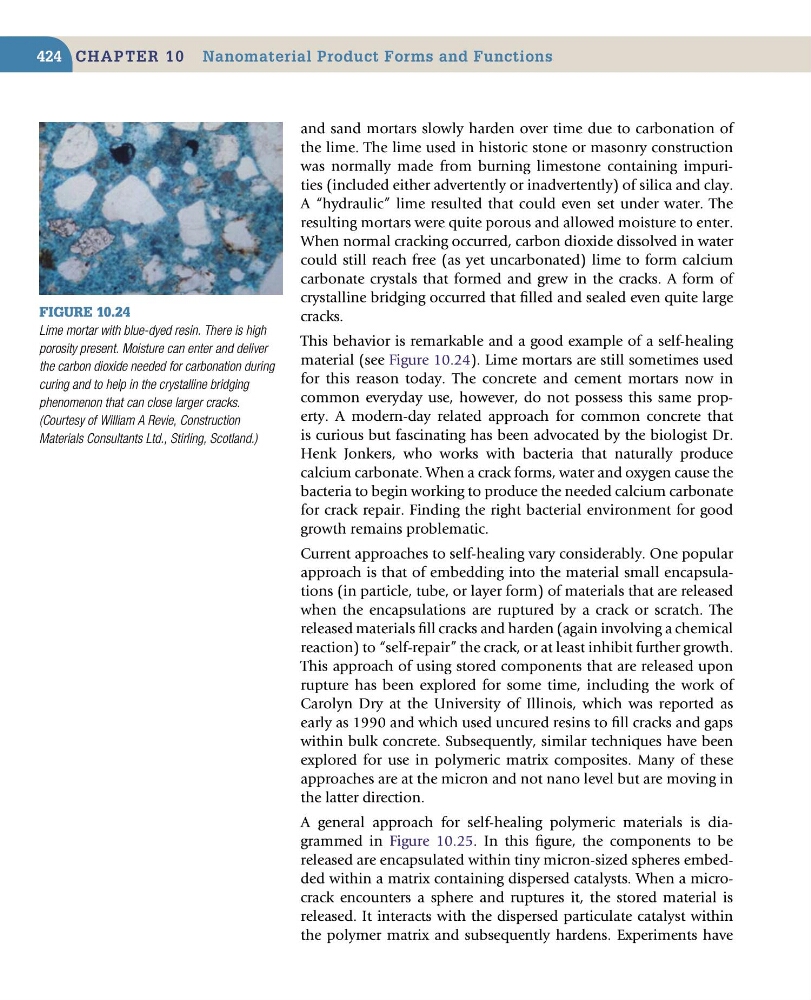
This behavior is remarkable and a good example of a self-healing
material (see Figure 10.24). Lime mortars are still sometimes used
for this reason today. The concrete and cement mortars now in
common everyday use, however, do not possess this same property. A modern-day related approach for common concrete that
is curious but fascinating has been advocated by the biologist Dr.
Henk Jonkers, who works with bacteria that naturally produce
calcium carbonate. When a crack forms, water and oxygen cause the
bacteria to begin working to produce the needed calcium carbonate
for crack repair. Finding the right bacterial environment for good
growth remains problematic.
Current approaches to self-healing vary considerably. One popular
approach is that of embedding into the material small encapsulations (in particle, tube, or layer form) of materials that are released
when the encapsulations are ruptured by a crack or scratch. The
released materials fill cracks and harden (again involving a chemical
reaction) to “self-repair” the crack, or at least inhibit further growth.
This approach of using stored components that are released upon
rupture has been explored for some time, including the work of
Carolyn Dry at the University of Illinois, which was reported as
early as 1990 and which used uncured resins to fill cracks and gaps
within bulk concrete. Subsequently, similar techniques have been
explored for use in polymeric matrix composites. Many of these
approaches are at the micron and not nano level but are moving in
the latter direction.
A general approach for self-healing polymeric materials is diagrammed in Figure 10.25. In this figure, the components to be
released are encapsulated within tiny micron-sized spheres embedded within a matrix containing dispersed catalysts. When a microcrack encounters a sphere and ruptures it, the stored material is
released. It interacts with the dispersed particulate catalyst within
the polymer matrix and subsequently hardens. Experiments have
Figure 10.24
Lime mortar with blue-dyed resin. There is high
porosity present. Moisture can enter and deliver
the carbon dioxide needed for carbonation during
curing and to help in the crystalline bridging
phenomenon that can close larger cracks.
(Courtesy of William A Revie, Construction
Materials Consultants Ltd., Stirling, Scotland.)
424
and sand mortars slowly harden over time due to carbonation of
the lime. The lime used in historic stone or masonry construction
was normally made from burning limestone containing impurities (included either advertently or inadvertently) of silica and clay.
A “hydraulic” lime resulted that could even set under water. The
resulting mortars were quite porous and allowed moisture to enter.
When normal cracking occurred, carbon dioxide dissolved in water
could still reach free (as yet uncarbonated) lime to form calcium
carbonate crystals that formed and grew in the cracks. A form of
crystalline bridging occurred that filled and sealed even quite large
cracks.
This behavior is remarkable and a good example of a self-healing
material (see Figure 10.24). Lime mortars are still sometimes used
for this reason today. The concrete and cement mortars now in
common everyday use, however, do not possess this same property. A modern-day related approach for common concrete that
is curious but fascinating has been advocated by the biologist Dr.
Henk Jonkers, who works with bacteria that naturally produce
calcium carbonate. When a crack forms, water and oxygen cause the
bacteria to begin working to produce the needed calcium carbonate
for crack repair. Finding the right bacterial environment for good
growth remains problematic.
Current approaches to self-healing vary considerably. One popular
approach is that of embedding into the material small encapsulations (in particle, tube, or layer form) of materials that are released
when the encapsulations are ruptured by a crack or scratch. The
released materials fill cracks and harden (again involving a chemical
reaction) to “self-repair” the crack, or at least inhibit further growth.
This approach of using stored components that are released upon
rupture has been explored for some time, including the work of
Carolyn Dry at the University of Illinois, which was reported as
early as 1990 and which used uncured resins to fill cracks and gaps
within bulk concrete. Subsequently, similar techniques have been
explored for use in polymeric matrix composites. Many of these
approaches are at the micron and not nano level but are moving in
the latter direction.
A general approach for self-healing polymeric materials is diagrammed in Figure 10.25. In this figure, the components to be
released are encapsulated within tiny micron-sized spheres embedded within a matrix containing dispersed catalysts. When a microcrack encounters a sphere and ruptures it, the stored material is
released. It interacts with the dispersed particulate catalyst within
the polymer matrix and subsequently hardens. Experiments have
Figure 10.24
Lime mortar with blue-dyed resin. There is high
porosity present. Moisture can enter and deliver
the carbon dioxide needed for carbonation during
curing and to help in the crystalline bridging
phenomenon that can close larger cracks.
(Courtesy of William A Revie, Construction
Materials Consultants Ltd., Stirling, Scotland.)