

423
ing applications, an inherent problem in this kind of research is
that surprisingly little is actually known about the precise mechanisms of mold growth, not only on but also particularly within the
many porous surfaces and material structures that surround us and
that hold moisture differently. Without better knowledge of these
mechanisms, responses cannot be nuanced but are rather of the
“coat it” variety.
self-healing materials
When material scientists and engineers give presentations extolling
the future benefits of research associated with advanced materials,
the phrase self-healing or self-repairing materials is seemingly invariably included. Similarly, in the popular press, the same phrase is
used over and over again to impart a specific and understandable
vision of what nanoengineering might accomplish. Indeed, there is
hype here. There is, however, also a very real basis for suggesting that
some type of self-healing or repairing is indeed a possibility—and
an exciting possibility at that. Cracks in materials or scratches on
surfaces are ubiquitous and always problematic. Cracks can either
lead to or signify serious performance problems in a material, even
foretelling structural collapse. Scratches on surfaces can seemingly
be only nuisances, but nuisances that society spends an enormous
amount of time and money addressing and trying to prevent.
A number of major automotive companies, for example, have
invested huge amounts of research in trying to achieve a really effective self-healing paint to be used on automobile bodies, with every
belief that it will pay off in terms of consumer response. Other kinds
of cracks or scratches might not be serious in themselves but could
lead to other problems, as might be the case with major scratches in
painted metal panels that in turn leads to corrosion. The need and
value of self-healing materials are clearly present.
Several basic approaches to accomplishing some type of selfhealing have been explored for some time. Observation of models
in nature, where self-healing is an intrinsic part of life, have naturally led many investigators to look for ways that similar models
might be developed for the materials we use. In other cases, astute
observers have noted that many materials just seem to naturally
heal themselves after cracks develop. In architecture, it has been
observed since the Medieval era that many cracks that initially
developed in the lime and sand mortars used in historic stone
construction seemed to simply disappear over time (see Figure
10.23). The reasons for that phenomenon are interesting. Lime
Functional Characteristics
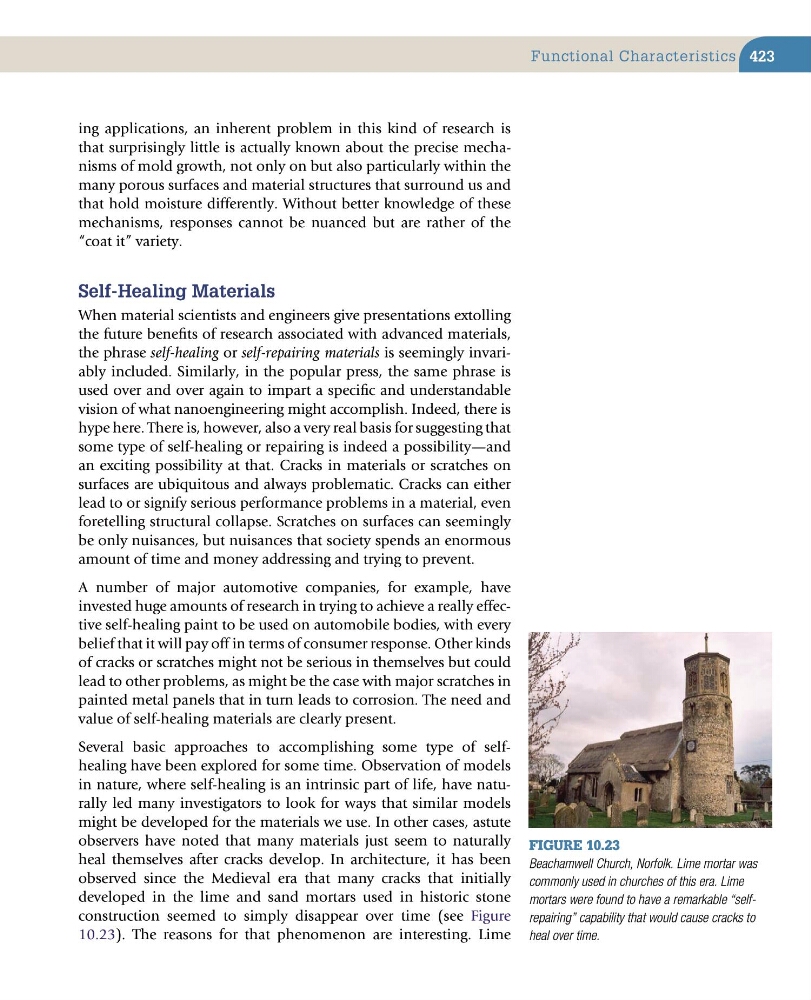
Figure 10.23
Beachamwell Church, Norfolk. Lime mortar was
commonly used in churches of this era. Lime
mortars were found to have a remarkable “selfrepairing” capability that would cause cracks to
heal over time.
ing applications, an inherent problem in this kind of research is
that surprisingly little is actually known about the precise mechanisms of mold growth, not only on but also particularly within the
many porous surfaces and material structures that surround us and
that hold moisture differently. Without better knowledge of these
mechanisms, responses cannot be nuanced but are rather of the
“coat it” variety.
self-healing materials
When material scientists and engineers give presentations extolling
the future benefits of research associated with advanced materials,
the phrase self-healing or self-repairing materials is seemingly invariably included. Similarly, in the popular press, the same phrase is
used over and over again to impart a specific and understandable
vision of what nanoengineering might accomplish. Indeed, there is
hype here. There is, however, also a very real basis for suggesting that
some type of self-healing or repairing is indeed a possibility—and
an exciting possibility at that. Cracks in materials or scratches on
surfaces are ubiquitous and always problematic. Cracks can either
lead to or signify serious performance problems in a material, even
foretelling structural collapse. Scratches on surfaces can seemingly
be only nuisances, but nuisances that society spends an enormous
amount of time and money addressing and trying to prevent.
A number of major automotive companies, for example, have
invested huge amounts of research in trying to achieve a really effective self-healing paint to be used on automobile bodies, with every
belief that it will pay off in terms of consumer response. Other kinds
of cracks or scratches might not be serious in themselves but could
lead to other problems, as might be the case with major scratches in
painted metal panels that in turn leads to corrosion. The need and
value of self-healing materials are clearly present.
Several basic approaches to accomplishing some type of selfhealing have been explored for some time. Observation of models
in nature, where self-healing is an intrinsic part of life, have naturally led many investigators to look for ways that similar models
might be developed for the materials we use. In other cases, astute
observers have noted that many materials just seem to naturally
heal themselves after cracks develop. In architecture, it has been
observed since the Medieval era that many cracks that initially
developed in the lime and sand mortars used in historic stone
construction seemed to simply disappear over time (see Figure
10.23). The reasons for that phenomenon are interesting. Lime
Functional Characteristics
Figure 10.23
Beachamwell Church, Norfolk. Lime mortar was
commonly used in churches of this era. Lime
mortars were found to have a remarkable “selfrepairing” capability that would cause cracks to
heal over time.