

C hapter 10 nanomaterial product Forms and Functions
422
cides or fungicides. The microcapsules are distributed on the surface
of a material as a coating and then are designed to have a “timedrelease” capability. Though the biocidal effect can be pronounced,
it is obviously time limited.
Mold was mentioned earlier. Though some molds are positive
(think of certain cheeses), other kinds of mold in buildings can
cause extreme health problems to occupants—witness the need to
tear down or completely rebuild many water-damaged houses in
New Orleans after the Hurricane Katrina disaster, simply because
of the mold development problem and its related health hazards
to returning occupants. Mold is a type of fungi that breaks down
organic materials. Molds grow under damp or wet conditions on
many kinds of surfaces. They reproduce by releasing spores into the
air, where they fall on other materials and germinate to form large
networks. The rate of growth of mold depends on many factors:
their type, the organic makeup and moistness of the material on
which the spores land, temperature, and other factors. Humans can
inhale airborne spores, touch them on surfaces, or even eat them
when they land on food.
Certain kinds of molds can very much affect human health by
causing allergies, irritations, infections, or various toxicities. Effects
depend on the types of mold present, the length of exposure, and
the susceptibility of the human in the environment. In buildings
with mold problems, there is obviously long-term exposure to
occupants. Health effects can be devastating. It is likewise enormously difficult to remove mold in a building once it takes hold.
The development of materials for building and other uses that
would have effective antimold properties that either killed spores
or inhibited their growth would be an enormous contribution to
human health.
Many kinds of antimold treatments are available on the market
today. Many are simply solution washes of one type or another
that kill mold on contact but rarely have any long-term effects.
Some coatings or treatments to materials are longer lasting. Many
are again based on titanium dioxide. For situations in which UV
light sources are present, as from the sun, the same photocatalytic
processes (based on titanium dioxide nanoparticles with their large
surface-to-volume ratios) that cause organic particles on a surface
to break down, as previously described, can be used effectively.
Other techniques that use antimicrobial coatings or additives to
primary materials offer promising approaches. For some applications, various layering approaches have been suggested. For buildFigure 10.21
Antibacterial textiles are widely sought after.
The image shows textured nanofiber with
microchannels for incrustation of catalysts and
antibacterial compounds. See the following section
on nanotextiles. (Courtesy of Juan P. Hinestrosa.)
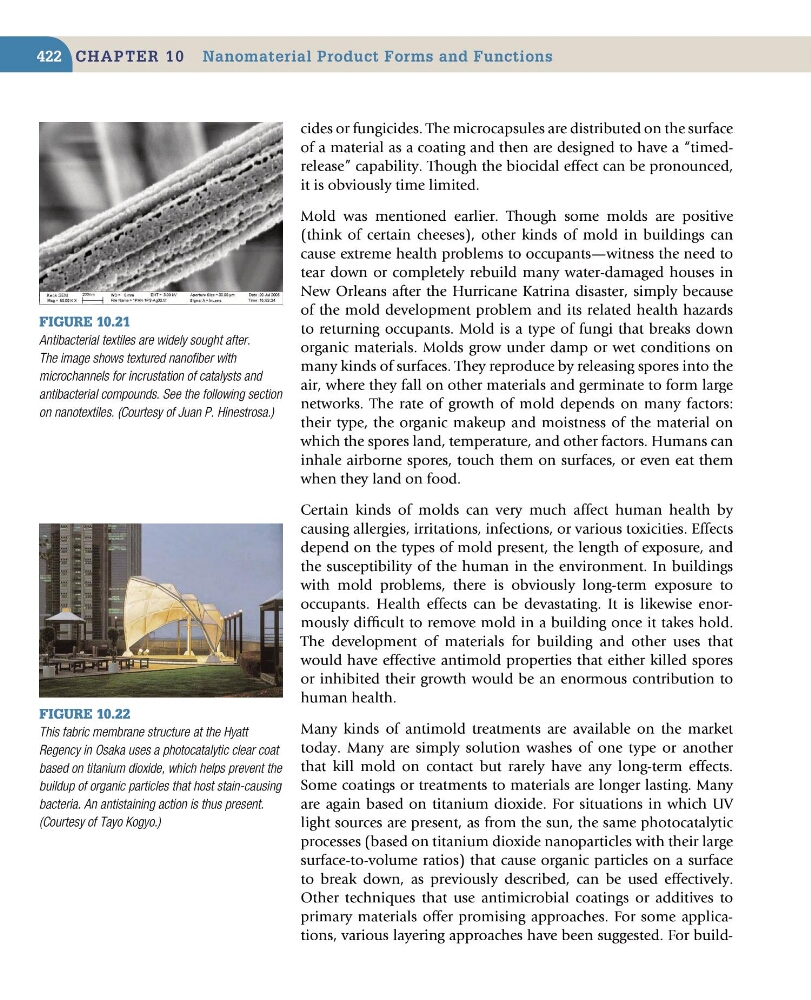
Figure 10.22
This fabric membrane structure at the Hyatt
Regency in Osaka uses a photocatalytic clear coat
based on titanium dioxide, which helps prevent the
buildup of organic particles that host stain-causing
bacteria. An antistaining action is thus present.
(Courtesy of Tayo Kogyo.)
422
cides or fungicides. The microcapsules are distributed on the surface
of a material as a coating and then are designed to have a “timedrelease” capability. Though the biocidal effect can be pronounced,
it is obviously time limited.
Mold was mentioned earlier. Though some molds are positive
(think of certain cheeses), other kinds of mold in buildings can
cause extreme health problems to occupants—witness the need to
tear down or completely rebuild many water-damaged houses in
New Orleans after the Hurricane Katrina disaster, simply because
of the mold development problem and its related health hazards
to returning occupants. Mold is a type of fungi that breaks down
organic materials. Molds grow under damp or wet conditions on
many kinds of surfaces. They reproduce by releasing spores into the
air, where they fall on other materials and germinate to form large
networks. The rate of growth of mold depends on many factors:
their type, the organic makeup and moistness of the material on
which the spores land, temperature, and other factors. Humans can
inhale airborne spores, touch them on surfaces, or even eat them
when they land on food.
Certain kinds of molds can very much affect human health by
causing allergies, irritations, infections, or various toxicities. Effects
depend on the types of mold present, the length of exposure, and
the susceptibility of the human in the environment. In buildings
with mold problems, there is obviously long-term exposure to
occupants. Health effects can be devastating. It is likewise enormously difficult to remove mold in a building once it takes hold.
The development of materials for building and other uses that
would have effective antimold properties that either killed spores
or inhibited their growth would be an enormous contribution to
human health.
Many kinds of antimold treatments are available on the market
today. Many are simply solution washes of one type or another
that kill mold on contact but rarely have any long-term effects.
Some coatings or treatments to materials are longer lasting. Many
are again based on titanium dioxide. For situations in which UV
light sources are present, as from the sun, the same photocatalytic
processes (based on titanium dioxide nanoparticles with their large
surface-to-volume ratios) that cause organic particles on a surface
to break down, as previously described, can be used effectively.
Other techniques that use antimicrobial coatings or additives to
primary materials offer promising approaches. For some applications, various layering approaches have been suggested. For buildFigure 10.21
Antibacterial textiles are widely sought after.
The image shows textured nanofiber with
microchannels for incrustation of catalysts and
antibacterial compounds. See the following section
on nanotextiles. (Courtesy of Juan P. Hinestrosa.)
Figure 10.22
This fabric membrane structure at the Hyatt
Regency in Osaka uses a photocatalytic clear coat
based on titanium dioxide, which helps prevent the
buildup of organic particles that host stain-causing
bacteria. An antistaining action is thus present.
(Courtesy of Tayo Kogyo.)