

421
Relatively little, however, is known about the kinds of preferred
types, concentrations, shapes, and size distributions of the nanoparticles for the most effective antimicrobial performance. Not
all disease-transmitting microbes, it should be noted, are affected
in the same way by similar compositions. Further studies are also
clearly needed into exactly what kinds of microbial activities are
inhibited and which are less affected for various compositions.
Despite the need for further research, there is great potential and
excitement here. Needs in the medical world alone are sufficient to
drive research in the area of disease transmission. The vast market
for antibacterial clothing or shoes is sufficient to drive research
in relation to mitigating other bacterial effects such as odors. The
notion of “odor-free” clothing is attractive to all. Antibacterial or
antifungal clothing or footwear can be made in various ways, typically either using synthetic polymeric fibers made using antimicrobial additives or by coating fibers. Depending on the application,
the intensity of fibers with antimicrobial properties can be increased
in certain places (such as in armpit areas for anti-odor applications)
and decreased in others as a way of reducing costs (see Figure
10.21). We will return to this topic in a following discussion on
nanotextiles in this chapter.
Another process suitable for certain antimicrobial applications is
essentially the same one of the approaches described for self-cleaning surfaces—a photocatalysis process. As previously described,
photocatalysis is a naturally occurring process that takes place when
certain materials are exposed to UV light from either the sun or artificial sources. Titanium dioxide (TiO 2 ) nanoparticles can be used to
impart photocatalytic properties. The photocatalysis process causes
oxidizing reagents to form that in turn cause the decomposition of
many organic substances that are deposited on or that form on surfaces. Microbial action naturally occurs within organic substances;
hence the photocatalysis action breaks down microbial structures
as well. Obviously, since the photocatalysis process depends on UV
light, this approach is suitable for some applications in which a
product or surface is regularly exposed to natural or artificial UV
light, but not in others. It is particularly useful in connection with
applications in large tents and other types of membrane structures
in architecture, where bacterial effects can cause discoloration on
the structural fabrics that have large surface areas normally exposed
to sunlight (see Figure 10.22).
An interesting avenue of approach for developing antimicrobial or
antifungal capabilities is through the microencapsulation of bioFunctional Characteristics
(a)
(b)
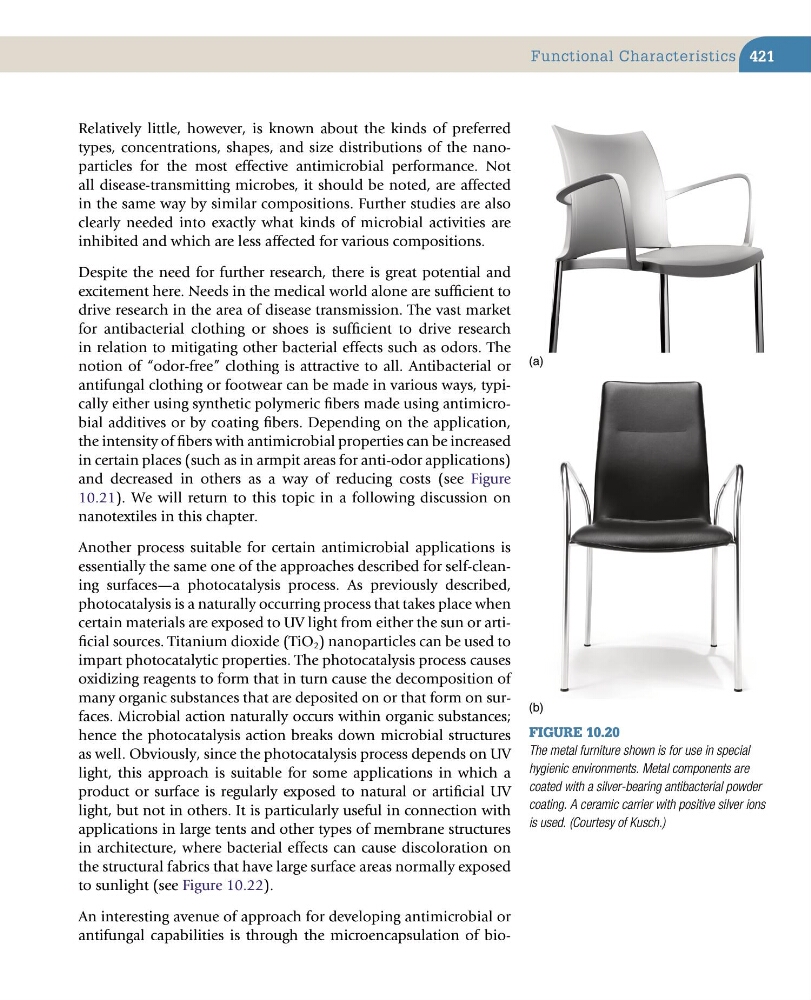
Figure 10.20
The metal furniture shown is for use in special
hygienic environments. Metal components are
coated with a silver-bearing antibacterial powder
coating. A ceramic carrier with positive silver ions
is used. (Courtesy of Kusch.)
Relatively little, however, is known about the kinds of preferred
types, concentrations, shapes, and size distributions of the nanoparticles for the most effective antimicrobial performance. Not
all disease-transmitting microbes, it should be noted, are affected
in the same way by similar compositions. Further studies are also
clearly needed into exactly what kinds of microbial activities are
inhibited and which are less affected for various compositions.
Despite the need for further research, there is great potential and
excitement here. Needs in the medical world alone are sufficient to
drive research in the area of disease transmission. The vast market
for antibacterial clothing or shoes is sufficient to drive research
in relation to mitigating other bacterial effects such as odors. The
notion of “odor-free” clothing is attractive to all. Antibacterial or
antifungal clothing or footwear can be made in various ways, typically either using synthetic polymeric fibers made using antimicrobial additives or by coating fibers. Depending on the application,
the intensity of fibers with antimicrobial properties can be increased
in certain places (such as in armpit areas for anti-odor applications)
and decreased in others as a way of reducing costs (see Figure
10.21). We will return to this topic in a following discussion on
nanotextiles in this chapter.
Another process suitable for certain antimicrobial applications is
essentially the same one of the approaches described for self-cleaning surfaces—a photocatalysis process. As previously described,
photocatalysis is a naturally occurring process that takes place when
certain materials are exposed to UV light from either the sun or artificial sources. Titanium dioxide (TiO 2 ) nanoparticles can be used to
impart photocatalytic properties. The photocatalysis process causes
oxidizing reagents to form that in turn cause the decomposition of
many organic substances that are deposited on or that form on surfaces. Microbial action naturally occurs within organic substances;
hence the photocatalysis action breaks down microbial structures
as well. Obviously, since the photocatalysis process depends on UV
light, this approach is suitable for some applications in which a
product or surface is regularly exposed to natural or artificial UV
light, but not in others. It is particularly useful in connection with
applications in large tents and other types of membrane structures
in architecture, where bacterial effects can cause discoloration on
the structural fabrics that have large surface areas normally exposed
to sunlight (see Figure 10.22).
An interesting avenue of approach for developing antimicrobial or
antifungal capabilities is through the microencapsulation of bioFunctional Characteristics
(a)
(b)
Figure 10.20
The metal furniture shown is for use in special
hygienic environments. Metal components are
coated with a silver-bearing antibacterial powder
coating. A ceramic carrier with positive silver ions
is used. (Courtesy of Kusch.)