

C hapter 10 nanomaterial product Forms and Functions
420
and is a huge growth industry. Keep in mind, however, that some
microflora are needed for human health. Further studies are needed
here.
Over the years many kinds of effective treatments to control bacteria
on surfaces have been developed. Agents include heat, radiation, or
various chemical disinfectants. There is also, of course, a long and
positive history of the development of antimicrobial compounds
of one type or another—a development that was spurred by the
need to treat wounded soldiers in World War II. In looking toward
the use of nanomaterials to control bacteria, a key difference is that
the antibacterial or antimicrobial properties under development
are not simply applied to a surface but are intrinsic to the material itself, either as a coating or embedded in surface layers, so that
the treatment cannot be washed off. Several existing materials are
already known to possess similar attributes to a greater or lesser
extent. Copper has long been known (arguably since early Egyptian
periods) to have certain antiparasitic properties and was long the
material of choice to be used on ships’ bottoms for inhibiting the
growth of algae. Copper sulfates have been used on grapevines for
many years to prevent fungi from developing. An early study by P.
J. Kuhn in assessing the growth rates of streptococci and staphylococci on stainless steel and brass in hospital environments observed
heavy growth on stainless steel but only slow growth on brass, which
contains copper. (The suggestion was subsequently made that older
hospitals with fine old brassware should not replace the pieces with
stainless steel.) More recently, various cloths have been coated with
different kinds of copper compounds to inhibit microbial growth.
The action occurs through copper ions attacking the cell walls of the
bacteria. Silver has similar properties.
There are several approaches to making improved antibacterial or
antimicrobial surfaces via the use of nanomaterials. One approach
is to use copper or silver nanoparticles embedded in some other
matrix as a coating on many kinds of base materials or incorporated
directly in the surfaces of the base materials. Clearly this approach
makes use of the long-known antimicrobial properties of copper,
but it is greatly enhanced because of the much larger surface area of
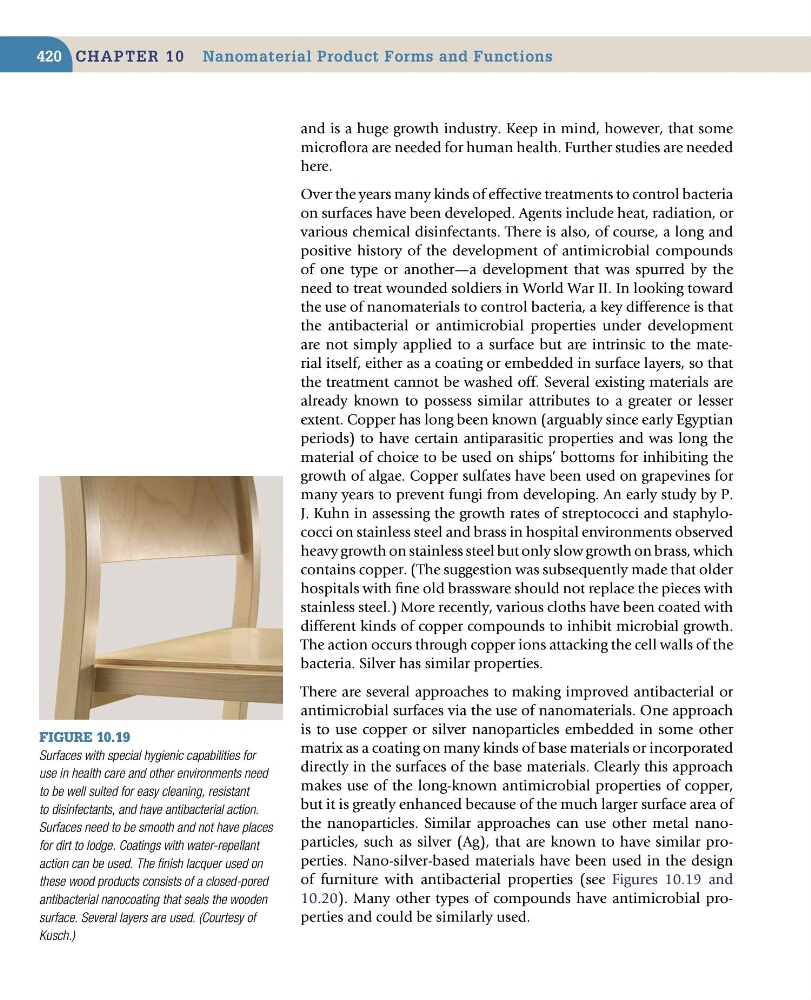
the nanoparticles. Similar approaches can use other metal nanoparticles, such as silver (Ag), that are known to have similar properties. Nano-silver-based materials have been used in the design
of furniture with antibacterial properties (see Figures 10.19 and
10.20). Many other types of compounds have antimicrobial properties and could be similarly used.
Figure 10.19
Surfaces with special hygienic capabilities for
use in health care and other environments need
to be well suited for easy cleaning, resistant
to disinfectants, and have antibacterial action.
Surfaces need to be smooth and not have places
for dirt to lodge. Coatings with water-repellant
action can be used. The finish lacquer used on
these wood products consists of a closed-pored
antibacterial nanocoating that seals the wooden
surface. Several layers are used. (Courtesy of
Kusch.)
420
and is a huge growth industry. Keep in mind, however, that some
microflora are needed for human health. Further studies are needed
here.
Over the years many kinds of effective treatments to control bacteria
on surfaces have been developed. Agents include heat, radiation, or
various chemical disinfectants. There is also, of course, a long and
positive history of the development of antimicrobial compounds
of one type or another—a development that was spurred by the
need to treat wounded soldiers in World War II. In looking toward
the use of nanomaterials to control bacteria, a key difference is that
the antibacterial or antimicrobial properties under development
are not simply applied to a surface but are intrinsic to the material itself, either as a coating or embedded in surface layers, so that
the treatment cannot be washed off. Several existing materials are
already known to possess similar attributes to a greater or lesser
extent. Copper has long been known (arguably since early Egyptian
periods) to have certain antiparasitic properties and was long the
material of choice to be used on ships’ bottoms for inhibiting the
growth of algae. Copper sulfates have been used on grapevines for
many years to prevent fungi from developing. An early study by P.
J. Kuhn in assessing the growth rates of streptococci and staphylococci on stainless steel and brass in hospital environments observed
heavy growth on stainless steel but only slow growth on brass, which
contains copper. (The suggestion was subsequently made that older
hospitals with fine old brassware should not replace the pieces with
stainless steel.) More recently, various cloths have been coated with
different kinds of copper compounds to inhibit microbial growth.
The action occurs through copper ions attacking the cell walls of the
bacteria. Silver has similar properties.
There are several approaches to making improved antibacterial or
antimicrobial surfaces via the use of nanomaterials. One approach
is to use copper or silver nanoparticles embedded in some other
matrix as a coating on many kinds of base materials or incorporated
directly in the surfaces of the base materials. Clearly this approach
makes use of the long-known antimicrobial properties of copper,
but it is greatly enhanced because of the much larger surface area of
the nanoparticles. Similar approaches can use other metal nanoparticles, such as silver (Ag), that are known to have similar properties. Nano-silver-based materials have been used in the design
of furniture with antibacterial properties (see Figures 10.19 and
10.20). Many other types of compounds have antimicrobial properties and could be similarly used.
Figure 10.19
Surfaces with special hygienic capabilities for
use in health care and other environments need
to be well suited for easy cleaning, resistant
to disinfectants, and have antibacterial action.
Surfaces need to be smooth and not have places
for dirt to lodge. Coatings with water-repellant
action can be used. The finish lacquer used on
these wood products consists of a closed-pored
antibacterial nanocoating that seals the wooden
surface. Several layers are used. (Courtesy of
Kusch.)