

419
the latter, particular care is also frequently taken to be sure that
designs do not have places where organic matter can accumulate.
This, coupled with the easy-cleaning capability, also helps prevent
bacteria buildup and spread. A major material design issue is assuring that common detergents or disinfectants used in cleaning do
not cause degradation of these surfaces.
The need for easy-cleaning surfaces goes far beyond the few application domains we’ve outlined. Additionally, many materials have
wide application in fields as diverse as equipment for health-care
facilities and cookware.
antimicrobial materials
Many materials exhibit properties variously described as antimicrobial, antibacterial, antifungal, or antimold. Microbes are minute life
forms that include bacteria, fungi, and protozoan parasites. Bacteria are all around us, in water and soils and on the many surfaces
we touch every day. Bacteria are microscopic organisms that are
typically one celled, have no chlorophyll, and multiply by simple
subdivision. Some bacteria aid in fermentation and in other useful
processes. Other bacteria are less positive and can cause deterioration, discoloration, or staining of surfaces or can be odor producing
(e.g., common body odors). Many microbes can cause disease or
aid in its spread, as is the case with pneumonia. Related are various
fungal growths that can produce mold. There is a clear need to be
able to control and deal with bacterial effects.
Surfaces that possess “antibacterial” properties either kill or inhibit
the development of bacteria that have deleterious effects such as discoloration, staining, or odors. Bacterial parasites that cause disease
are called pathogens, and the term antipathegenetic is sometimes
used. Antimicrobial surfaces target disease-producing microorganisms with the aim of helping prevent the spread of germs injurious to health. The term antimicrobial, however, is sometimes loosely
extended to include antifungals or even antivirals (although viruses
cannot reproduce in the same way as microbes). Clearly these
kinds of surfaces are important in the medical field, but they are
also important in everyday circumstances for normal healthy living.
Positive applications certainly include the multitude of surfaces that
proliferate in medical environments (walls, chairs, beds, instruments, and the like) but also in bandages, bedding, and clothing
used in care settings as well as in diverse medical products such as
filters. In everyday consumer goods, the prospect of antibacterial
clothing that can remain “odor free” after wearing is intriguing
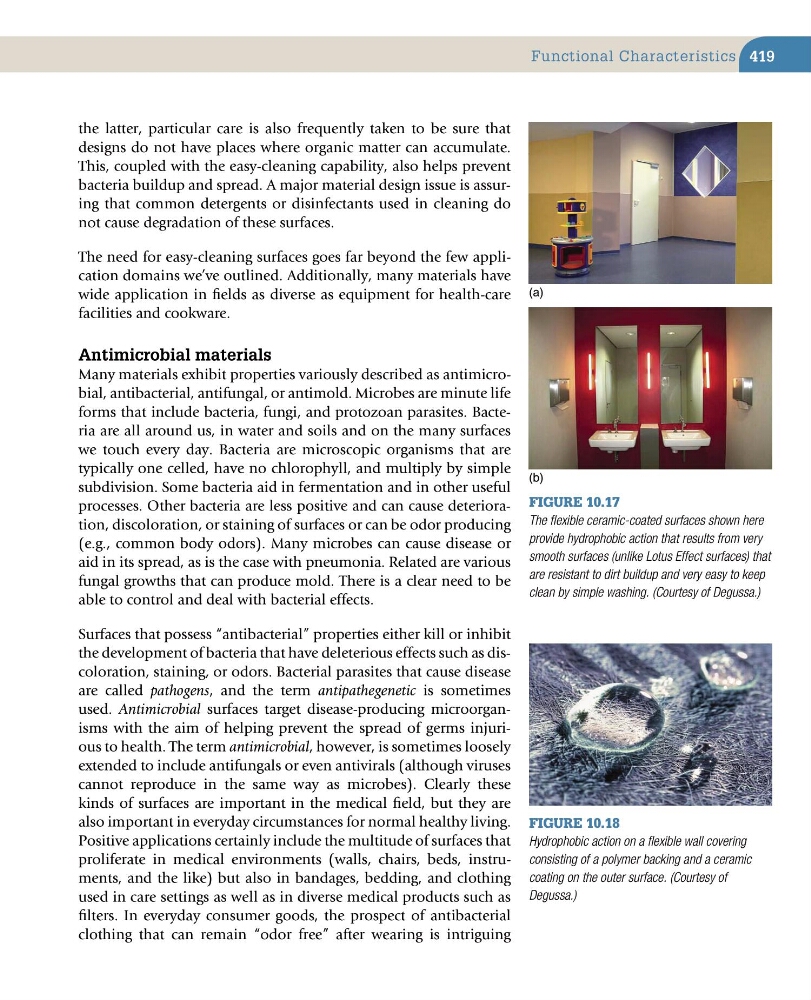
Figure 10.17
The flexible ceramic-coated surfaces shown here
provide hydrophobic action that results from very
smooth surfaces (unlike Lotus Effect surfaces) that
are resistant to dirt buildup and very easy to keep
clean by simple washing. (Courtesy of Degussa.)
(a)
(b)
Figure 10.18
Hydrophobic action on a flexible wall covering
consisting of a polymer backing and a ceramic
coating on the outer surface. (Courtesy of
Degussa.)
Functional Characteristics
the latter, particular care is also frequently taken to be sure that
designs do not have places where organic matter can accumulate.
This, coupled with the easy-cleaning capability, also helps prevent
bacteria buildup and spread. A major material design issue is assuring that common detergents or disinfectants used in cleaning do
not cause degradation of these surfaces.
The need for easy-cleaning surfaces goes far beyond the few application domains we’ve outlined. Additionally, many materials have
wide application in fields as diverse as equipment for health-care
facilities and cookware.
antimicrobial materials
Many materials exhibit properties variously described as antimicrobial, antibacterial, antifungal, or antimold. Microbes are minute life
forms that include bacteria, fungi, and protozoan parasites. Bacteria are all around us, in water and soils and on the many surfaces
we touch every day. Bacteria are microscopic organisms that are
typically one celled, have no chlorophyll, and multiply by simple
subdivision. Some bacteria aid in fermentation and in other useful
processes. Other bacteria are less positive and can cause deterioration, discoloration, or staining of surfaces or can be odor producing
(e.g., common body odors). Many microbes can cause disease or
aid in its spread, as is the case with pneumonia. Related are various
fungal growths that can produce mold. There is a clear need to be
able to control and deal with bacterial effects.
Surfaces that possess “antibacterial” properties either kill or inhibit
the development of bacteria that have deleterious effects such as discoloration, staining, or odors. Bacterial parasites that cause disease
are called pathogens, and the term antipathegenetic is sometimes
used. Antimicrobial surfaces target disease-producing microorganisms with the aim of helping prevent the spread of germs injurious to health. The term antimicrobial, however, is sometimes loosely
extended to include antifungals or even antivirals (although viruses
cannot reproduce in the same way as microbes). Clearly these
kinds of surfaces are important in the medical field, but they are
also important in everyday circumstances for normal healthy living.
Positive applications certainly include the multitude of surfaces that
proliferate in medical environments (walls, chairs, beds, instruments, and the like) but also in bandages, bedding, and clothing
used in care settings as well as in diverse medical products such as
filters. In everyday consumer goods, the prospect of antibacterial
clothing that can remain “odor free” after wearing is intriguing
Figure 10.17
The flexible ceramic-coated surfaces shown here
provide hydrophobic action that results from very
smooth surfaces (unlike Lotus Effect surfaces) that
are resistant to dirt buildup and very easy to keep
clean by simple washing. (Courtesy of Degussa.)
(a)
(b)
Figure 10.18
Hydrophobic action on a flexible wall covering
consisting of a polymer backing and a ceramic
coating on the outer surface. (Courtesy of
Degussa.)
Functional Characteristics