

C hapter 10 nanomaterial product Forms and Functions
418
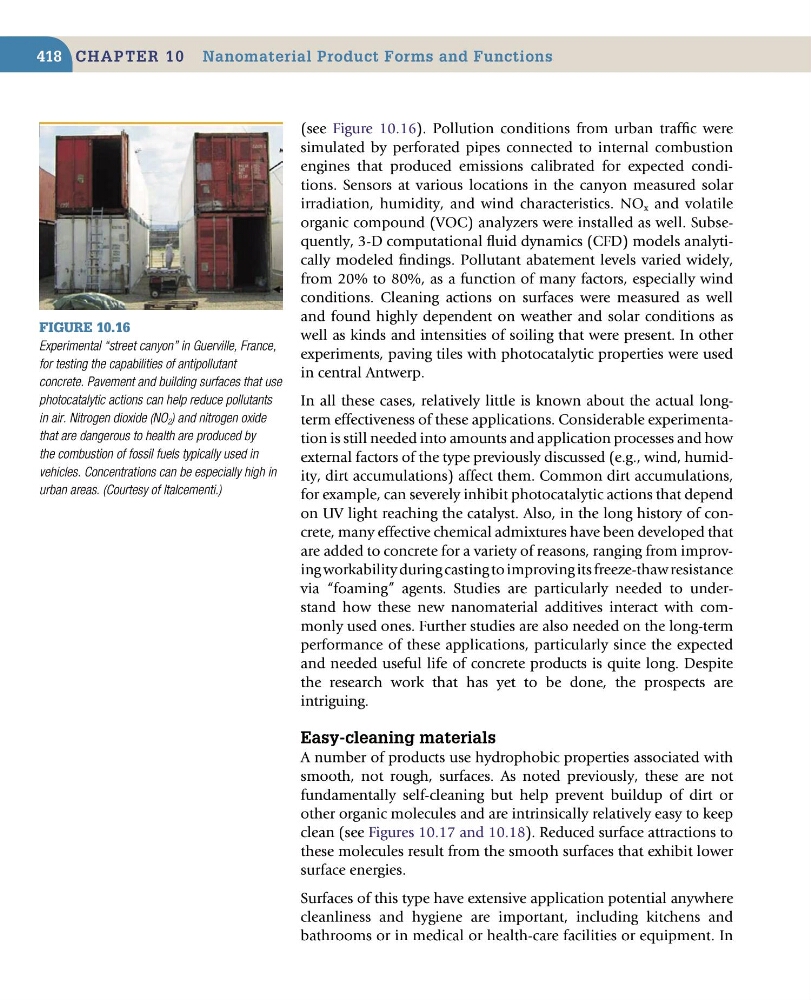
(see Figure 10.16). Pollution conditions from urban traffic were
simulated by perforated pipes connected to internal combustion
engines that produced emissions calibrated for expected conditions. Sensors at various locations in the canyon measured solar
irradiation, humidity, and wind characteristics. NO x and volatile
organic compound (VOC) analyzers were installed as well. Subsequently, 3-D computational fluid dynamics (CFD) models analytically modeled findings. Pollutant abatement levels varied widely,
from 20% to 80%, as a function of many factors, especially wind
conditions. Cleaning actions on surfaces were measured as well
and found highly dependent on weather and solar conditions as
well as kinds and intensities of soiling that were present. In other
experiments, paving tiles with photocatalytic properties were used
in central Antwerp.
In all these cases, relatively little is known about the actual longterm effectiveness of these applications. Considerable experimentation is still needed into amounts and application processes and how
external factors of the type previously discussed (e.g., wind, humidity, dirt accumulations) affect them. Common dirt accumulations,
for example, can severely inhibit photocatalytic actions that depend
on UV light reaching the catalyst. Also, in the long history of concrete, many effective chemical admixtures have been developed that
are added to concrete for a variety of reasons, ranging from improving workability during casting to improving its freeze-thaw resistance
via “foaming” agents. Studies are particularly needed to understand how these new nanomaterial additives interact with commonly used ones. Further studies are also needed on the long-term
performance of these applications, particularly since the expected
and needed useful life of concrete products is quite long. Despite
the research work that has yet to be done, the prospects are
intriguing.
easy-cleaning materials
A number of products use hydrophobic properties associated with
smooth, not rough, surfaces. As noted previously, these are not
fundamentally self-cleaning but help prevent buildup of dirt or
other organic molecules and are intrinsically relatively easy to keep
clean (see Figures 10.17 and 10.18). Reduced surface attractions to
these molecules result from the smooth surfaces that exhibit lower
surface energies.
Surfaces of this type have extensive application potential anywhere
cleanliness and hygiene are important, including kitchens and
bathrooms or in medical or health-care facilities or equipment. In
Figure 10.16
Experimental “street canyon” in Guerville, France,
for testing the capabilities of antipollutant
concrete. Pavement and building surfaces that use
photocatalytic actions can help reduce pollutants
in air. Nitrogen dioxide (NO 2 ) and nitrogen oxide
that are dangerous to health are produced by
the combustion of fossil fuels typically used in
vehicles. Concentrations can be especially high in
urban areas. (Courtesy of Italcementi.)
418
(see Figure 10.16). Pollution conditions from urban traffic were
simulated by perforated pipes connected to internal combustion
engines that produced emissions calibrated for expected conditions. Sensors at various locations in the canyon measured solar
irradiation, humidity, and wind characteristics. NO x and volatile
organic compound (VOC) analyzers were installed as well. Subsequently, 3-D computational fluid dynamics (CFD) models analytically modeled findings. Pollutant abatement levels varied widely,
from 20% to 80%, as a function of many factors, especially wind
conditions. Cleaning actions on surfaces were measured as well
and found highly dependent on weather and solar conditions as
well as kinds and intensities of soiling that were present. In other
experiments, paving tiles with photocatalytic properties were used
in central Antwerp.
In all these cases, relatively little is known about the actual longterm effectiveness of these applications. Considerable experimentation is still needed into amounts and application processes and how
external factors of the type previously discussed (e.g., wind, humidity, dirt accumulations) affect them. Common dirt accumulations,
for example, can severely inhibit photocatalytic actions that depend
on UV light reaching the catalyst. Also, in the long history of concrete, many effective chemical admixtures have been developed that
are added to concrete for a variety of reasons, ranging from improving workability during casting to improving its freeze-thaw resistance
via “foaming” agents. Studies are particularly needed to understand how these new nanomaterial additives interact with commonly used ones. Further studies are also needed on the long-term
performance of these applications, particularly since the expected
and needed useful life of concrete products is quite long. Despite
the research work that has yet to be done, the prospects are
intriguing.
easy-cleaning materials
A number of products use hydrophobic properties associated with
smooth, not rough, surfaces. As noted previously, these are not
fundamentally self-cleaning but help prevent buildup of dirt or
other organic molecules and are intrinsically relatively easy to keep
clean (see Figures 10.17 and 10.18). Reduced surface attractions to
these molecules result from the smooth surfaces that exhibit lower
surface energies.
Surfaces of this type have extensive application potential anywhere
cleanliness and hygiene are important, including kitchens and
bathrooms or in medical or health-care facilities or equipment. In
Figure 10.16
Experimental “street canyon” in Guerville, France,
for testing the capabilities of antipollutant
concrete. Pavement and building surfaces that use
photocatalytic actions can help reduce pollutants
in air. Nitrogen dioxide (NO 2 ) and nitrogen oxide
that are dangerous to health are produced by
the combustion of fossil fuels typically used in
vehicles. Concentrations can be especially high in
urban areas. (Courtesy of Italcementi.)