

417
action from rains or washings then causes the impinging water to
form into thin-sheet forms that carry away dirt particles. Alternative
approaches explored by others involve spraying concrete with a
photocatalytic coating.
In addition to self-cleaning properties, the concrete reportedly has
capabilities for reducing pollutants such as nitric oxides in the air.
As discussed in more detail in Section 11.3, air pollution is a major
health hazard. Photocatalytic materials exposed to UV light can
cause various types of organic and inorganic pollutant particulates
to oxidize and be transformed into a more benign form. This possibility has been initially explored by work sponsored by Italcementi
via laboratory tests and some on-site experiments. It is worth dwelling for a moment on them, since so little work has been done in
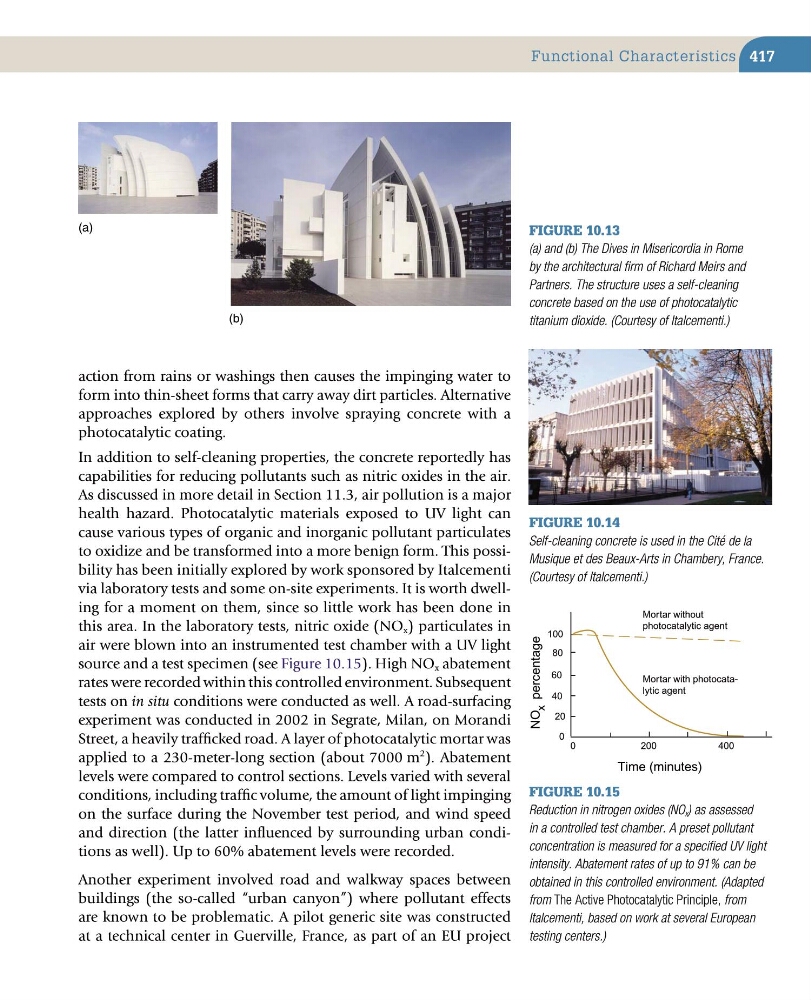
this area. In the laboratory tests, nitric oxide (NO x ) particulates in
air were blown into an instrumented test chamber with a UV light
source and a test specimen (see Figure 10.15). High NO x abatement
rates were recorded within this controlled environment. Subsequent
tests on in situ conditions were conducted as well. A road-surfacing
experiment was conducted in 2002 in Segrate, Milan, on Morandi
Street, a heavily trafficked road. A layer of photocatalytic mortar was
applied to a 230-meter-long section (about 7000 m
2
). Abatement
levels were compared to control sections. Levels varied with several
conditions, including traffic volume, the amount of light impinging
on the surface during the November test period, and wind speed
and direction (the latter influenced by surrounding urban conditions as well). Up to 60% abatement levels were recorded.
Another experiment involved road and walkway spaces between
buildings (the so-called “urban canyon”) where pollutant effects
are known to be problematic. A pilot generic site was constructed
at a technical center in Guerville, France, as part of an EU project
Figure 10.13
(a) and (b) The Dives in Misericordia in Rome
by the architectural firm of Richard Meirs and
Partners. The structure uses a self-cleaning
concrete based on the use of photocatalytic
titanium dioxide. (Courtesy of Italcementi.)
(a)
(b)
Figure 10.14
Self-cleaning concrete is used in the Cité de la
Musique et des Beaux-Arts in Chambery, France.
(Courtesy of Italcementi.)
Figure 10.15
Reduction in nitrogen oxides (NO x ) as assessed
in a controlled test chamber. A preset pollutant
concentration is measured for a specified UV light
intensity. Abatement rates of up to 91% can be
obtained in this controlled environment. (Adapted
from The Active Photocatalytic Principle, from
Italcementi, based on work at several European
testing centers.)
Mortar without
photocatalytic agent
20
60
80
40
100
Mortar with photocatalytic agent
0
0
200
400
Time (minutes)
NO percentage
x
Functional Characteristics
action from rains or washings then causes the impinging water to
form into thin-sheet forms that carry away dirt particles. Alternative
approaches explored by others involve spraying concrete with a
photocatalytic coating.
In addition to self-cleaning properties, the concrete reportedly has
capabilities for reducing pollutants such as nitric oxides in the air.
As discussed in more detail in Section 11.3, air pollution is a major
health hazard. Photocatalytic materials exposed to UV light can
cause various types of organic and inorganic pollutant particulates
to oxidize and be transformed into a more benign form. This possibility has been initially explored by work sponsored by Italcementi
via laboratory tests and some on-site experiments. It is worth dwelling for a moment on them, since so little work has been done in
this area. In the laboratory tests, nitric oxide (NO x ) particulates in
air were blown into an instrumented test chamber with a UV light
source and a test specimen (see Figure 10.15). High NO x abatement
rates were recorded within this controlled environment. Subsequent
tests on in situ conditions were conducted as well. A road-surfacing
experiment was conducted in 2002 in Segrate, Milan, on Morandi
Street, a heavily trafficked road. A layer of photocatalytic mortar was
applied to a 230-meter-long section (about 7000 m
2
). Abatement
levels were compared to control sections. Levels varied with several
conditions, including traffic volume, the amount of light impinging
on the surface during the November test period, and wind speed
and direction (the latter influenced by surrounding urban conditions as well). Up to 60% abatement levels were recorded.
Another experiment involved road and walkway spaces between
buildings (the so-called “urban canyon”) where pollutant effects
are known to be problematic. A pilot generic site was constructed
at a technical center in Guerville, France, as part of an EU project
Figure 10.13
(a) and (b) The Dives in Misericordia in Rome
by the architectural firm of Richard Meirs and
Partners. The structure uses a self-cleaning
concrete based on the use of photocatalytic
titanium dioxide. (Courtesy of Italcementi.)
(a)
(b)
Figure 10.14
Self-cleaning concrete is used in the Cité de la
Musique et des Beaux-Arts in Chambery, France.
(Courtesy of Italcementi.)
Figure 10.15
Reduction in nitrogen oxides (NO x ) as assessed
in a controlled test chamber. A preset pollutant
concentration is measured for a specified UV light
intensity. Abatement rates of up to 91% can be
obtained in this controlled environment. (Adapted
from The Active Photocatalytic Principle, from
Italcementi, based on work at several European
testing centers.)
Mortar without
photocatalytic agent
20
60
80
40
100
Mortar with photocatalytic agent
0
0
200
400
Time (minutes)
NO percentage
x
Functional Characteristics