

409
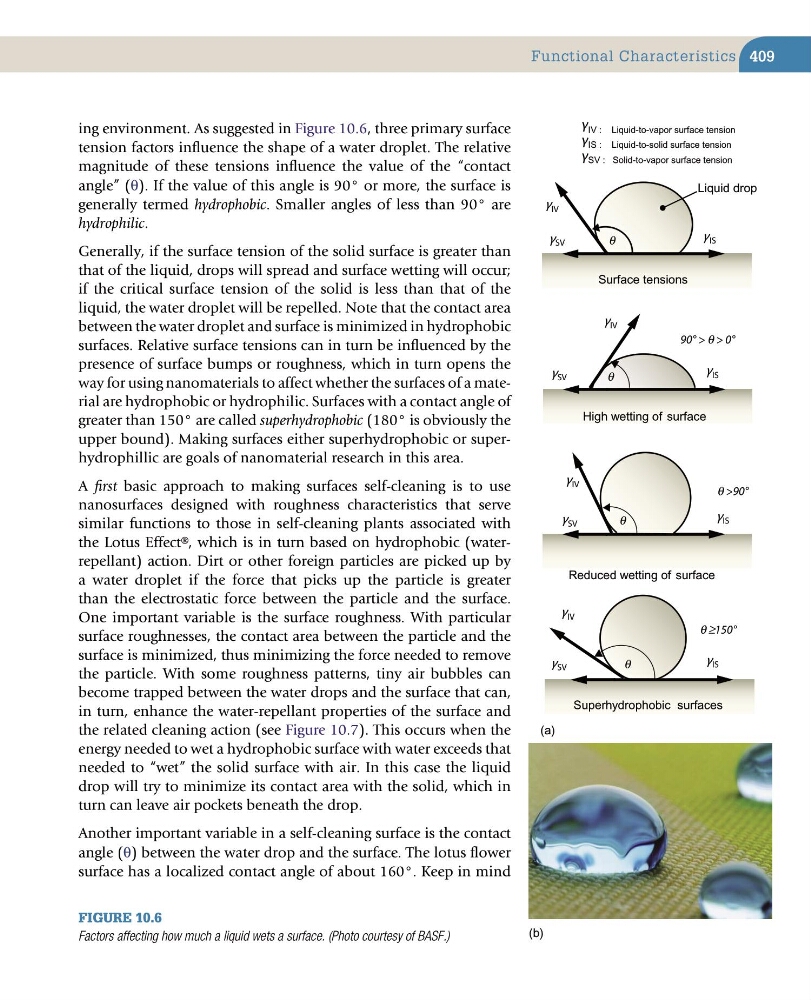
ing environment. As suggested in Figure 10.6, three primary surface
tension factors influence the shape of a water droplet. The relative
magnitude of these tensions influence the value of the “contact
angle” (θ). If the value of this angle is 90° or more, the surface is
generally termed hydrophobic. Smaller angles of less than 90° are
hydrophilic.
Generally, if the surface tension of the solid surface is greater than
that of the liquid, drops will spread and surface wetting will occur;
if the critical surface tension of the solid is less than that of the
liquid, the water droplet will be repelled. Note that the contact area
between the water droplet and surface is minimized in hydrophobic
surfaces. Relative surface tensions can in turn be influenced by the
presence of surface bumps or roughness, which in turn opens the
way for using nanomaterials to affect whether the surfaces of a material are hydrophobic or hydrophilic. Surfaces with a contact angle of
greater than 150° are called superhydrophobic (180° is obviously the
upper bound). Making surfaces either superhydrophobic or superhydrophillic are goals of nanomaterial research in this area.
A first basic approach to making surfaces self-cleaning is to use
nanosurfaces designed with roughness characteristics that serve
similar functions to those in self-cleaning plants associated with
the Lotus Effect®, which is in turn based on hydrophobic (waterrepellant) action. Dirt or other foreign particles are picked up by
a water droplet if the force that picks up the particle is greater
than the electrostatic force between the particle and the surface.
One important variable is the surface roughness. With particular
surface roughnesses, the contact area between the particle and the
surface is minimized, thus minimizing the force needed to remove
the particle. With some roughness patterns, tiny air bubbles can
become trapped between the water drops and the surface that can,
in turn, enhance the water-repellant properties of the surface and
the related cleaning action (see Figure 10.7). This occurs when the
energy needed to wet a hydrophobic surface with water exceeds that
needed to “wet” the solid surface with air. In this case the liquid
drop will try to minimize its contact area with the solid, which in
turn can leave air pockets beneath the drop.
Another important variable in a self-cleaning surface is the contact
angle (θ) between the water drop and the surface. The lotus flower
surface has a localized contact angle of about 160°. Keep in mind
(a)
(b)
q
IV
IV : Liquid-to-vapor surface tension
IS : Liquid-to-solid surface tension
SV : Solid-to-vapor surface tension
Liquid drop
SV
IS
q
IV
SV
IS
Reduced wetting of surface
q
IV
SV
IS
High wetting of surface
Surface tensions
q
q ≥150°
q >90°
90° > q > 0°
IV
SV
IS
Superhydrophobic surfaces
Figure 10.6
Factors affecting how much a liquid wets a surface. (Photo courtesy of BASF.)
Functional Characteristics
ing environment. As suggested in Figure 10.6, three primary surface
tension factors influence the shape of a water droplet. The relative
magnitude of these tensions influence the value of the “contact
angle” (θ). If the value of this angle is 90° or more, the surface is
generally termed hydrophobic. Smaller angles of less than 90° are
hydrophilic.
Generally, if the surface tension of the solid surface is greater than
that of the liquid, drops will spread and surface wetting will occur;
if the critical surface tension of the solid is less than that of the
liquid, the water droplet will be repelled. Note that the contact area
between the water droplet and surface is minimized in hydrophobic
surfaces. Relative surface tensions can in turn be influenced by the
presence of surface bumps or roughness, which in turn opens the
way for using nanomaterials to affect whether the surfaces of a material are hydrophobic or hydrophilic. Surfaces with a contact angle of
greater than 150° are called superhydrophobic (180° is obviously the
upper bound). Making surfaces either superhydrophobic or superhydrophillic are goals of nanomaterial research in this area.
A first basic approach to making surfaces self-cleaning is to use
nanosurfaces designed with roughness characteristics that serve
similar functions to those in self-cleaning plants associated with
the Lotus Effect®, which is in turn based on hydrophobic (waterrepellant) action. Dirt or other foreign particles are picked up by
a water droplet if the force that picks up the particle is greater
than the electrostatic force between the particle and the surface.
One important variable is the surface roughness. With particular
surface roughnesses, the contact area between the particle and the
surface is minimized, thus minimizing the force needed to remove
the particle. With some roughness patterns, tiny air bubbles can
become trapped between the water drops and the surface that can,
in turn, enhance the water-repellant properties of the surface and
the related cleaning action (see Figure 10.7). This occurs when the
energy needed to wet a hydrophobic surface with water exceeds that
needed to “wet” the solid surface with air. In this case the liquid
drop will try to minimize its contact area with the solid, which in
turn can leave air pockets beneath the drop.
Another important variable in a self-cleaning surface is the contact
angle (θ) between the water drop and the surface. The lotus flower
surface has a localized contact angle of about 160°. Keep in mind
(a)
(b)
q
IV
IV : Liquid-to-vapor surface tension
IS : Liquid-to-solid surface tension
SV : Solid-to-vapor surface tension
Liquid drop
SV
IS
q
IV
SV
IS
Reduced wetting of surface
q
IV
SV
IS
High wetting of surface
Surface tensions
q
q ≥150°
q >90°
90° > q > 0°
IV
SV
IS
Superhydrophobic surfaces
Figure 10.6
Factors affecting how much a liquid wets a surface. (Photo courtesy of BASF.)
Functional Characteristics