

C hapter 10 nanomaterial product Forms and Functions
408
but, in the case of the lotus leaves, the surfaces had fairly rough
micro- and nanostructures that imparted roughness to the surface.
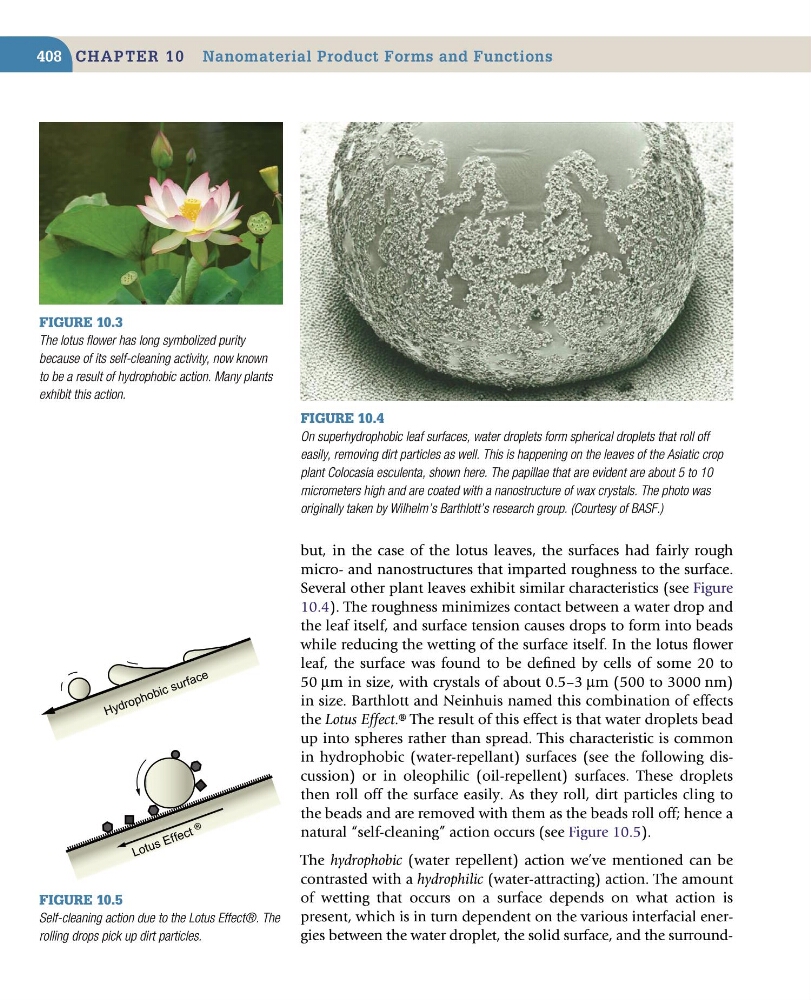
Several other plant leaves exhibit similar characteristics (see Figure
10.4). The roughness minimizes contact between a water drop and
the leaf itself, and surface tension causes drops to form into beads
while reducing the wetting of the surface itself. In the lotus flower
leaf, the surface was found to be defined by cells of some 20 to
50 µm in size, with crystals of about 0.5–3 µm (500 to 3000 nm)
in size. Barthlott and Neinhuis named this combination of effects
the Lotus Effect.® The result of this effect is that water droplets bead
up into spheres rather than spread. This characteristic is common
in hydrophobic (water-repellant) surfaces (see the following discussion) or in oleophilic (oil-repellent) surfaces. These droplets
then roll off the surface easily. As they roll, dirt particles cling to
the beads and are removed with them as the beads roll off; hence a
natural “self-cleaning” action occurs (see Figure 10.5).
The hydrophobic (water repellent) action we’ve mentioned can be
contrasted with a hydrophilic (water-attracting) action. The amount
of wetting that occurs on a surface depends on what action is
present, which is in turn dependent on the various interfacial energies between the water droplet, the solid surface, and the surroundFigure 10.3
The lotus flower has long symbolized purity
because of its self-cleaning activity, now known
to be a result of hydrophobic action. Many plants
exhibit this action.
Figure 10.4
On superhydrophobic leaf surfaces, water droplets form spherical droplets that roll off
easily, removing dirt particles as well. This is happening on the leaves of the Asiatic crop
plant Colocasia esculenta, shown here. The papillae that are evident are about 5 to 10
micrometers high and are coated with a nanostructure of wax crystals. The photo was
originally taken by Wilhelm’s Barthlott’s research group. (Courtesy of BASF.)
Figure 10.5
Self-cleaning action due to the Lotus Effect®. The
rolling drops pick up dirt particles.
H y d ro p h o b ic s u rf a c e
L o tu s E ff e c t
®
408
but, in the case of the lotus leaves, the surfaces had fairly rough
micro- and nanostructures that imparted roughness to the surface.
Several other plant leaves exhibit similar characteristics (see Figure
10.4). The roughness minimizes contact between a water drop and
the leaf itself, and surface tension causes drops to form into beads
while reducing the wetting of the surface itself. In the lotus flower
leaf, the surface was found to be defined by cells of some 20 to
50 µm in size, with crystals of about 0.5–3 µm (500 to 3000 nm)
in size. Barthlott and Neinhuis named this combination of effects
the Lotus Effect.® The result of this effect is that water droplets bead
up into spheres rather than spread. This characteristic is common
in hydrophobic (water-repellant) surfaces (see the following discussion) or in oleophilic (oil-repellent) surfaces. These droplets
then roll off the surface easily. As they roll, dirt particles cling to
the beads and are removed with them as the beads roll off; hence a
natural “self-cleaning” action occurs (see Figure 10.5).
The hydrophobic (water repellent) action we’ve mentioned can be
contrasted with a hydrophilic (water-attracting) action. The amount
of wetting that occurs on a surface depends on what action is
present, which is in turn dependent on the various interfacial energies between the water droplet, the solid surface, and the surroundFigure 10.3
The lotus flower has long symbolized purity
because of its self-cleaning activity, now known
to be a result of hydrophobic action. Many plants
exhibit this action.
Figure 10.4
On superhydrophobic leaf surfaces, water droplets form spherical droplets that roll off
easily, removing dirt particles as well. This is happening on the leaves of the Asiatic crop
plant Colocasia esculenta, shown here. The papillae that are evident are about 5 to 10
micrometers high and are coated with a nanostructure of wax crystals. The photo was
originally taken by Wilhelm’s Barthlott’s research group. (Courtesy of BASF.)
Figure 10.5
Self-cleaning action due to the Lotus Effect®. The
rolling drops pick up dirt particles.
H y d ro p h o b ic s u rf a c e
L o tu s E ff e c t
®