

C hapter 10 nanomaterial product Forms and Functions
410
Figure 10.7
Hydrophobic (water-repelling) action due to surface
roughness. Nanopatterns can reduce the contact
area and increase hydrophobic behavior.
Air pockets
Liquid drop
that though our discussion has constantly referred to the lotus
flower surface, many materials can be engineered to produce
equivalent surface structures. Teflon, for example, intrinsically has
a relatively high localized contact angle (115°) for water, which
intrinsically gives it some of these properties and can be altered
to have even higher contact angle values. Note that though references have been made to water droplets only, the actual contact
angles vary depending on what liquid is used as well as what
solid surface is present. This dependency is significant when
liquids other than water are important. Oleophylic surfaces, for
example, repel oil.
A second approach involving water-repellant actions involves
extremely smooth, surfaces (not rough), which is fundamentally
quite different from the Lotus Effect® cleaning action. With highly
smooth surfaces, there is a decrease in the surface energy of the
surface and consequently a lower force of surface attraction, which
again causes water beads to form. Surfaces based specifically on
this action are easy to clean and resistant to dirt buildup. They are
not intrinsically self-cleaning in the sense we’ve described, albeit
natural actions such as rain can aid in washing away dirt particles
from sloped or vertical surfaces. Surfaces of this type are widely
used in locations where easy cleaning is important, such as bathroom fixtures. In these approaches, the objective is to use the waterattraction characteristic to develop a thin sheetlike film of water
that can be largely transparent and that aids in surface washing and
cleaning. Hydrophilic surfaces also form the basis for some “antifogging” applications.
The third major action of interest here is photocatalysis, a naturally
occurring process that happens when certain materials are exposed
to ultraviolet (UV) UV light. It is one of the most fundamental
approaches used to enable many functional behaviors, including
self-cleaning and antimicrobial actions. Later we will see that photocatalytic approaches are also used for many other applications,
such as air purification.
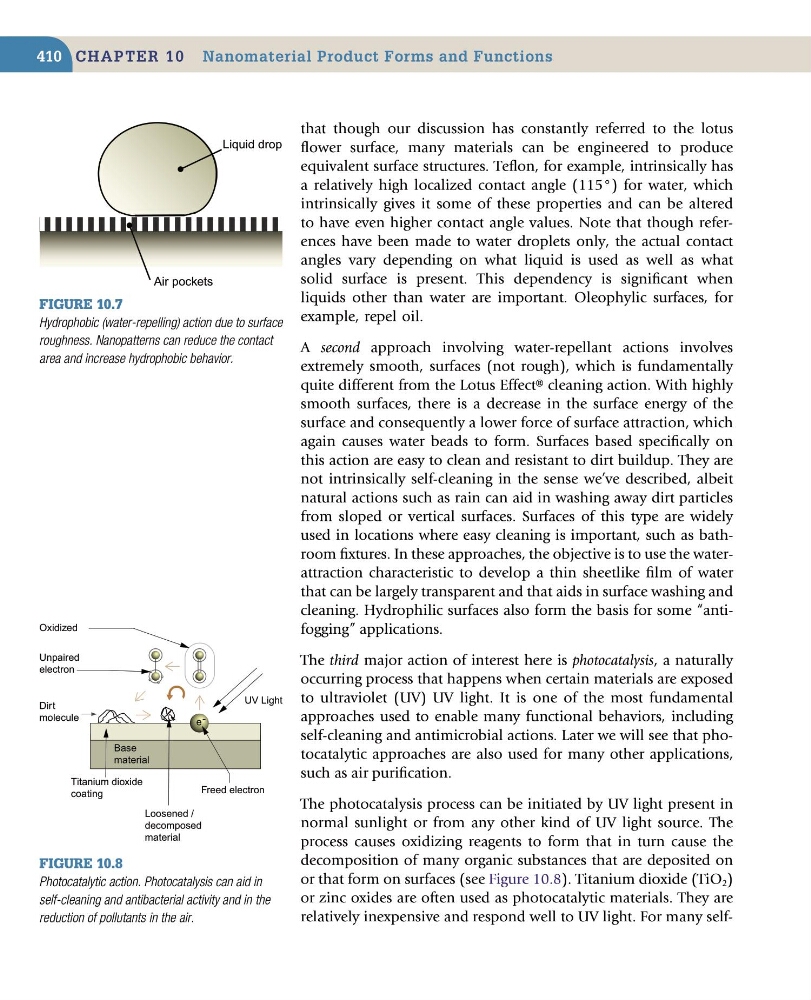
The photocatalysis process can be initiated by UV light present in
normal sunlight or from any other kind of UV light source. The
process causes oxidizing reagents to form that in turn cause the
decomposition of many organic substances that are deposited on
or that form on surfaces (see Figure 10.8). Titanium dioxide (TiO 2 )
or zinc oxides are often used as photocatalytic materials. They are
relatively inexpensive and respond well to UV light. For many selfFigure 10.8
Photocatalytic action. Photocatalysis can aid in
self-cleaning and antibacterial activity and in the
reduction of pollutants in the air.
UV Light
Dirt
molecule
Unpaired
electron
Oxidized
Titanium dioxide
coating
Freed electron
Base
material
Loosened /
decomposed
material
e -
410
Figure 10.7
Hydrophobic (water-repelling) action due to surface
roughness. Nanopatterns can reduce the contact
area and increase hydrophobic behavior.
Air pockets
Liquid drop
that though our discussion has constantly referred to the lotus
flower surface, many materials can be engineered to produce
equivalent surface structures. Teflon, for example, intrinsically has
a relatively high localized contact angle (115°) for water, which
intrinsically gives it some of these properties and can be altered
to have even higher contact angle values. Note that though references have been made to water droplets only, the actual contact
angles vary depending on what liquid is used as well as what
solid surface is present. This dependency is significant when
liquids other than water are important. Oleophylic surfaces, for
example, repel oil.
A second approach involving water-repellant actions involves
extremely smooth, surfaces (not rough), which is fundamentally
quite different from the Lotus Effect® cleaning action. With highly
smooth surfaces, there is a decrease in the surface energy of the
surface and consequently a lower force of surface attraction, which
again causes water beads to form. Surfaces based specifically on
this action are easy to clean and resistant to dirt buildup. They are
not intrinsically self-cleaning in the sense we’ve described, albeit
natural actions such as rain can aid in washing away dirt particles
from sloped or vertical surfaces. Surfaces of this type are widely
used in locations where easy cleaning is important, such as bathroom fixtures. In these approaches, the objective is to use the waterattraction characteristic to develop a thin sheetlike film of water
that can be largely transparent and that aids in surface washing and
cleaning. Hydrophilic surfaces also form the basis for some “antifogging” applications.
The third major action of interest here is photocatalysis, a naturally
occurring process that happens when certain materials are exposed
to ultraviolet (UV) UV light. It is one of the most fundamental
approaches used to enable many functional behaviors, including
self-cleaning and antimicrobial actions. Later we will see that photocatalytic approaches are also used for many other applications,
such as air purification.
The photocatalysis process can be initiated by UV light present in
normal sunlight or from any other kind of UV light source. The
process causes oxidizing reagents to form that in turn cause the
decomposition of many organic substances that are deposited on
or that form on surfaces (see Figure 10.8). Titanium dioxide (TiO 2 )
or zinc oxides are often used as photocatalytic materials. They are
relatively inexpensive and respond well to UV light. For many selfFigure 10.8
Photocatalytic action. Photocatalysis can aid in
self-cleaning and antibacterial activity and in the
reduction of pollutants in the air.
UV Light
Dirt
molecule
Unpaired
electron
Oxidized
Titanium dioxide
coating
Freed electron
Base
material
Loosened /
decomposed
material
e -