

387
properties are still unknown. In addition, these materials are still
very expensive.
Aside from the anode, the cathode is a key factor in developing
high-performance lithium-ion batteries. Typically, the cathode
contains a transition metal, which can be easily reduced and oxidized, must interact with lithium rapidly and without inducing
a structural change, should be a good electronic conductor, and
should be cheap and nontoxic. Finally, it must react with lithium
and produce a high voltage. The most used cathode material is
the layered LiCoO 2 . This compound is easy to process and has a
long shelf life. However, it does not exceed a reversible capacity of
140 mAh/g (half the theoretical capacity) and contains toxic and
expensive cobalt. The layered LiNiO 2 is less expensive and less toxic
than LiCoO 2 , showing also higher capacity, but it is difficult to synthesize, may release oxygen at high temperature, and is likely to
exhibit a drastic fade in capacity during cycling.
More recently, LiFePO 4 has been suggested as a cathode material
for Li-ion batteries. Because Fe is also a transition metal, is more
available than Co and Ni, and is less toxic, this compound seems to
be a good choice. In addition, it has a good capacity of 170 mAh/g
at a cell voltage of 3.4 V, while the phosphate group is very stable.
However, this material has a quite low electronic conductivity at
room temperature and poor lithium conductivity. As a result, this
material is now being studied in great detail, particularly because it
is being thought of for use in electric vehicles. In this regard, reducing the size of LiFePO4 particles to the nanoscale and coating them
with carbon seem to be very effective in improving the electronic
and ionic conductivities.
Another route that has been thought to improve the energy and
power of Li-ion batteries is to use layered Li 2 MnO 3 and LiMO 2
(M = Co, Cr, Ni, Mn). These materials exhibit high capacities of
around 250 mAh/g, although they are still in the early stages of
development.
Finally, some words about the electrolyte. For lithium-ion batteries, a good electrolyte must exhibit high ionic conductivity,
good electrochemical and thermal stability and low reactivity with
the other elements of the battery and be cheap and environmentally friendly. Typically, the electrolytes used so far tend to be
liquid solutions. However, recently there has been a great interest in replacing liquid electrolytes with gel polymer electrolytes,
which are membranes formed by containing a liquid solution
in a polymer matrix. Shifting away from the Li-ion system, there
Enabling Environments and Systems: Energy
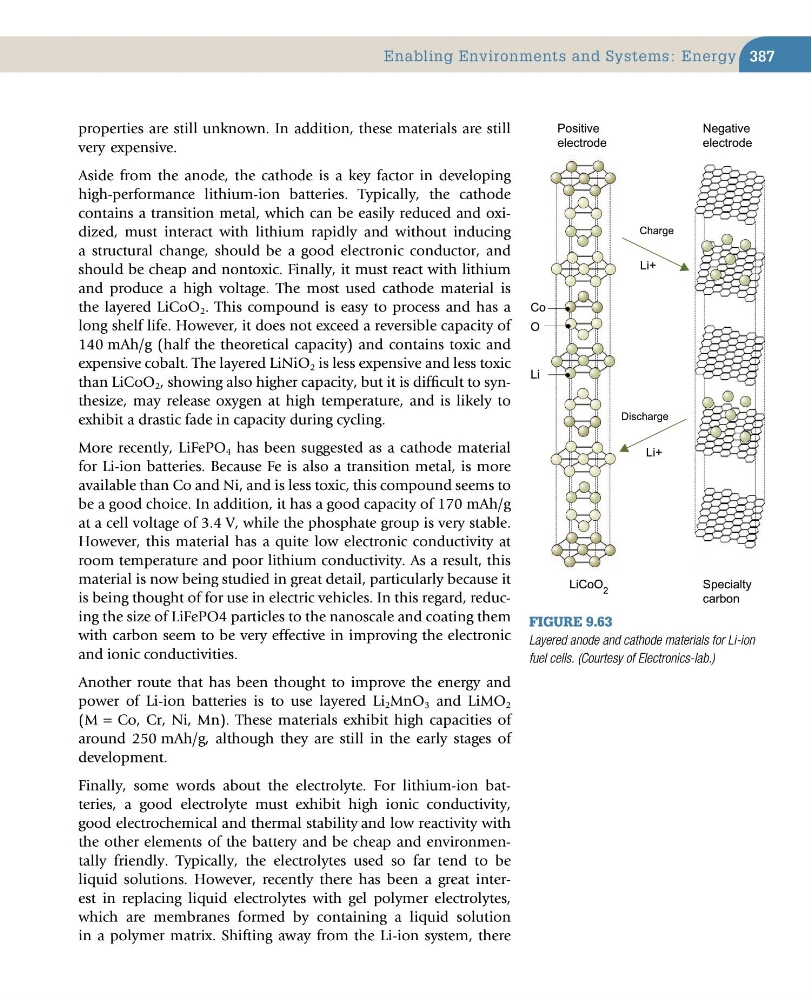
Figure 9.63
Layered anode and cathode materials for Li-ion
fuel cells. (Courtesy of Electronics-lab.)
Co
Li
O
Positive
electrode
Negative
electrode
Charge
Discharge
Li+
Li+
Specialty
carbon
LiCoO 2
properties are still unknown. In addition, these materials are still
very expensive.
Aside from the anode, the cathode is a key factor in developing
high-performance lithium-ion batteries. Typically, the cathode
contains a transition metal, which can be easily reduced and oxidized, must interact with lithium rapidly and without inducing
a structural change, should be a good electronic conductor, and
should be cheap and nontoxic. Finally, it must react with lithium
and produce a high voltage. The most used cathode material is
the layered LiCoO 2 . This compound is easy to process and has a
long shelf life. However, it does not exceed a reversible capacity of
140 mAh/g (half the theoretical capacity) and contains toxic and
expensive cobalt. The layered LiNiO 2 is less expensive and less toxic
than LiCoO 2 , showing also higher capacity, but it is difficult to synthesize, may release oxygen at high temperature, and is likely to
exhibit a drastic fade in capacity during cycling.
More recently, LiFePO 4 has been suggested as a cathode material
for Li-ion batteries. Because Fe is also a transition metal, is more
available than Co and Ni, and is less toxic, this compound seems to
be a good choice. In addition, it has a good capacity of 170 mAh/g
at a cell voltage of 3.4 V, while the phosphate group is very stable.
However, this material has a quite low electronic conductivity at
room temperature and poor lithium conductivity. As a result, this
material is now being studied in great detail, particularly because it
is being thought of for use in electric vehicles. In this regard, reducing the size of LiFePO4 particles to the nanoscale and coating them
with carbon seem to be very effective in improving the electronic
and ionic conductivities.
Another route that has been thought to improve the energy and
power of Li-ion batteries is to use layered Li 2 MnO 3 and LiMO 2
(M = Co, Cr, Ni, Mn). These materials exhibit high capacities of
around 250 mAh/g, although they are still in the early stages of
development.
Finally, some words about the electrolyte. For lithium-ion batteries, a good electrolyte must exhibit high ionic conductivity,
good electrochemical and thermal stability and low reactivity with
the other elements of the battery and be cheap and environmentally friendly. Typically, the electrolytes used so far tend to be
liquid solutions. However, recently there has been a great interest in replacing liquid electrolytes with gel polymer electrolytes,
which are membranes formed by containing a liquid solution
in a polymer matrix. Shifting away from the Li-ion system, there
Enabling Environments and Systems: Energy
Figure 9.63
Layered anode and cathode materials for Li-ion
fuel cells. (Courtesy of Electronics-lab.)
Co
Li
O
Positive
electrode
Negative
electrode
Charge
Discharge
Li+
Li+
Specialty
carbon
LiCoO 2