

C haptEr 9 design Environments and systems
386
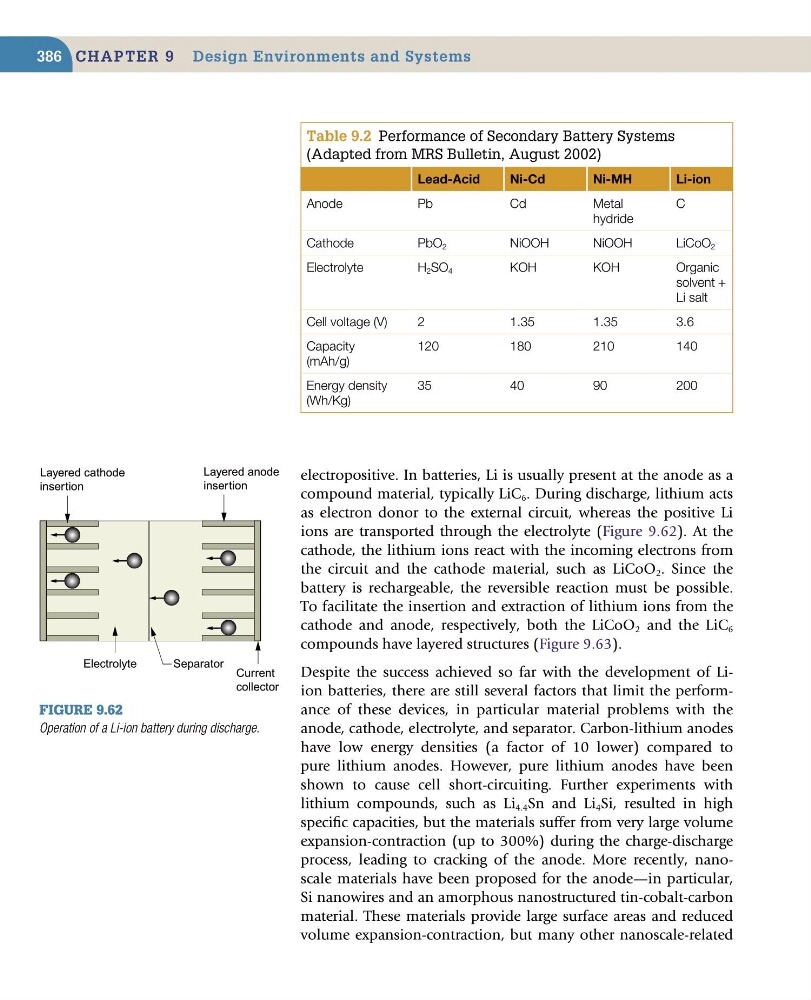
electropositive. In batteries, Li is usually present at the anode as a
compound material, typically LiC 6 . During discharge, lithium acts
as electron donor to the external circuit, whereas the positive Li
ions are transported through the electrolyte (Figure 9.62). At the
cathode, the lithium ions react with the incoming electrons from
the circuit and the cathode material, such as LiCoO 2 . Since the
battery is rechargeable, the reversible reaction must be possible.
To facilitate the insertion and extraction of lithium ions from the
cathode and anode, respectively, both the LiCoO 2 and the LiC 6
compounds have layered structures (Figure 9.63).
Despite the success achieved so far with the development of Liion batteries, there are still several factors that limit the performance of these devices, in particular material problems with the
anode, cathode, electrolyte, and separator. Carbon-lithium anodes
have low energy densities (a factor of 10 lower) compared to
pure lithium anodes. However, pure lithium anodes have been
shown to cause cell short-circuiting. Further experiments with
lithium compounds, such as Li 4.4 Sn and Li 4 Si, resulted in high
specific capacities, but the materials suffer from very large volume
expansion-contraction (up to 300%) during the charge-discharge
process, leading to cracking of the anode. More recently, nanoscale materials have been proposed for the anode—in particular,
Si nanowires and an amorphous nanostructured tin-cobalt-carbon
material. These materials provide large surface areas and reduced
volume expansion-contraction, but many other nanoscale-related
table 9.2 Performance of Secondary Battery Systems
(Adapted from MRS Bulletin, August 2002)
Lead-Acid
Ni-Cd
Ni-MH
Li-ion
Anode
Pb
Cd
Metal
hydride
C
Cathode
PbO 2
NiOOH
NiOOH
LiCoO 2
Electrolyte
H 2 SO 4
KOH
KOH
Organic
solvent +
Li salt
Cell voltage (V)
2
1.35
1.35
3.6
Capacity
(mAh/g)
120
180
210
140
Energy density
(Wh/Kg)
35
40
90
200
Figure 9.62
Operation of a Li-ion battery during discharge.
Electrolyte
Separator
Layered cathode
insertion
Current
collector
Layered anode
insertion
386
electropositive. In batteries, Li is usually present at the anode as a
compound material, typically LiC 6 . During discharge, lithium acts
as electron donor to the external circuit, whereas the positive Li
ions are transported through the electrolyte (Figure 9.62). At the
cathode, the lithium ions react with the incoming electrons from
the circuit and the cathode material, such as LiCoO 2 . Since the
battery is rechargeable, the reversible reaction must be possible.
To facilitate the insertion and extraction of lithium ions from the
cathode and anode, respectively, both the LiCoO 2 and the LiC 6
compounds have layered structures (Figure 9.63).
Despite the success achieved so far with the development of Liion batteries, there are still several factors that limit the performance of these devices, in particular material problems with the
anode, cathode, electrolyte, and separator. Carbon-lithium anodes
have low energy densities (a factor of 10 lower) compared to
pure lithium anodes. However, pure lithium anodes have been
shown to cause cell short-circuiting. Further experiments with
lithium compounds, such as Li 4.4 Sn and Li 4 Si, resulted in high
specific capacities, but the materials suffer from very large volume
expansion-contraction (up to 300%) during the charge-discharge
process, leading to cracking of the anode. More recently, nanoscale materials have been proposed for the anode—in particular,
Si nanowires and an amorphous nanostructured tin-cobalt-carbon
material. These materials provide large surface areas and reduced
volume expansion-contraction, but many other nanoscale-related
table 9.2 Performance of Secondary Battery Systems
(Adapted from MRS Bulletin, August 2002)
Lead-Acid
Ni-Cd
Ni-MH
Li-ion
Anode
Pb
Cd
Metal
hydride
C
Cathode
PbO 2
NiOOH
NiOOH
LiCoO 2
Electrolyte
H 2 SO 4
KOH
KOH
Organic
solvent +
Li salt
Cell voltage (V)
2
1.35
1.35
3.6
Capacity
(mAh/g)
120
180
210
140
Energy density
(Wh/Kg)
35
40
90
200
Figure 9.62
Operation of a Li-ion battery during discharge.
Electrolyte
Separator
Layered cathode
insertion
Current
collector
Layered anode
insertion