

C haptEr 9 design Environments and systems
388
has been some work in developing batteries based on sodium.
However, the low melting temperature of sodium has generated
several practical concerns.
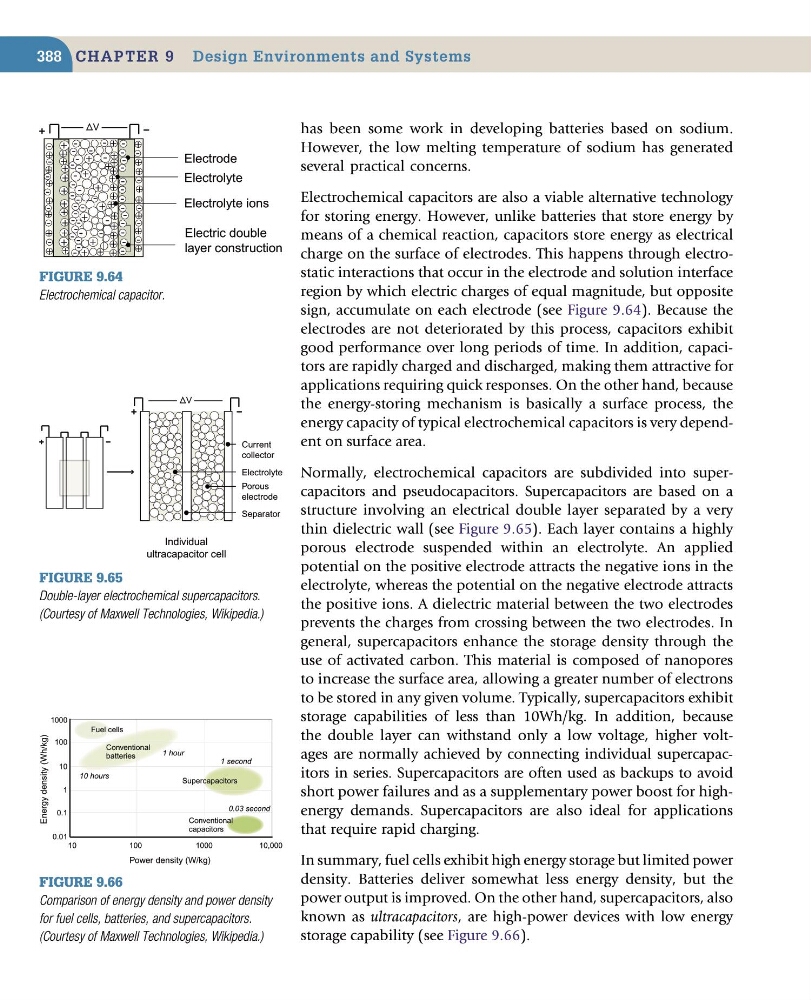
Electrochemical capacitors are also a viable alternative technology
for storing energy. However, unlike batteries that store energy by
means of a chemical reaction, capacitors store energy as electrical
charge on the surface of electrodes. This happens through electrostatic interactions that occur in the electrode and solution interface
region by which electric charges of equal magnitude, but opposite
sign, accumulate on each electrode (see Figure 9.64). Because the
electrodes are not deteriorated by this process, capacitors exhibit
good performance over long periods of time. In addition, capacitors are rapidly charged and discharged, making them attractive for
applications requiring quick responses. On the other hand, because
the energy-storing mechanism is basically a surface process, the
energy capacity of typical electrochemical capacitors is very dependent on surface area.
Normally, electrochemical capacitors are subdivided into supercapacitors and pseudocapacitors. Supercapacitors are based on a
structure involving an electrical double layer separated by a very
thin dielectric wall (see Figure 9.65). Each layer contains a highly
porous electrode suspended within an electrolyte. An applied
potential on the positive electrode attracts the negative ions in the
electrolyte, whereas the potential on the negative electrode attracts
the positive ions. A dielectric material between the two electrodes
prevents the charges from crossing between the two electrodes. In
general, supercapacitors enhance the storage density through the
use of activated carbon. This material is composed of nanopores
to increase the surface area, allowing a greater number of electrons
to be stored in any given volume. Typically, supercapacitors exhibit
storage capabilities of less than 10Wh/kg. In addition, because
the double layer can withstand only a low voltage, higher voltages are normally achieved by connecting individual supercapacitors in series. Supercapacitors are often used as backups to avoid
short power failures and as a supplementary power boost for highenergy demands. Supercapacitors are also ideal for applications
that require rapid charging.
In summary, fuel cells exhibit high energy storage but limited power
density. Batteries deliver somewhat less energy density, but the
power output is improved. On the other hand, supercapacitors, also
known as ultracapacitors, are high-power devices with low energy
storage capability (see Figure 9.66).
Figure 9.64
Electrochemical capacitor.
-
-
-
+ -
-
V
-
-
-
-
+
+
+
+ + -
-
+
-
-
-
-
-
-
-
-
-
-
-
+
+
+
+
+
+
+
+
+
+
+
-
-
-
-
-
-
-
-
-
-
-
+
+
+
+
-
-
-
-
-
-
-
-
-
+
+
+
+
+
+
-
-
Electrode
Electrolyte
Electrolyte ions
Electric double
layer construction
+
+
+
+
+
+
+
+
+
+
+
+
-
-
-
-
+
+
+
+ +
+
+
+
+
+
+
+
+
+
+
-
-
-
-
-
-
-
-
- -
-
-
-
Figure 9.65
Double-layer electrochemical supercapacitors.
(Courtesy of Maxwell Technologies, Wikipedia.)
Current
collector
Porous
electrode
Electrolyte
Separator
V
Individual
ultracapacitor cell
Figure 9.66
Comparison of energy density and power density
for fuel cells, batteries, and supercapacitors.
(Courtesy of Maxwell Technologies, Wikipedia.)
Conventional
capacitors
Supercapacitors
1 second
0.03 second
1 hour
Fuel cells
Conventional
batteries
10
100
1000
10,000
0.01
0.1
1
10
100
1000
Power density (W/kg)
Energy density (Wh/kg)
10 hours
388
has been some work in developing batteries based on sodium.
However, the low melting temperature of sodium has generated
several practical concerns.
Electrochemical capacitors are also a viable alternative technology
for storing energy. However, unlike batteries that store energy by
means of a chemical reaction, capacitors store energy as electrical
charge on the surface of electrodes. This happens through electrostatic interactions that occur in the electrode and solution interface
region by which electric charges of equal magnitude, but opposite
sign, accumulate on each electrode (see Figure 9.64). Because the
electrodes are not deteriorated by this process, capacitors exhibit
good performance over long periods of time. In addition, capacitors are rapidly charged and discharged, making them attractive for
applications requiring quick responses. On the other hand, because
the energy-storing mechanism is basically a surface process, the
energy capacity of typical electrochemical capacitors is very dependent on surface area.
Normally, electrochemical capacitors are subdivided into supercapacitors and pseudocapacitors. Supercapacitors are based on a
structure involving an electrical double layer separated by a very
thin dielectric wall (see Figure 9.65). Each layer contains a highly
porous electrode suspended within an electrolyte. An applied
potential on the positive electrode attracts the negative ions in the
electrolyte, whereas the potential on the negative electrode attracts
the positive ions. A dielectric material between the two electrodes
prevents the charges from crossing between the two electrodes. In
general, supercapacitors enhance the storage density through the
use of activated carbon. This material is composed of nanopores
to increase the surface area, allowing a greater number of electrons
to be stored in any given volume. Typically, supercapacitors exhibit
storage capabilities of less than 10Wh/kg. In addition, because
the double layer can withstand only a low voltage, higher voltages are normally achieved by connecting individual supercapacitors in series. Supercapacitors are often used as backups to avoid
short power failures and as a supplementary power boost for highenergy demands. Supercapacitors are also ideal for applications
that require rapid charging.
In summary, fuel cells exhibit high energy storage but limited power
density. Batteries deliver somewhat less energy density, but the
power output is improved. On the other hand, supercapacitors, also
known as ultracapacitors, are high-power devices with low energy
storage capability (see Figure 9.66).
Figure 9.64
Electrochemical capacitor.
-
-
-
+ -
-
V
-
-
-
-
+
+
+
+ + -
-
+
-
-
-
-
-
-
-
-
-
-
-
+
+
+
+
+
+
+
+
+
+
+
-
-
-
-
-
-
-
-
-
-
-
+
+
+
+
-
-
-
-
-
-
-
-
-
+
+
+
+
+
+
-
-
Electrode
Electrolyte
Electrolyte ions
Electric double
layer construction
+
+
+
+
+
+
+
+
+
+
+
+
-
-
-
-
+
+
+
+ +
+
+
+
+
+
+
+
+
+
+
-
-
-
-
-
-
-
-
- -
-
-
-
Figure 9.65
Double-layer electrochemical supercapacitors.
(Courtesy of Maxwell Technologies, Wikipedia.)
Current
collector
Porous
electrode
Electrolyte
Separator
V
Individual
ultracapacitor cell
Figure 9.66
Comparison of energy density and power density
for fuel cells, batteries, and supercapacitors.
(Courtesy of Maxwell Technologies, Wikipedia.)
Conventional
capacitors
Supercapacitors
1 second
0.03 second
1 hour
Fuel cells
Conventional
batteries
10
100
1000
10,000
0.01
0.1
1
10
100
1000
Power density (W/kg)
Energy density (Wh/kg)
10 hours