

C haptEr 9 design Environments and systems
384
high temperatures are being developed. PEMFCs are very good
candidates for transportation, personal electronics, and relatively
small stationary and portable power generation. For large-scale
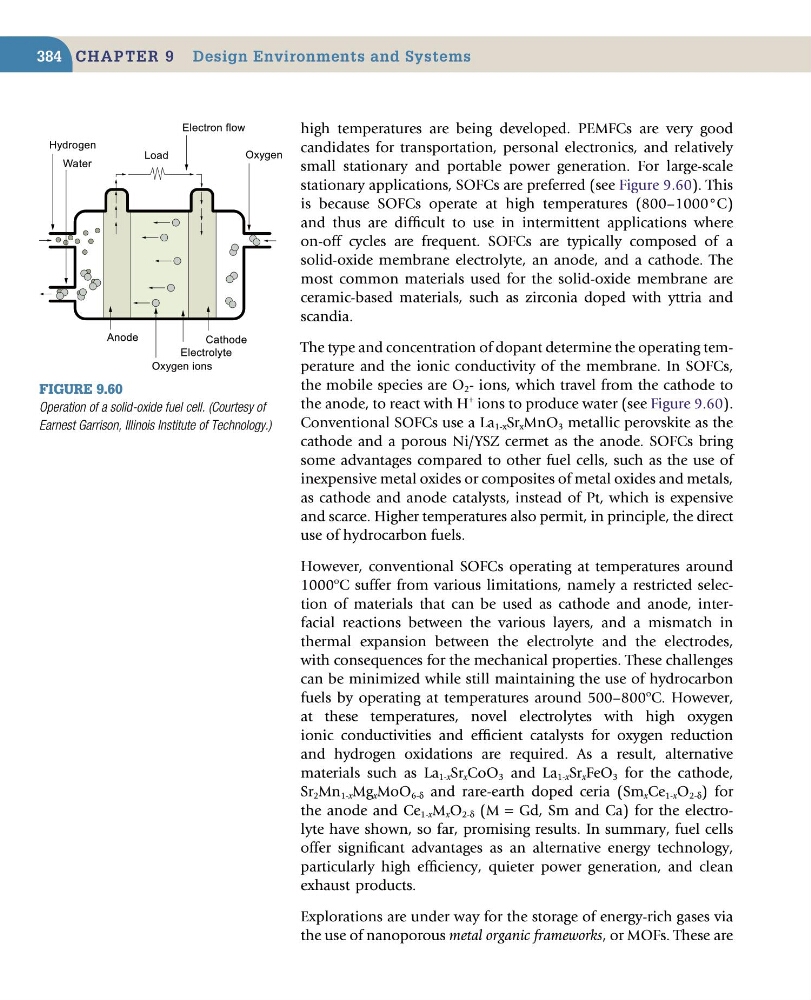
stationary applications, SOFCs are preferred (see Figure 9.60). This
is because SOFCs operate at high temperatures (800–1000°C)
and thus are difficult to use in intermittent applications where
on-off cycles are frequent. SOFCs are typically composed of a
solid-oxide membrane electrolyte, an anode, and a cathode. The
most common materials used for the solid-oxide membrane are
ceramic-based materials, such as zirconia doped with yttria and
scandia.
The type and concentration of dopant determine the operating temperature and the ionic conductivity of the membrane. In SOFCs,
the mobile species are O 2 - ions, which travel from the cathode to
the anode, to react with H
+ ions to produce water (see Figure 9.60).
Conventional SOFCs use a La 1-x Sr x MnO 3 metallic perovskite as the
cathode and a porous Ni/YSZ cermet as the anode. SOFCs bring
some advantages compared to other fuel cells, such as the use of
inexpensive metal oxides or composites of metal oxides and metals,
as cathode and anode catalysts, instead of Pt, which is expensive
and scarce. Higher temperatures also permit, in principle, the direct
use of hydrocarbon fuels.
However, conventional SOFCs operating at temperatures around
1000
o
C suffer from various limitations, namely a restricted selection of materials that can be used as cathode and anode, interfacial reactions between the various layers, and a mismatch in
thermal expansion between the electrolyte and the electrodes,
with consequences for the mechanical properties. These challenges
can be minimized while still maintaining the use of hydrocarbon
fuels by operating at temperatures around 500–800
o C. However,
at these temperatures, novel electrolytes with high oxygen
ionic conductivities and efficient catalysts for oxygen reduction
and hydrogen oxidations are required. As a result, alternative
materials such as La 1-x Sr x CoO 3 and La 1-x Sr x FeO 3 for the cathode,
Sr 2 Mn 1-x Mg x MoO 6-δ and rare-earth doped ceria (Sm x Ce 1-x O 2-δ ) for
the anode and Ce 1-x M x O 2-δ (M = Gd, Sm and Ca) for the electrolyte have shown, so far, promising results. In summary, fuel cells
offer significant advantages as an alternative energy technology,
particularly high efficiency, quieter power generation, and clean
exhaust products.
Explorations are under way for the storage of energy-rich gases via
the use of nanoporous metal organic frameworks, or MOFs. These are
Figure 9.60
Operation of a solid-oxide fuel cell. (Courtesy of
Earnest Garrison, Illinois Institute of Technology.)
Hydrogen
Water
Anode
Cathode
Electrolyte
Oxygen ions
Oxygen
Load
Electron flow
384
high temperatures are being developed. PEMFCs are very good
candidates for transportation, personal electronics, and relatively
small stationary and portable power generation. For large-scale
stationary applications, SOFCs are preferred (see Figure 9.60). This
is because SOFCs operate at high temperatures (800–1000°C)
and thus are difficult to use in intermittent applications where
on-off cycles are frequent. SOFCs are typically composed of a
solid-oxide membrane electrolyte, an anode, and a cathode. The
most common materials used for the solid-oxide membrane are
ceramic-based materials, such as zirconia doped with yttria and
scandia.
The type and concentration of dopant determine the operating temperature and the ionic conductivity of the membrane. In SOFCs,
the mobile species are O 2 - ions, which travel from the cathode to
the anode, to react with H
+ ions to produce water (see Figure 9.60).
Conventional SOFCs use a La 1-x Sr x MnO 3 metallic perovskite as the
cathode and a porous Ni/YSZ cermet as the anode. SOFCs bring
some advantages compared to other fuel cells, such as the use of
inexpensive metal oxides or composites of metal oxides and metals,
as cathode and anode catalysts, instead of Pt, which is expensive
and scarce. Higher temperatures also permit, in principle, the direct
use of hydrocarbon fuels.
However, conventional SOFCs operating at temperatures around
1000
o
C suffer from various limitations, namely a restricted selection of materials that can be used as cathode and anode, interfacial reactions between the various layers, and a mismatch in
thermal expansion between the electrolyte and the electrodes,
with consequences for the mechanical properties. These challenges
can be minimized while still maintaining the use of hydrocarbon
fuels by operating at temperatures around 500–800
o C. However,
at these temperatures, novel electrolytes with high oxygen
ionic conductivities and efficient catalysts for oxygen reduction
and hydrogen oxidations are required. As a result, alternative
materials such as La 1-x Sr x CoO 3 and La 1-x Sr x FeO 3 for the cathode,
Sr 2 Mn 1-x Mg x MoO 6-δ and rare-earth doped ceria (Sm x Ce 1-x O 2-δ ) for
the anode and Ce 1-x M x O 2-δ (M = Gd, Sm and Ca) for the electrolyte have shown, so far, promising results. In summary, fuel cells
offer significant advantages as an alternative energy technology,
particularly high efficiency, quieter power generation, and clean
exhaust products.
Explorations are under way for the storage of energy-rich gases via
the use of nanoporous metal organic frameworks, or MOFs. These are
Figure 9.60
Operation of a solid-oxide fuel cell. (Courtesy of
Earnest Garrison, Illinois Institute of Technology.)
Hydrogen
Water
Anode
Cathode
Electrolyte
Oxygen ions
Oxygen
Load
Electron flow