

383
membranes are quite thick, to prevent fuel crossover. However, for
applications in transportation, thinner membranes with higher
power density are preferred. In addition, typical membranes for
PEMFCs require hydration, which limits the operating temperature
of the fuel cell to around 80°C.
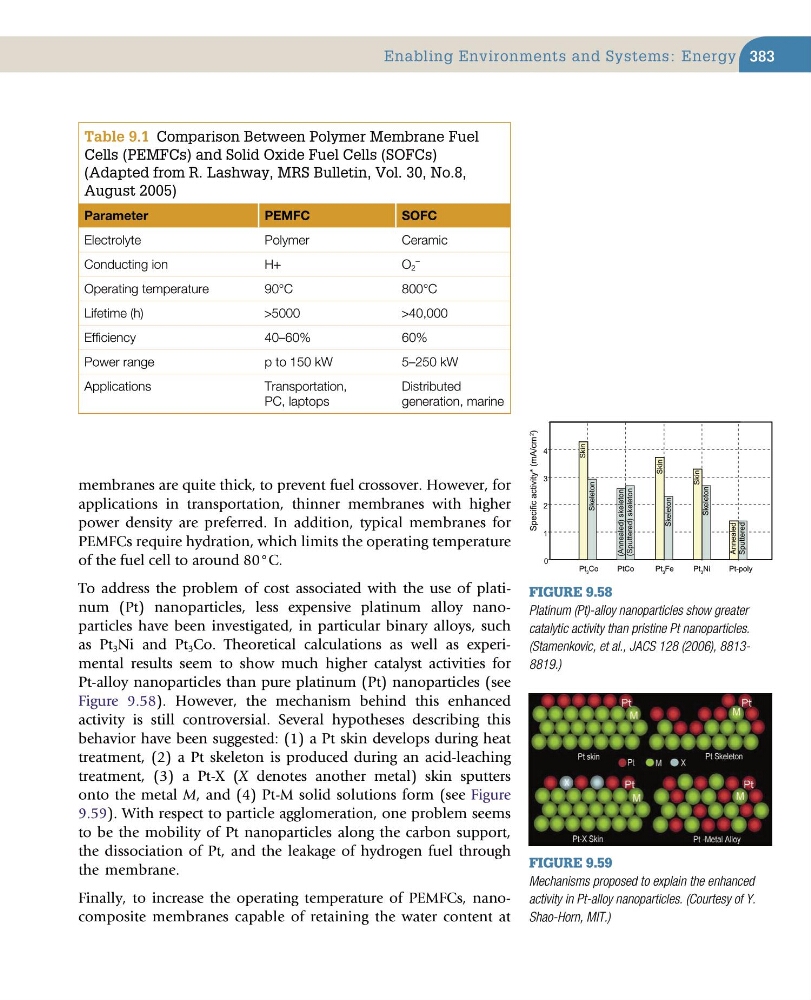
To address the problem of cost associated with the use of platinum (Pt) nanoparticles, less expensive platinum alloy nanoparticles have been investigated, in particular binary alloys, such
as Pt 3 Ni and Pt 3 Co. Theoretical calculations as well as experimental results seem to show much higher catalyst activities for
Pt-alloy nanoparticles than pure platinum (Pt) nanoparticles (see
Figure 9.58). However, the mechanism behind this enhanced
activity is still controversial. Several hypotheses describing this
behavior have been suggested: (1) a Pt skin develops during heat
treatment, (2) a Pt skeleton is produced during an acid-leaching
treatment, (3) a Pt-X (X denotes another metal) skin sputters
onto the metal M, and (4) Pt-M solid solutions form (see Figure
9.59). With respect to particle agglomeration, one problem seems
to be the mobility of Pt nanoparticles along the carbon support,
the dissociation of Pt, and the leakage of hydrogen fuel through
the membrane.
Finally, to increase the operating temperature of PEMFCs, nanocomposite membranes capable of retaining the water content at
table 9.1 Comparison Between Polymer Membrane Fuel
Cells (PEMFCs) and Solid Oxide Fuel Cells (SOFCs)
(Adapted from R. Lashway, MRS Bulletin, Vol. 30, No.8,
August 2005)
Parameter
PEMFC
SOFC
Electrolyte
Polymer
Ceramic
Conducting ion
H+
O 2
−
Operating temperature
90°C
800°C
Lifetime (h)
>5000
>40,000
Efficiency
40–60%
60%
Power range
p to 150 kW
5–250 kW
Applications
Transportation,
PC, laptops
Distributed
generation, marine
Figure 9.58
Platinum (Pt)-alloy nanoparticles show greater
catalytic activity than pristine Pt nanoparticles.
(Stamenkovic, et al., JACS 128 (2006), 88138819.)
0
1
2
3
4
Pt 3 Co
PtCo
Pt 3 Fe
Pt 3 Ni
Pt-poly
Specific activity* (mA/cm
2
)
Skeleton
Skeleton
Skeleton
(Annealed) skeleton
(Sputtered) skeleton
Annealed
Sputtered
Skin
Skin
Skin
Figure 9.59
Mechanisms proposed to explain the enhanced
activity in Pt-alloy nanoparticles. (Courtesy of Y.
Shao-Horn, MIT.)
Enabling Environments and Systems: Energy
membranes are quite thick, to prevent fuel crossover. However, for
applications in transportation, thinner membranes with higher
power density are preferred. In addition, typical membranes for
PEMFCs require hydration, which limits the operating temperature
of the fuel cell to around 80°C.
To address the problem of cost associated with the use of platinum (Pt) nanoparticles, less expensive platinum alloy nanoparticles have been investigated, in particular binary alloys, such
as Pt 3 Ni and Pt 3 Co. Theoretical calculations as well as experimental results seem to show much higher catalyst activities for
Pt-alloy nanoparticles than pure platinum (Pt) nanoparticles (see
Figure 9.58). However, the mechanism behind this enhanced
activity is still controversial. Several hypotheses describing this
behavior have been suggested: (1) a Pt skin develops during heat
treatment, (2) a Pt skeleton is produced during an acid-leaching
treatment, (3) a Pt-X (X denotes another metal) skin sputters
onto the metal M, and (4) Pt-M solid solutions form (see Figure
9.59). With respect to particle agglomeration, one problem seems
to be the mobility of Pt nanoparticles along the carbon support,
the dissociation of Pt, and the leakage of hydrogen fuel through
the membrane.
Finally, to increase the operating temperature of PEMFCs, nanocomposite membranes capable of retaining the water content at
table 9.1 Comparison Between Polymer Membrane Fuel
Cells (PEMFCs) and Solid Oxide Fuel Cells (SOFCs)
(Adapted from R. Lashway, MRS Bulletin, Vol. 30, No.8,
August 2005)
Parameter
PEMFC
SOFC
Electrolyte
Polymer
Ceramic
Conducting ion
H+
O 2
−
Operating temperature
90°C
800°C
Lifetime (h)
>5000
>40,000
Efficiency
40–60%
60%
Power range
p to 150 kW
5–250 kW
Applications
Transportation,
PC, laptops
Distributed
generation, marine
Figure 9.58
Platinum (Pt)-alloy nanoparticles show greater
catalytic activity than pristine Pt nanoparticles.
(Stamenkovic, et al., JACS 128 (2006), 88138819.)
0
1
2
3
4
Pt 3 Co
PtCo
Pt 3 Fe
Pt 3 Ni
Pt-poly
Specific activity* (mA/cm
2
)
Skeleton
Skeleton
Skeleton
(Annealed) skeleton
(Sputtered) skeleton
Annealed
Sputtered
Skin
Skin
Skin
Figure 9.59
Mechanisms proposed to explain the enhanced
activity in Pt-alloy nanoparticles. (Courtesy of Y.
Shao-Horn, MIT.)
Enabling Environments and Systems: Energy