

C haptEr 9 design Environments and systems
382
strates, and can be manufactured with high throughput rates at low
costs. Therefore, despite their moderate efficiencies of around 5%,
similar to conventional crystalline silicon, the low cost can make
organic photovoltaics an important technology in the near future.
Yet several challenges remain for organic photovoltaics to be considered truly matured—in particular the discovery of molecules
capable of absorbing a wider solar spectrum, the development of
nanoscale interfaces optimized for exciton decomposition, and
polymer stability.
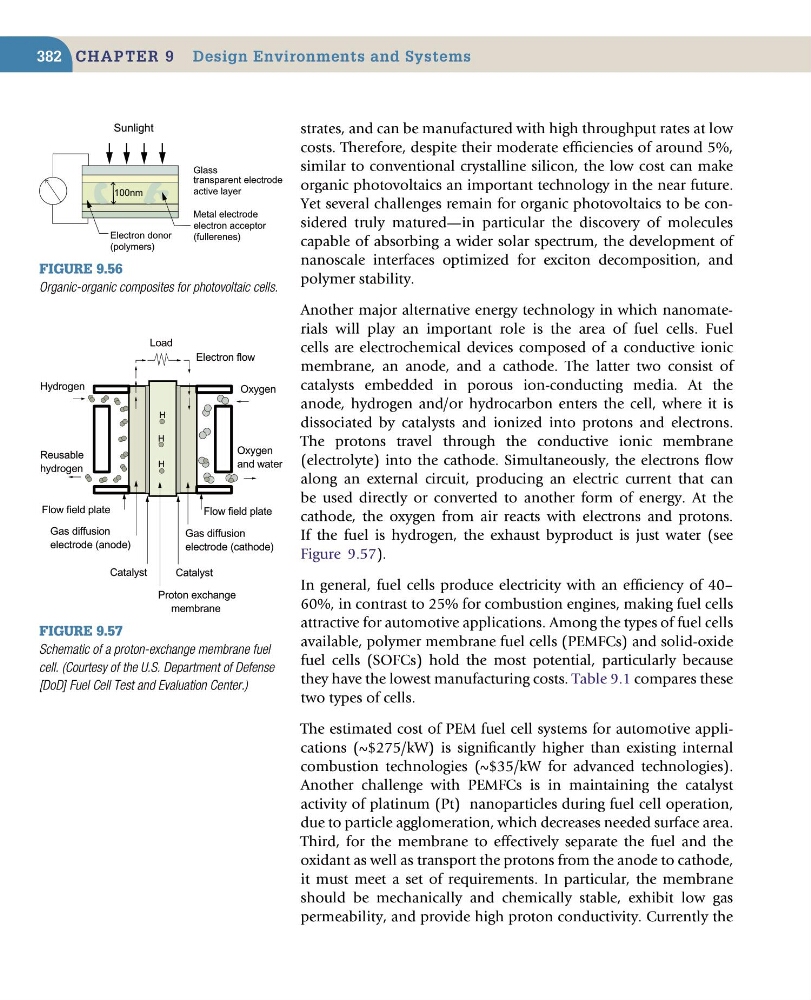
Another major alternative energy technology in which nanomaterials will play an important role is the area of fuel cells. Fuel
cells are electrochemical devices composed of a conductive ionic
membrane, an anode, and a cathode. The latter two consist of
catalysts embedded in porous ion-conducting media. At the
anode, hydrogen and/or hydrocarbon enters the cell, where it is
dissociated by catalysts and ionized into protons and electrons.
The protons travel through the conductive ionic membrane
(electrolyte) into the cathode. Simultaneously, the electrons flow
along an external circuit, producing an electric current that can
be used directly or converted to another form of energy. At the
cathode, the oxygen from air reacts with electrons and protons.
If the fuel is hydrogen, the exhaust byproduct is just water (see
Figure 9.57).
In general, fuel cells produce electricity with an efficiency of 40–
60%, in contrast to 25% for combustion engines, making fuel cells
attractive for automotive applications. Among the types of fuel cells
available, polymer membrane fuel cells (PEMFCs) and solid-oxide
fuel cells (SOFCs) hold the most potential, particularly because
they have the lowest manufacturing costs. Table 9.1 compares these
two types of cells.
The estimated cost of PEM fuel cell systems for automotive applications (~$275/kW) is significantly higher than existing internal
combustion technologies (~$35/kW for advanced technologies).
Another challenge with PEMFCs is in maintaining the catalyst
activity of platinum (Pt) nanoparticles during fuel cell operation,
due to particle agglomeration, which decreases needed surface area.
Third, for the membrane to effectively separate the fuel and the
oxidant as well as transport the protons from the anode to cathode,
it must meet a set of requirements. In particular, the membrane
should be mechanically and chemically stable, exhibit low gas
permeability, and provide high proton conductivity. Currently the
Figure 9.56
Organic-organic composites for photovoltaic cells.
Sunlight
active layer
Electron donor
(polymers)
electron acceptor
(fullerenes)
transparent electrode
Glass
Metal electrode
100nm
Figure 9.57
Schematic of a proton-exchange membrane fuel
cell. (Courtesy of the U.S. Department of Defense
[DoD] Fuel Cell Test and Evaluation Center.)
Hydrogen
H
H
H
Reusable
hydrogen
Flow field plate
Flow field plate
Catalyst
Catalyst
Oxygen
and water
Gas diffusion
electrode (anode)
Gas diffusion
electrode (cathode)
Proton exchange
membrane
Oxygen
Load
Electron flow
382
strates, and can be manufactured with high throughput rates at low
costs. Therefore, despite their moderate efficiencies of around 5%,
similar to conventional crystalline silicon, the low cost can make
organic photovoltaics an important technology in the near future.
Yet several challenges remain for organic photovoltaics to be considered truly matured—in particular the discovery of molecules
capable of absorbing a wider solar spectrum, the development of
nanoscale interfaces optimized for exciton decomposition, and
polymer stability.
Another major alternative energy technology in which nanomaterials will play an important role is the area of fuel cells. Fuel
cells are electrochemical devices composed of a conductive ionic
membrane, an anode, and a cathode. The latter two consist of
catalysts embedded in porous ion-conducting media. At the
anode, hydrogen and/or hydrocarbon enters the cell, where it is
dissociated by catalysts and ionized into protons and electrons.
The protons travel through the conductive ionic membrane
(electrolyte) into the cathode. Simultaneously, the electrons flow
along an external circuit, producing an electric current that can
be used directly or converted to another form of energy. At the
cathode, the oxygen from air reacts with electrons and protons.
If the fuel is hydrogen, the exhaust byproduct is just water (see
Figure 9.57).
In general, fuel cells produce electricity with an efficiency of 40–
60%, in contrast to 25% for combustion engines, making fuel cells
attractive for automotive applications. Among the types of fuel cells
available, polymer membrane fuel cells (PEMFCs) and solid-oxide
fuel cells (SOFCs) hold the most potential, particularly because
they have the lowest manufacturing costs. Table 9.1 compares these
two types of cells.
The estimated cost of PEM fuel cell systems for automotive applications (~$275/kW) is significantly higher than existing internal
combustion technologies (~$35/kW for advanced technologies).
Another challenge with PEMFCs is in maintaining the catalyst
activity of platinum (Pt) nanoparticles during fuel cell operation,
due to particle agglomeration, which decreases needed surface area.
Third, for the membrane to effectively separate the fuel and the
oxidant as well as transport the protons from the anode to cathode,
it must meet a set of requirements. In particular, the membrane
should be mechanically and chemically stable, exhibit low gas
permeability, and provide high proton conductivity. Currently the
Figure 9.56
Organic-organic composites for photovoltaic cells.
Sunlight
active layer
Electron donor
(polymers)
electron acceptor
(fullerenes)
transparent electrode
Glass
Metal electrode
100nm
Figure 9.57
Schematic of a proton-exchange membrane fuel
cell. (Courtesy of the U.S. Department of Defense
[DoD] Fuel Cell Test and Evaluation Center.)
Hydrogen
H
H
H
Reusable
hydrogen
Flow field plate
Flow field plate
Catalyst
Catalyst
Oxygen
and water
Gas diffusion
electrode (anode)
Gas diffusion
electrode (cathode)
Proton exchange
membrane
Oxygen
Load
Electron flow