

381
niques used to produce amorphous silicon are the same used for
obtaining micro- or nanocrystalline structures, combinations of
these amorphous/micro/nanostructures are now being investigated.
Despite these developments, the synthesis of these materials is still
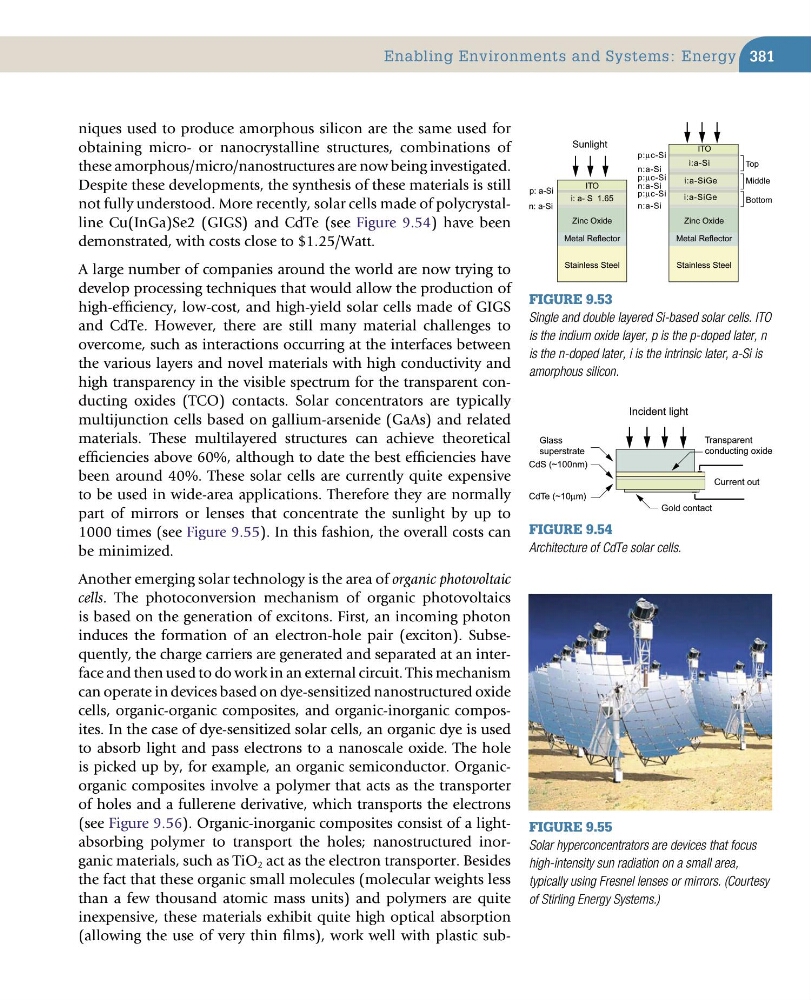
not fully understood. More recently, solar cells made of polycrystalline Cu(InGa)Se2 (GIGS) and CdTe (see Figure 9.54) have been
demonstrated, with costs close to $1.25/Watt.
A large number of companies around the world are now trying to
develop processing techniques that would allow the production of
high-efficiency, low-cost, and high-yield solar cells made of GIGS
and CdTe. However, there are still many material challenges to
overcome, such as interactions occurring at the interfaces between
the various layers and novel materials with high conductivity and
high transparency in the visible spectrum for the transparent conducting oxides (TCO) contacts. Solar concentrators are typically
multijunction cells based on gallium-arsenide (GaAs) and related
materials. These multilayered structures can achieve theoretical
efficiencies above 60%, although to date the best efficiencies have
been around 40%. These solar cells are currently quite expensive
to be used in wide-area applications. Therefore they are normally
part of mirrors or lenses that concentrate the sunlight by up to
1000 times (see Figure 9.55). In this fashion, the overall costs can
be minimized.
Another emerging solar technology is the area of organic photovoltaic
cells. The photoconversion mechanism of organic photovoltaics
is based on the generation of excitons. First, an incoming photon
induces the formation of an electron-hole pair (exciton). Subsequently, the charge carriers are generated and separated at an interface and then used to do work in an external circuit. This mechanism
can operate in devices based on dye-sensitized nanostructured oxide
cells, organic-organic composites, and organic-inorganic composites. In the case of dye-sensitized solar cells, an organic dye is used
to absorb light and pass electrons to a nanoscale oxide. The hole
is picked up by, for example, an organic semiconductor. Organicorganic composites involve a polymer that acts as the transporter
of holes and a fullerene derivative, which transports the electrons
(see Figure 9.56). Organic-inorganic composites consist of a lightabsorbing polymer to transport the holes; nanostructured inorganic materials, such as TiO 2 act as the electron transporter. Besides
the fact that these organic small molecules (molecular weights less
than a few thousand atomic mass units) and polymers are quite
inexpensive, these materials exhibit quite high optical absorption
(allowing the use of very thin films), work well with plastic subFigure 9.53
Single and double layered Si-based solar cells. ITO
is the indium oxide layer, p is the p-doped later, n
is the n-doped later, i is the intrinsic later, a-Si is
amorphous silicon.
Stainless Steel
Metal Reflector
Zinc Oxide
Stainless Steel
Metal Reflector
Zinc Oxide
Top
Middle
Bottom
i: a- S 1.65
p: a-Si
n: a-Si
ITO
ITO
Sunlight
i:a-Si
i:a-SiGe
i:a-SiGe
p:µc-Si
n:a-Si
p:µc-Si
n:a-Si
p:µc-Si
n:a-Si
Figure 9.54
Architecture of CdTe solar cells.
Gold contact
CdTe (~10µm)
CdS (~100nm)
Glass
superstrate
Incident light
Transparent
conducting oxide
Current out
Figure 9.55
Solar hyperconcentrators are devices that focus
high-intensity sun radiation on a small area,
typically using Fresnel lenses or mirrors. (Courtesy
of Stirling Energy Systems.)
Enabling Environments and Systems: Energy
niques used to produce amorphous silicon are the same used for
obtaining micro- or nanocrystalline structures, combinations of
these amorphous/micro/nanostructures are now being investigated.
Despite these developments, the synthesis of these materials is still
not fully understood. More recently, solar cells made of polycrystalline Cu(InGa)Se2 (GIGS) and CdTe (see Figure 9.54) have been
demonstrated, with costs close to $1.25/Watt.
A large number of companies around the world are now trying to
develop processing techniques that would allow the production of
high-efficiency, low-cost, and high-yield solar cells made of GIGS
and CdTe. However, there are still many material challenges to
overcome, such as interactions occurring at the interfaces between
the various layers and novel materials with high conductivity and
high transparency in the visible spectrum for the transparent conducting oxides (TCO) contacts. Solar concentrators are typically
multijunction cells based on gallium-arsenide (GaAs) and related
materials. These multilayered structures can achieve theoretical
efficiencies above 60%, although to date the best efficiencies have
been around 40%. These solar cells are currently quite expensive
to be used in wide-area applications. Therefore they are normally
part of mirrors or lenses that concentrate the sunlight by up to
1000 times (see Figure 9.55). In this fashion, the overall costs can
be minimized.
Another emerging solar technology is the area of organic photovoltaic
cells. The photoconversion mechanism of organic photovoltaics
is based on the generation of excitons. First, an incoming photon
induces the formation of an electron-hole pair (exciton). Subsequently, the charge carriers are generated and separated at an interface and then used to do work in an external circuit. This mechanism
can operate in devices based on dye-sensitized nanostructured oxide
cells, organic-organic composites, and organic-inorganic composites. In the case of dye-sensitized solar cells, an organic dye is used
to absorb light and pass electrons to a nanoscale oxide. The hole
is picked up by, for example, an organic semiconductor. Organicorganic composites involve a polymer that acts as the transporter
of holes and a fullerene derivative, which transports the electrons
(see Figure 9.56). Organic-inorganic composites consist of a lightabsorbing polymer to transport the holes; nanostructured inorganic materials, such as TiO 2 act as the electron transporter. Besides
the fact that these organic small molecules (molecular weights less
than a few thousand atomic mass units) and polymers are quite
inexpensive, these materials exhibit quite high optical absorption
(allowing the use of very thin films), work well with plastic subFigure 9.53
Single and double layered Si-based solar cells. ITO
is the indium oxide layer, p is the p-doped later, n
is the n-doped later, i is the intrinsic later, a-Si is
amorphous silicon.
Stainless Steel
Metal Reflector
Zinc Oxide
Stainless Steel
Metal Reflector
Zinc Oxide
Top
Middle
Bottom
i: a- S 1.65
p: a-Si
n: a-Si
ITO
ITO
Sunlight
i:a-Si
i:a-SiGe
i:a-SiGe
p:µc-Si
n:a-Si
p:µc-Si
n:a-Si
p:µc-Si
n:a-Si
Figure 9.54
Architecture of CdTe solar cells.
Gold contact
CdTe (~10µm)
CdS (~100nm)
Glass
superstrate
Incident light
Transparent
conducting oxide
Current out
Figure 9.55
Solar hyperconcentrators are devices that focus
high-intensity sun radiation on a small area,
typically using Fresnel lenses or mirrors. (Courtesy
of Stirling Energy Systems.)
Enabling Environments and Systems: Energy