

361
The performance of many types of basic technologies in wide use,
such as LCDs, can be enhanced by the use of nanomaterials and
nanotechnologies, as discussed shortly. In all these approaches,
many related technologies are invariably involved. Thus the many
kinds of light-control films we’ve previously discussed will find
wide use in displays of any type to enhance viewing, such as the use
of antireflective coatings. Various nanophosphors also have many
optical properties that make them attractive for use in many types
of display technologies, particularly flexible screens.
Liquid crystal displays (LCDs) are widely used in product display
screens. They can also be used in larger sizes as transparency control
technology for “privacy” windows and related applications. LCDs
have electrically activated color-changing liquid crystals sandwiched
between two transparent sheets. Liquid crystals are an intermediate
phase or state between isotropic liquids and crystalline solids. Not
all materials exhibit liquid crystal phases; for example, the transitions from ice to water to vapor do not, whereas several organic
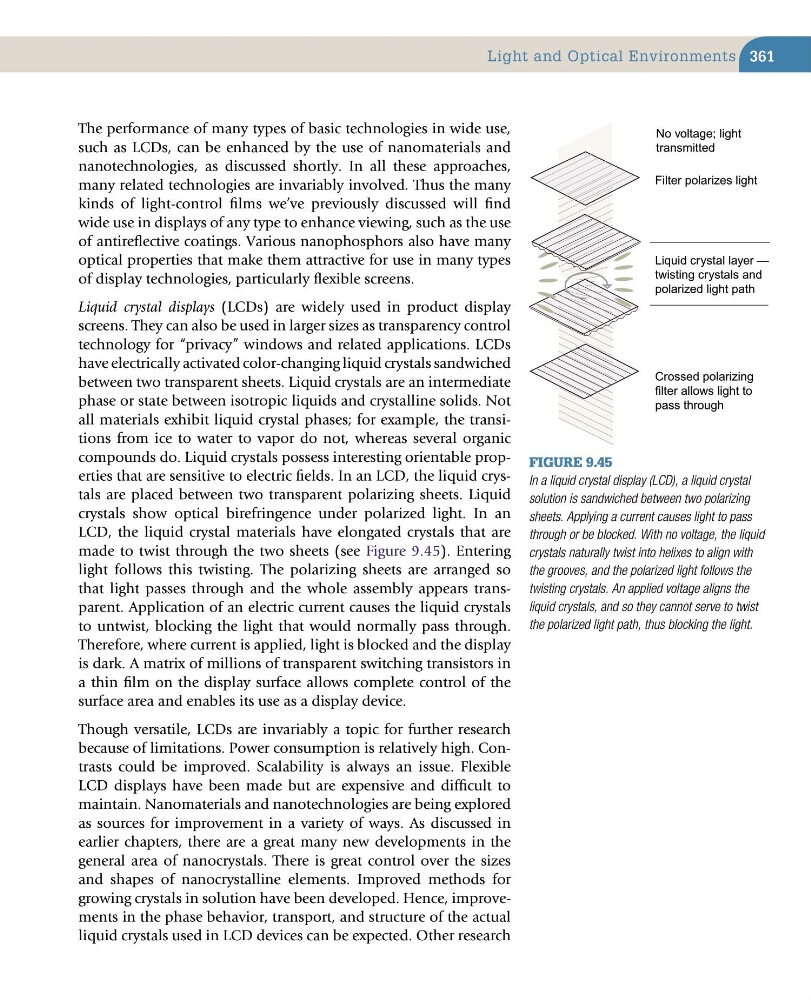
compounds do. Liquid crystals possess interesting orientable properties that are sensitive to electric fields. In an LCD, the liquid crystals are placed between two transparent polarizing sheets. Liquid
crystals show optical birefringence under polarized light. In an
LCD, the liquid crystal materials have elongated crystals that are
made to twist through the two sheets (see Figure 9.45). Entering
light follows this twisting. The polarizing sheets are arranged so
that light passes through and the whole assembly appears transparent. Application of an electric current causes the liquid crystals
to untwist, blocking the light that would normally pass through.
Therefore, where current is applied, light is blocked and the display
is dark. A matrix of millions of transparent switching transistors in
a thin film on the display surface allows complete control of the
surface area and enables its use as a display device.
Though versatile, LCDs are invariably a topic for further research
because of limitations. Power consumption is relatively high. Contrasts could be improved. Scalability is always an issue. Flexible
LCD displays have been made but are expensive and difficult to
maintain. Nanomaterials and nanotechnologies are being explored
as sources for improvement in a variety of ways. As discussed in
earlier chapters, there are a great many new developments in the
general area of nanocrystals. There is great control over the sizes
and shapes of nanocrystalline elements. Improved methods for
growing crystals in solution have been developed. Hence, improvements in the phase behavior, transport, and structure of the actual
liquid crystals used in LCD devices can be expected. Other research
Figure 9.45
In a liquid crystal display (LCD), a liquid crystal
solution is sandwiched between two polarizing
sheets. Applying a current causes light to pass
through or be blocked. With no voltage, the liquid
crystals naturally twist into helixes to align with
the grooves, and the polarized light follows the
twisting crystals. An applied voltage aligns the
liquid crystals, and so they cannot serve to twist
the polarized light path, thus blocking the light.
Liquid crystal layer —
twisting crystals and
polarized light path
Filter polarizes light
Crossed polarizing
filter allows light to
pass through
No voltage; light
transmitted
Light and Optical Environments
The performance of many types of basic technologies in wide use,
such as LCDs, can be enhanced by the use of nanomaterials and
nanotechnologies, as discussed shortly. In all these approaches,
many related technologies are invariably involved. Thus the many
kinds of light-control films we’ve previously discussed will find
wide use in displays of any type to enhance viewing, such as the use
of antireflective coatings. Various nanophosphors also have many
optical properties that make them attractive for use in many types
of display technologies, particularly flexible screens.
Liquid crystal displays (LCDs) are widely used in product display
screens. They can also be used in larger sizes as transparency control
technology for “privacy” windows and related applications. LCDs
have electrically activated color-changing liquid crystals sandwiched
between two transparent sheets. Liquid crystals are an intermediate
phase or state between isotropic liquids and crystalline solids. Not
all materials exhibit liquid crystal phases; for example, the transitions from ice to water to vapor do not, whereas several organic
compounds do. Liquid crystals possess interesting orientable properties that are sensitive to electric fields. In an LCD, the liquid crystals are placed between two transparent polarizing sheets. Liquid
crystals show optical birefringence under polarized light. In an
LCD, the liquid crystal materials have elongated crystals that are
made to twist through the two sheets (see Figure 9.45). Entering
light follows this twisting. The polarizing sheets are arranged so
that light passes through and the whole assembly appears transparent. Application of an electric current causes the liquid crystals
to untwist, blocking the light that would normally pass through.
Therefore, where current is applied, light is blocked and the display
is dark. A matrix of millions of transparent switching transistors in
a thin film on the display surface allows complete control of the
surface area and enables its use as a display device.
Though versatile, LCDs are invariably a topic for further research
because of limitations. Power consumption is relatively high. Contrasts could be improved. Scalability is always an issue. Flexible
LCD displays have been made but are expensive and difficult to
maintain. Nanomaterials and nanotechnologies are being explored
as sources for improvement in a variety of ways. As discussed in
earlier chapters, there are a great many new developments in the
general area of nanocrystals. There is great control over the sizes
and shapes of nanocrystalline elements. Improved methods for
growing crystals in solution have been developed. Hence, improvements in the phase behavior, transport, and structure of the actual
liquid crystals used in LCD devices can be expected. Other research
Figure 9.45
In a liquid crystal display (LCD), a liquid crystal
solution is sandwiched between two polarizing
sheets. Applying a current causes light to pass
through or be blocked. With no voltage, the liquid
crystals naturally twist into helixes to align with
the grooves, and the polarized light follows the
twisting crystals. An applied voltage aligns the
liquid crystals, and so they cannot serve to twist
the polarized light path, thus blocking the light.
Liquid crystal layer —
twisting crystals and
polarized light path
Filter polarizes light
Crossed polarizing
filter allows light to
pass through
No voltage; light
transmitted
Light and Optical Environments