

C haptEr 9 design Environments and systems
362
is directed toward the surrounding polarizing sheets. As discussed,
the use of nanotechnologies is expected to increase our ability to
polarize sheets and hence improve LCD performances. Scalability
is particularly a goal that can be helped by developments in this
area.
Given their status and widespread use as well as their limitations,
LCDs are often cited as the display technology to be beat or the
target for disruptive technologies. Despite their many faults, including their complexity and cumbersomeness, LCDs still unquestionably remain one of the great workhorses of our electronic product
world.
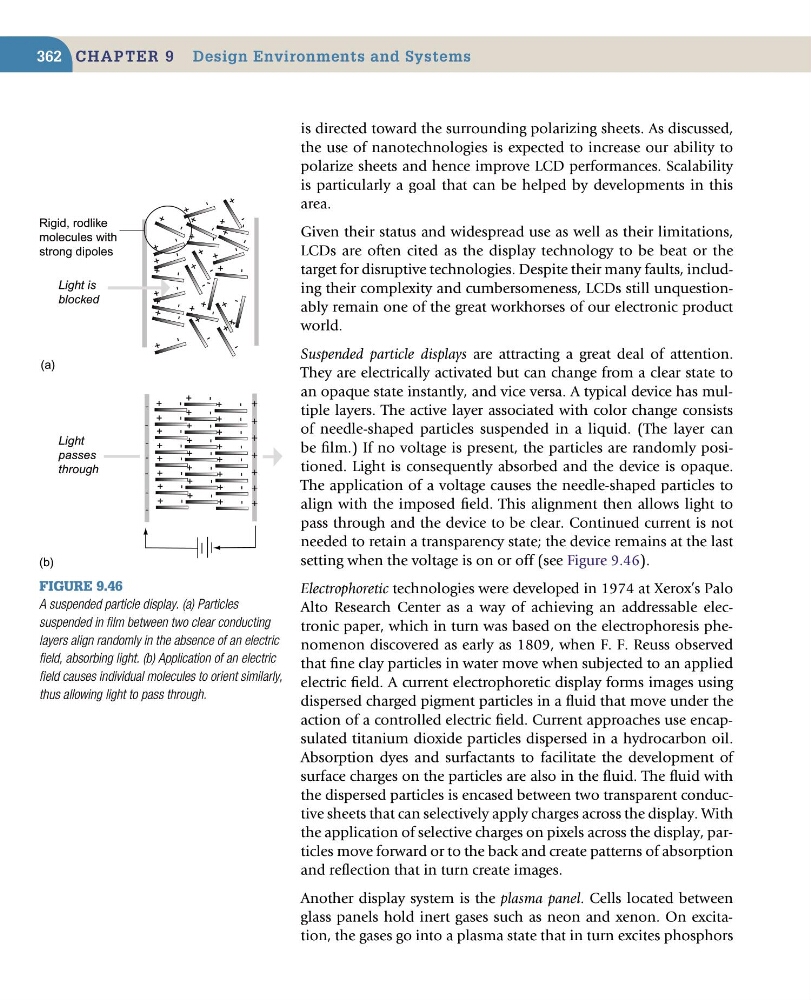
Suspended particle displays are attracting a great deal of attention.
They are electrically activated but can change from a clear state to
an opaque state instantly, and vice versa. A typical device has multiple layers. The active layer associated with color change consists
of needle-shaped particles suspended in a liquid. (The layer can
be film.) If no voltage is present, the particles are randomly positioned. Light is consequently absorbed and the device is opaque.
The application of a voltage causes the needle-shaped particles to
align with the imposed field. This alignment then allows light to
pass through and the device to be clear. Continued current is not
needed to retain a transparency state; the device remains at the last
setting when the voltage is on or off (see Figure 9.46).
Electrophoretic technologies were developed in 1974 at Xerox’s Palo
Alto Research Center as a way of achieving an addressable electronic paper, which in turn was based on the electrophoresis phenomenon discovered as early as 1809, when F. F. Reuss observed
that fine clay particles in water move when subjected to an applied
electric field. A current electrophoretic display forms images using
dispersed charged pigment particles in a fluid that move under the
action of a controlled electric field. Current approaches use encapsulated titanium dioxide particles dispersed in a hydrocarbon oil.
Absorption dyes and surfactants to facilitate the development of
surface charges on the particles are also in the fluid. The fluid with
the dispersed particles is encased between two transparent conductive sheets that can selectively apply charges across the display. With
the application of selective charges on pixels across the display, particles move forward or to the back and create patterns of absorption
and reflection that in turn create images.
Another display system is the plasma panel. Cells located between
glass panels hold inert gases such as neon and xenon. On excitation, the gases go into a plasma state that in turn excites phosphors
Figure 9.46
A suspended particle display. (a) Particles
suspended in film between two clear conducting
layers align randomly in the absence of an electric
field, absorbing light. (b) Application of an electric
field causes individual molecules to orient similarly,
thus allowing light to pass through.
+
-
+
-
+
-
+
-
+
-
+
-
+
-
+
-
+
-
+
-
+
-
+
-
+
-
+
-
+
-
+
-
+
-
+
-
+
-
+
-
+
-
+
-
+
-
+
-
Light is
blocked
Rigid, rodlike
molecules with
strong dipoles
(b)
(a)
+
-
+
-
+
-
+
-
+
-
+
-
+
-
+
-
+
-
+
-
+
-
+
-
+
-
+
-
+
-
+
-
+
-
+
-
+
-
+
-
+
-
+
-
+
-
+
-
Light
passes
through
+
+
+
+
+
+
+
-
-
-
-
-
-
-
362
is directed toward the surrounding polarizing sheets. As discussed,
the use of nanotechnologies is expected to increase our ability to
polarize sheets and hence improve LCD performances. Scalability
is particularly a goal that can be helped by developments in this
area.
Given their status and widespread use as well as their limitations,
LCDs are often cited as the display technology to be beat or the
target for disruptive technologies. Despite their many faults, including their complexity and cumbersomeness, LCDs still unquestionably remain one of the great workhorses of our electronic product
world.
Suspended particle displays are attracting a great deal of attention.
They are electrically activated but can change from a clear state to
an opaque state instantly, and vice versa. A typical device has multiple layers. The active layer associated with color change consists
of needle-shaped particles suspended in a liquid. (The layer can
be film.) If no voltage is present, the particles are randomly positioned. Light is consequently absorbed and the device is opaque.
The application of a voltage causes the needle-shaped particles to
align with the imposed field. This alignment then allows light to
pass through and the device to be clear. Continued current is not
needed to retain a transparency state; the device remains at the last
setting when the voltage is on or off (see Figure 9.46).
Electrophoretic technologies were developed in 1974 at Xerox’s Palo
Alto Research Center as a way of achieving an addressable electronic paper, which in turn was based on the electrophoresis phenomenon discovered as early as 1809, when F. F. Reuss observed
that fine clay particles in water move when subjected to an applied
electric field. A current electrophoretic display forms images using
dispersed charged pigment particles in a fluid that move under the
action of a controlled electric field. Current approaches use encapsulated titanium dioxide particles dispersed in a hydrocarbon oil.
Absorption dyes and surfactants to facilitate the development of
surface charges on the particles are also in the fluid. The fluid with
the dispersed particles is encased between two transparent conductive sheets that can selectively apply charges across the display. With
the application of selective charges on pixels across the display, particles move forward or to the back and create patterns of absorption
and reflection that in turn create images.
Another display system is the plasma panel. Cells located between
glass panels hold inert gases such as neon and xenon. On excitation, the gases go into a plasma state that in turn excites phosphors
Figure 9.46
A suspended particle display. (a) Particles
suspended in film between two clear conducting
layers align randomly in the absence of an electric
field, absorbing light. (b) Application of an electric
field causes individual molecules to orient similarly,
thus allowing light to pass through.
+
-
+
-
+
-
+
-
+
-
+
-
+
-
+
-
+
-
+
-
+
-
+
-
+
-
+
-
+
-
+
-
+
-
+
-
+
-
+
-
+
-
+
-
+
-
+
-
Light is
blocked
Rigid, rodlike
molecules with
strong dipoles
(b)
(a)
+
-
+
-
+
-
+
-
+
-
+
-
+
-
+
-
+
-
+
-
+
-
+
-
+
-
+
-
+
-
+
-
+
-
+
-
+
-
+
-
+
-
+
-
+
-
+
-
Light
passes
through
+
+
+
+
+
+
+
-
-
-
-
-
-
-