

C haptEr 9 design Environments and systems
360
a nation’s energy use, the potential energy savings that would accrue
from dramatically improving efficiencies could also go a long way
toward remedying some of our energy problems. In the United
States, electricity for artificial lighting now accounts for around one
fifth of the nation’s electricity use and nearly a tenth of the nation’s
total energy use. The opportunities afforded by improvements in
form factors will also undoubtedly make these same solutions far
more likely to be adopted and used by designers in the future.
displays, screens, and Electronic papers
Displays are ubiquitously present in everything from TVs and computers to a host of product control screens and larger information
conveyance devices. It is obvious that huge amounts of research
and development work have not only brought display technologies
to an already high level of sophistication but that driving forces
in the industry will seek to use the many affordances provided by
nanomaterials to achieve even higher levels of sophistication. Largeformat screens are certainly sought after. Electronic papers—devices
that seek to replace the ancient printed page—have been under
development for years and have begun to achieve wider adoption.
Collectively, this field is extremely large and beyond the scope of
this book. We review only a few primary approaches here.
Display design issues include viewable size, viewing angles, response
rates, contrast and brightness ratios, color fidelity and registration, spectrum coverage, image persistence, ghosting, geometric
distortion, power consumption, size and weight, and costs. Flatscreen technologies include liquid crystal displays (LCDs), plasma
devices, suspended particle displays, electrochromic displays, electrophoretic displays, and, more recently, possibly thermochromic
displays. All require, of course, highly sophisticated and active electronic control systems to allow the color, contrast, or transparency
changes that are necessary across a screen to enable the formation
of images or text.
Electronic paper approaches normally have some similar issues relating to the quality of image (color fidelity, contrast, and brightness),
but response rates are less critical. An additional goal for these portable devices is to be able to hold text and images with no or very
low power consumption and to change images with very low power.
Flexible displays are usually considered essential for electronic
papers. Electronic papers are explored not only as book replacements but also for point-of-purchase store display tags and virtually
everywhere print-on paper now appears.
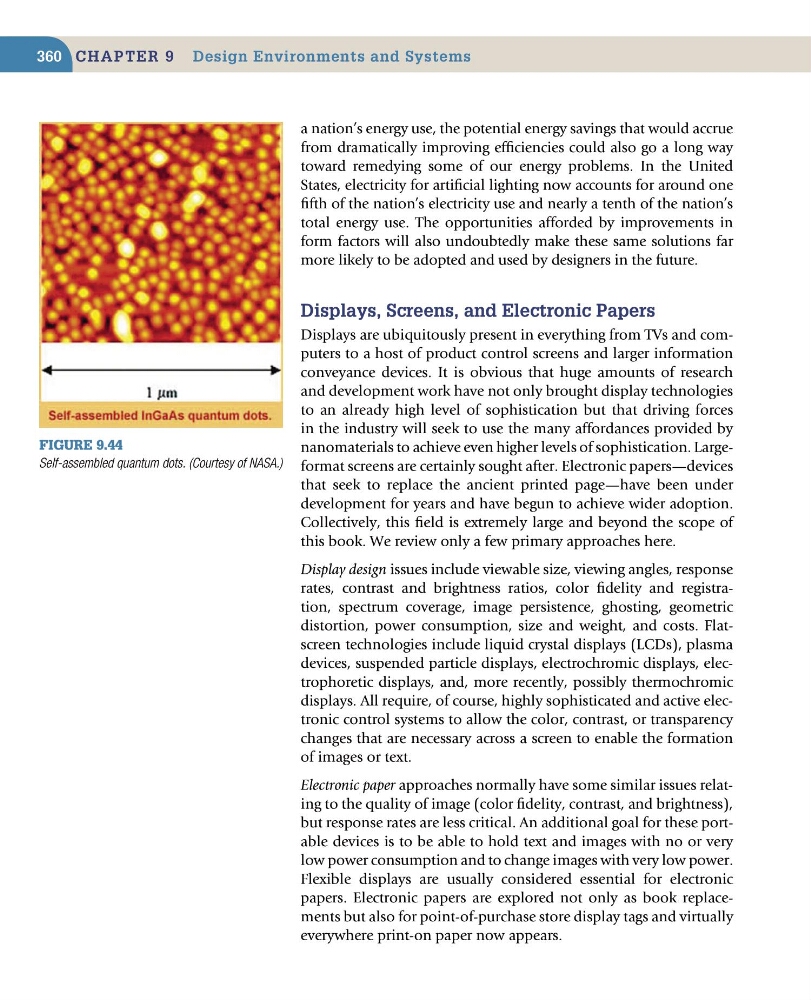
Figure 9.44
Self-assembled quantum dots. (Courtesy of NASA.)
360
a nation’s energy use, the potential energy savings that would accrue
from dramatically improving efficiencies could also go a long way
toward remedying some of our energy problems. In the United
States, electricity for artificial lighting now accounts for around one
fifth of the nation’s electricity use and nearly a tenth of the nation’s
total energy use. The opportunities afforded by improvements in
form factors will also undoubtedly make these same solutions far
more likely to be adopted and used by designers in the future.
displays, screens, and Electronic papers
Displays are ubiquitously present in everything from TVs and computers to a host of product control screens and larger information
conveyance devices. It is obvious that huge amounts of research
and development work have not only brought display technologies
to an already high level of sophistication but that driving forces
in the industry will seek to use the many affordances provided by
nanomaterials to achieve even higher levels of sophistication. Largeformat screens are certainly sought after. Electronic papers—devices
that seek to replace the ancient printed page—have been under
development for years and have begun to achieve wider adoption.
Collectively, this field is extremely large and beyond the scope of
this book. We review only a few primary approaches here.
Display design issues include viewable size, viewing angles, response
rates, contrast and brightness ratios, color fidelity and registration, spectrum coverage, image persistence, ghosting, geometric
distortion, power consumption, size and weight, and costs. Flatscreen technologies include liquid crystal displays (LCDs), plasma
devices, suspended particle displays, electrochromic displays, electrophoretic displays, and, more recently, possibly thermochromic
displays. All require, of course, highly sophisticated and active electronic control systems to allow the color, contrast, or transparency
changes that are necessary across a screen to enable the formation
of images or text.
Electronic paper approaches normally have some similar issues relating to the quality of image (color fidelity, contrast, and brightness),
but response rates are less critical. An additional goal for these portable devices is to be able to hold text and images with no or very
low power consumption and to change images with very low power.
Flexible displays are usually considered essential for electronic
papers. Electronic papers are explored not only as book replacements but also for point-of-purchase store display tags and virtually
everywhere print-on paper now appears.
Figure 9.44
Self-assembled quantum dots. (Courtesy of NASA.)