

359
cumbersome phosphors. By mixing the right kinds of constituent
quantum dots, a high-quality white light can be obtained.
Even here, however, keep in mind that for white light to be used
for task or general architectural lighting, the ideal distribution of
emitted photon wavelengths should relate to the spectrum perceived by the human eye if colors are to be perceived correctly. For
efficiency, there should be no photons outside the visible range. For
task and architectural applications, high outputs and brightnesses
are usually needed for sufficient illuminations, which in turn tend
to reduce efficiencies. Meeting both spectral and efficiency needs
in solid-state lighting remains a tall order for even the quantum
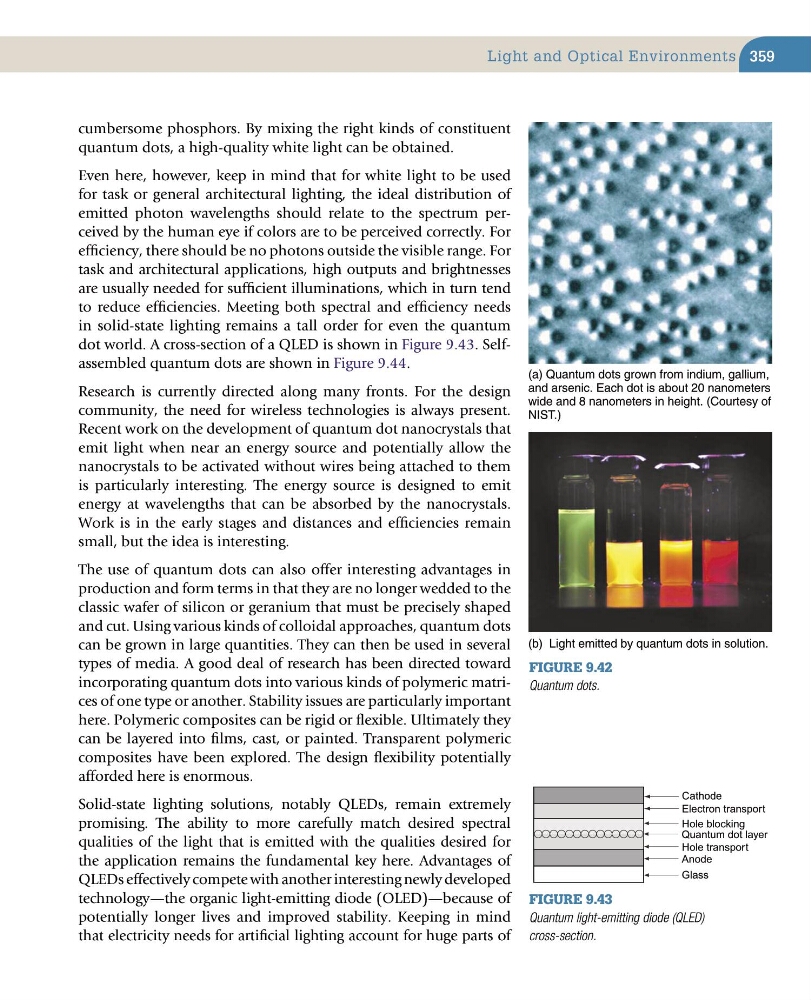
dot world. A cross-section of a QLED is shown in Figure 9.43. Selfassembled quantum dots are shown in Figure 9.44.
Research is currently directed along many fronts. For the design
community, the need for wireless technologies is always present.
Recent work on the development of quantum dot nanocrystals that
emit light when near an energy source and potentially allow the
nanocrystals to be activated without wires being attached to them
is particularly interesting. The energy source is designed to emit
energy at wavelengths that can be absorbed by the nanocrystals.
Work is in the early stages and distances and efficiencies remain
small, but the idea is interesting.
The use of quantum dots can also offer interesting advantages in
production and form terms in that they are no longer wedded to the
classic wafer of silicon or geranium that must be precisely shaped
and cut. Using various kinds of colloidal approaches, quantum dots
can be grown in large quantities. They can then be used in several
types of media. A good deal of research has been directed toward
incorporating quantum dots into various kinds of polymeric matrices of one type or another. Stability issues are particularly important
here. Polymeric composites can be rigid or flexible. Ultimately they
can be layered into films, cast, or painted. Transparent polymeric
composites have been explored. The design flexibility potentially
afforded here is enormous.
Solid-state lighting solutions, notably QLEDs, remain extremely
promising. The ability to more carefully match desired spectral
qualities of the light that is emitted with the qualities desired for
the application remains the fundamental key here. Advantages of
QLEDs effectively compete with another interesting newly developed
technology—the organic light-emitting diode (OLED)—because of
potentially longer lives and improved stability. Keeping in mind
that electricity needs for artificial lighting account for huge parts of
Figure 9.42
Quantum dots.
(a) Quantum dots grown from indium, gallium,
and arsenic. Each dot is about 20 nanometers
wide and 8 nanometers in height. (Courtesy of
NIST.)
(b) Light emitted by quantum dots in solution.
Figure 9.43
Quantum light-emitting diode (QLED)
cross-section.
Glass
Anode
Hole transport
Electron transport
Cathode
Hole blocking
Quantum dot layer
Light and Optical Environments
cumbersome phosphors. By mixing the right kinds of constituent
quantum dots, a high-quality white light can be obtained.
Even here, however, keep in mind that for white light to be used
for task or general architectural lighting, the ideal distribution of
emitted photon wavelengths should relate to the spectrum perceived by the human eye if colors are to be perceived correctly. For
efficiency, there should be no photons outside the visible range. For
task and architectural applications, high outputs and brightnesses
are usually needed for sufficient illuminations, which in turn tend
to reduce efficiencies. Meeting both spectral and efficiency needs
in solid-state lighting remains a tall order for even the quantum
dot world. A cross-section of a QLED is shown in Figure 9.43. Selfassembled quantum dots are shown in Figure 9.44.
Research is currently directed along many fronts. For the design
community, the need for wireless technologies is always present.
Recent work on the development of quantum dot nanocrystals that
emit light when near an energy source and potentially allow the
nanocrystals to be activated without wires being attached to them
is particularly interesting. The energy source is designed to emit
energy at wavelengths that can be absorbed by the nanocrystals.
Work is in the early stages and distances and efficiencies remain
small, but the idea is interesting.
The use of quantum dots can also offer interesting advantages in
production and form terms in that they are no longer wedded to the
classic wafer of silicon or geranium that must be precisely shaped
and cut. Using various kinds of colloidal approaches, quantum dots
can be grown in large quantities. They can then be used in several
types of media. A good deal of research has been directed toward
incorporating quantum dots into various kinds of polymeric matrices of one type or another. Stability issues are particularly important
here. Polymeric composites can be rigid or flexible. Ultimately they
can be layered into films, cast, or painted. Transparent polymeric
composites have been explored. The design flexibility potentially
afforded here is enormous.
Solid-state lighting solutions, notably QLEDs, remain extremely
promising. The ability to more carefully match desired spectral
qualities of the light that is emitted with the qualities desired for
the application remains the fundamental key here. Advantages of
QLEDs effectively compete with another interesting newly developed
technology—the organic light-emitting diode (OLED)—because of
potentially longer lives and improved stability. Keeping in mind
that electricity needs for artificial lighting account for huge parts of
Figure 9.42
Quantum dots.
(a) Quantum dots grown from indium, gallium,
and arsenic. Each dot is about 20 nanometers
wide and 8 nanometers in height. (Courtesy of
NIST.)
(b) Light emitted by quantum dots in solution.
Figure 9.43
Quantum light-emitting diode (QLED)
cross-section.
Glass
Anode
Hole transport
Electron transport
Cathode
Hole blocking
Quantum dot layer
Light and Optical Environments