

C haptEr 9 design Environments and systems
358
tion of phosphors. Hence the actual emission wavelengths that can
be generated remain limited and not easily adjustable—all serving
to prevent their use in some applications that demand precise
control of light wavelengths (a common need in many engineering
or industrial applications).
Alternatively, the ever-present need to produce full-spectrum
“white light” is equally problematic. Current approaches use
mixed red, green, and blue phosphors that are applied to the
semiconductor material. These are difficult to both accurately mix
and precisely apply. As these phosphors age or even heat up,
visible color differences can be observed. Consequently, though
“white light” may be possible, the quality is low. Despite their
relatively high efficiencies as energy conversion devices compared
to old incandescents and other sources, current solid-state lighting systems still fall far short of desired efficiencies and well short
of theoretical efficiencies.
Quantum dots offer great potential in the form of QLEDs
which are made out of networks of quantum dots and can also
build on, yet dramatically improve, existing LED technologies.
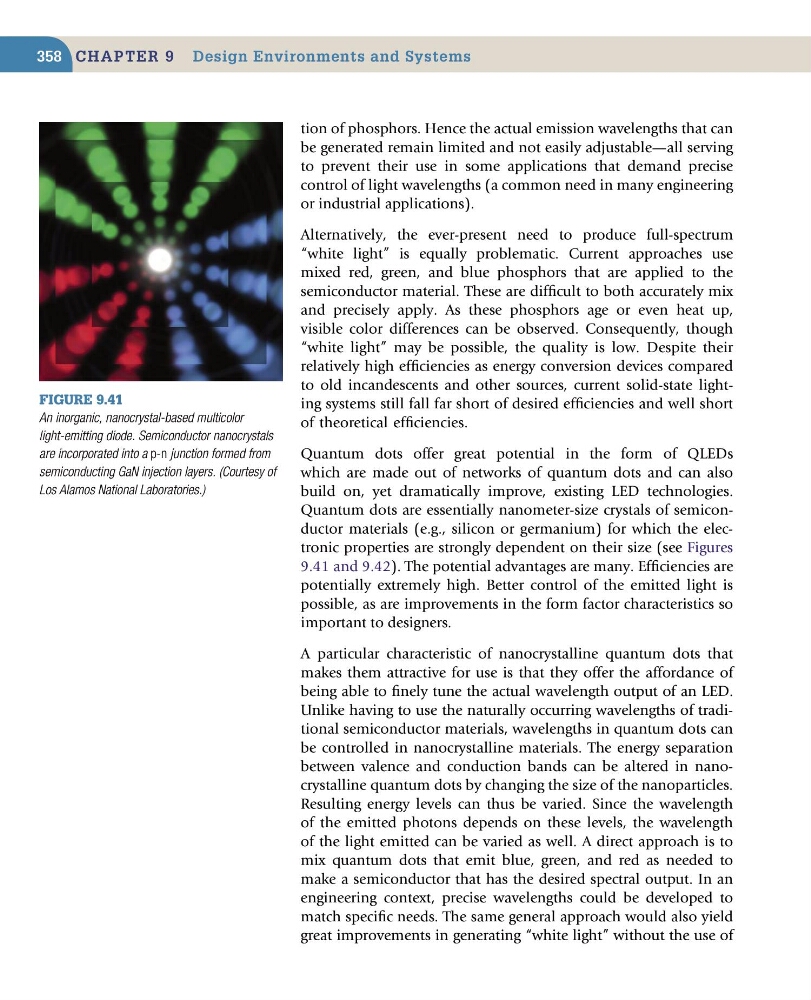
Quantum dots are essentially nanometer-size crystals of semiconductor materials (e.g., silicon or germanium) for which the electronic properties are strongly dependent on their size (see Figures
9.41 and 9.42). The potential advantages are many. Efficiencies are
potentially extremely high. Better control of the emitted light is
possible, as are improvements in the form factor characteristics so
important to designers.
A particular characteristic of nanocrystalline quantum dots that
makes them attractive for use is that they offer the affordance of
being able to finely tune the actual wavelength output of an LED.
Unlike having to use the naturally occurring wavelengths of traditional semiconductor materials, wavelengths in quantum dots can
be controlled in nanocrystalline materials. The energy separation
between valence and conduction bands can be altered in nanocrystalline quantum dots by changing the size of the nanoparticles.
Resulting energy levels can thus be varied. Since the wavelength
of the emitted photons depends on these levels, the wavelength
of the light emitted can be varied as well. A direct approach is to
mix quantum dots that emit blue, green, and red as needed to
make a semiconductor that has the desired spectral output. In an
engineering context, precise wavelengths could be developed to
match specific needs. The same general approach would also yield
great improvements in generating “white light” without the use of
Figure 9.41
An inorganic, nanocrystal-based multicolor
light-emitting diode. Semiconductor nanocrystals
are incorporated into a p-n junction formed from
semiconducting GaN injection layers. (Courtesy of
Los Alamos National Laboratories.)
358
tion of phosphors. Hence the actual emission wavelengths that can
be generated remain limited and not easily adjustable—all serving
to prevent their use in some applications that demand precise
control of light wavelengths (a common need in many engineering
or industrial applications).
Alternatively, the ever-present need to produce full-spectrum
“white light” is equally problematic. Current approaches use
mixed red, green, and blue phosphors that are applied to the
semiconductor material. These are difficult to both accurately mix
and precisely apply. As these phosphors age or even heat up,
visible color differences can be observed. Consequently, though
“white light” may be possible, the quality is low. Despite their
relatively high efficiencies as energy conversion devices compared
to old incandescents and other sources, current solid-state lighting systems still fall far short of desired efficiencies and well short
of theoretical efficiencies.
Quantum dots offer great potential in the form of QLEDs
which are made out of networks of quantum dots and can also
build on, yet dramatically improve, existing LED technologies.
Quantum dots are essentially nanometer-size crystals of semiconductor materials (e.g., silicon or germanium) for which the electronic properties are strongly dependent on their size (see Figures
9.41 and 9.42). The potential advantages are many. Efficiencies are
potentially extremely high. Better control of the emitted light is
possible, as are improvements in the form factor characteristics so
important to designers.
A particular characteristic of nanocrystalline quantum dots that
makes them attractive for use is that they offer the affordance of
being able to finely tune the actual wavelength output of an LED.
Unlike having to use the naturally occurring wavelengths of traditional semiconductor materials, wavelengths in quantum dots can
be controlled in nanocrystalline materials. The energy separation
between valence and conduction bands can be altered in nanocrystalline quantum dots by changing the size of the nanoparticles.
Resulting energy levels can thus be varied. Since the wavelength
of the emitted photons depends on these levels, the wavelength
of the light emitted can be varied as well. A direct approach is to
mix quantum dots that emit blue, green, and red as needed to
make a semiconductor that has the desired spectral output. In an
engineering context, precise wavelengths could be developed to
match specific needs. The same general approach would also yield
great improvements in generating “white light” without the use of
Figure 9.41
An inorganic, nanocrystal-based multicolor
light-emitting diode. Semiconductor nanocrystals
are incorporated into a p-n junction formed from
semiconducting GaN injection layers. (Courtesy of
Los Alamos National Laboratories.)