

357
solid-state lighting: Quantum dots and QlEds
In comparison to older incandescent or fluorescent lighting devices,
the introduction in recent years of solid-state lighting technologies—the direct conversion of electricity to light using semiconductor materials (normally in the form of LEDs)—was an enormous
step forward. LEDs fundamentally produce light via a special form
of electroluminescence. Within just a few years, LEDs have become
the most dominant type of available solid-state lighting solution.
LEDs have been used everywhere—from simple point sources that
glow or blink to convey information about the functioning of a
product to complex manipulable arrays that define unique architectural environments. LEDs are even used in common flashlights.
LEDs are not only used directly but often form a source for light to
be manipulated via lenses, filters, or other techniques. The demand
for devices incorporating LEDs remains huge.
Despite their now common use, however, current LED technologies based on semiconductor materials made from wafers are not
without their limitations, which nano-based quantum dot technologies promise not only to help redress but to move to a new level of
sophistication. In particular, one of the fundamental problems with
LEDs—that of narrow sets of emission frequencies that limit their
uses—is solvable via quantum dot technologies. A new generation
of solid-state lighting—quantum light-emitting diodes (QLEDs)
made of quantum dot networks—are coming into use that would
work similarly to traditional LEDs but have greatly improved functionalities and new uses.
To understand how quantum dot technologies can spur the development of solid-state lighting to a new level, let’s first look at traditional LEDs. Current LEDs are fabricated from wafers of traditional
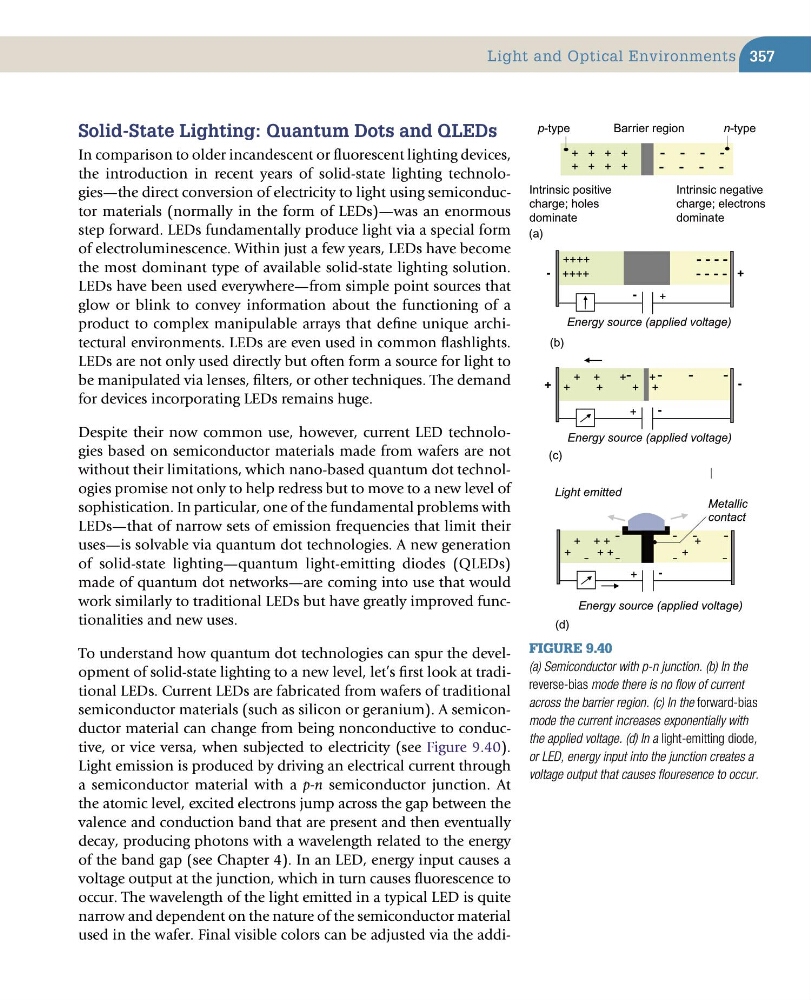
semiconductor materials (such as silicon or geranium). A semiconductor material can change from being nonconductive to conductive, or vice versa, when subjected to electricity (see Figure 9.40).
Light emission is produced by driving an electrical current through
a semiconductor material with a p-n semiconductor junction. At
the atomic level, excited electrons jump across the gap between the
valence and conduction band that are present and then eventually
decay, producing photons with a wavelength related to the energy
of the band gap (see Chapter 4). In an LED, energy input causes a
voltage output at the junction, which in turn causes fluorescence to
occur. The wavelength of the light emitted in a typical LED is quite
narrow and dependent on the nature of the semiconductor material
used in the wafer. Final visible colors can be adjusted via the addiFigure 9.40
(a) Semiconductor with p-n junction. (b) In the
reverse-bias mode there is no flow of current
across the barrier region. (c) In the forward-bias
mode the current increases exponentially with
the applied voltage. (d) In a light-emitting diode,
or LED, energy input into the junction creates a
voltage output that causes flouresence to occur.
Barrier region
- - - -
+ + + +
- - - -
+ + + +
p-type
n-type
Intrinsic negative
charge; electrons
dominate
Intrinsic positive
charge; holes
dominate
- - - -
++++
- - - -
++++
+
-
-
+
(b)
(a)
+
+
+ +
+
-
-
+
Energy source (applied voltage)
+ +
+
+
-
-
-
-
Energy source (applied voltage)
(c)
+
+ +
+
+ + +
+
-
- -
-
-
-
-
-
Energy source (applied voltage)
+
-
Light emitted
(d)
Metallic
contact
Light and Optical Environments
solid-state lighting: Quantum dots and QlEds
In comparison to older incandescent or fluorescent lighting devices,
the introduction in recent years of solid-state lighting technologies—the direct conversion of electricity to light using semiconductor materials (normally in the form of LEDs)—was an enormous
step forward. LEDs fundamentally produce light via a special form
of electroluminescence. Within just a few years, LEDs have become
the most dominant type of available solid-state lighting solution.
LEDs have been used everywhere—from simple point sources that
glow or blink to convey information about the functioning of a
product to complex manipulable arrays that define unique architectural environments. LEDs are even used in common flashlights.
LEDs are not only used directly but often form a source for light to
be manipulated via lenses, filters, or other techniques. The demand
for devices incorporating LEDs remains huge.
Despite their now common use, however, current LED technologies based on semiconductor materials made from wafers are not
without their limitations, which nano-based quantum dot technologies promise not only to help redress but to move to a new level of
sophistication. In particular, one of the fundamental problems with
LEDs—that of narrow sets of emission frequencies that limit their
uses—is solvable via quantum dot technologies. A new generation
of solid-state lighting—quantum light-emitting diodes (QLEDs)
made of quantum dot networks—are coming into use that would
work similarly to traditional LEDs but have greatly improved functionalities and new uses.
To understand how quantum dot technologies can spur the development of solid-state lighting to a new level, let’s first look at traditional LEDs. Current LEDs are fabricated from wafers of traditional
semiconductor materials (such as silicon or geranium). A semiconductor material can change from being nonconductive to conductive, or vice versa, when subjected to electricity (see Figure 9.40).
Light emission is produced by driving an electrical current through
a semiconductor material with a p-n semiconductor junction. At
the atomic level, excited electrons jump across the gap between the
valence and conduction band that are present and then eventually
decay, producing photons with a wavelength related to the energy
of the band gap (see Chapter 4). In an LED, energy input causes a
voltage output at the junction, which in turn causes fluorescence to
occur. The wavelength of the light emitted in a typical LED is quite
narrow and dependent on the nature of the semiconductor material
used in the wafer. Final visible colors can be adjusted via the addiFigure 9.40
(a) Semiconductor with p-n junction. (b) In the
reverse-bias mode there is no flow of current
across the barrier region. (c) In the forward-bias
mode the current increases exponentially with
the applied voltage. (d) In a light-emitting diode,
or LED, energy input into the junction creates a
voltage output that causes flouresence to occur.
Barrier region
- - - -
+ + + +
- - - -
+ + + +
p-type
n-type
Intrinsic negative
charge; electrons
dominate
Intrinsic positive
charge; holes
dominate
- - - -
++++
- - - -
++++
+
-
-
+
(b)
(a)
+
+
+ +
+
-
-
+
Energy source (applied voltage)
+ +
+
+
-
-
-
-
Energy source (applied voltage)
(c)
+
+ +
+
+ + +
+
-
- -
-
-
-
-
-
Energy source (applied voltage)
+
-
Light emitted
(d)
Metallic
contact
Light and Optical Environments