

C haptEr 9 design Environments and systems
350
optimize the total transmission, which can be found to correspond
to the transmittances of both interfaces being equal. Layer thicknesses must also be carefully controlled. Similar design procedures
can be applied to multilayer assemblies, to either increase transmissions or, conversely, to enhance reflectivities.
It is here that the many opportunities to either subtly or dramatically vary basic material properties through the use of nanomaterials come into play. Coatings can be fine-tuned to respond to the
various needs that have different impinging frequencies, angles
of incidence, and so forth. Reflections of light from certain wavelengths can be suppressed or enhanced, as can transmissions.
dichroics
The term dichroism is usually used to describe light-related angular
dependencies in surfaces. Dichroism is both a much used and
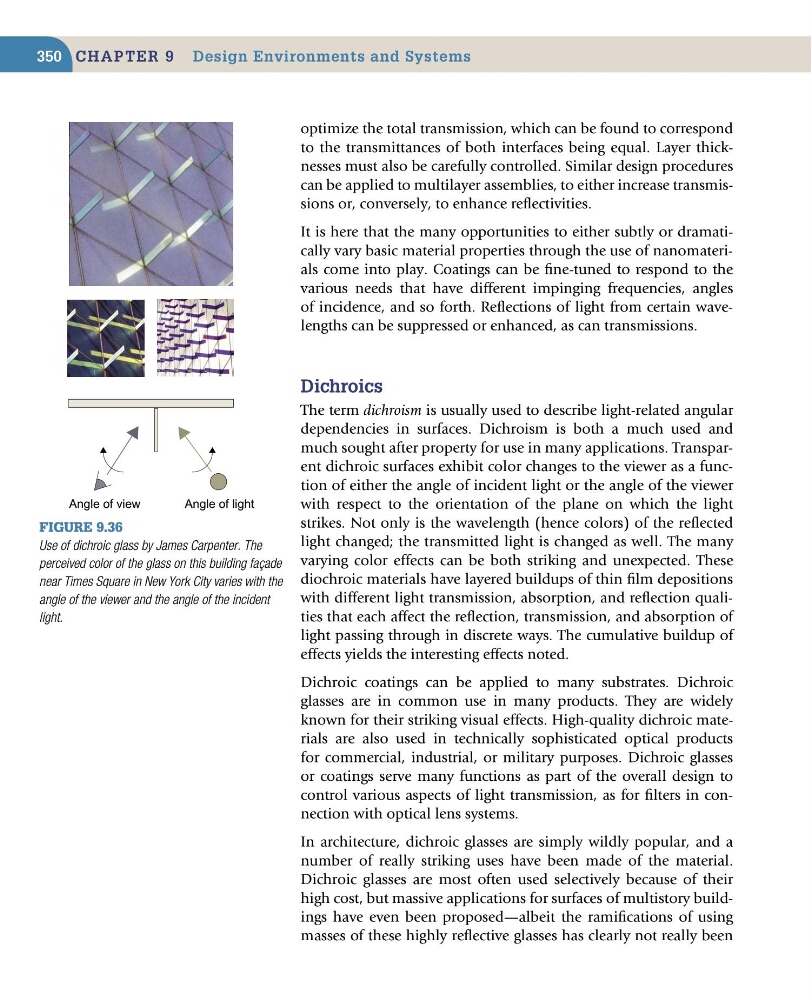
much sought after property for use in many applications. Transparent dichroic surfaces exhibit color changes to the viewer as a function of either the angle of incident light or the angle of the viewer
with respect to the orientation of the plane on which the light
strikes. Not only is the wavelength (hence colors) of the reflected
light changed; the transmitted light is changed as well. The many
varying color effects can be both striking and unexpected. These
diochroic materials have layered buildups of thin film depositions
with different light transmission, absorption, and reflection qualities that each affect the reflection, transmission, and absorption of
light passing through in discrete ways. The cumulative buildup of
effects yields the interesting effects noted.
Dichroic coatings can be applied to many substrates. Dichroic
glasses are in common use in many products. They are widely
known for their striking visual effects. High-quality dichroic materials are also used in technically sophisticated optical products
for commercial, industrial, or military purposes. Dichroic glasses
or coatings serve many functions as part of the overall design to
control various aspects of light transmission, as for filters in connection with optical lens systems.
In architecture, dichroic glasses are simply wildly popular, and a
number of really striking uses have been made of the material.
Dichroic glasses are most often used selectively because of their
high cost, but massive applications for surfaces of multistory buildings have even been proposed—albeit the ramifications of using
masses of these highly reflective glasses has clearly not really been
Figure 9.36
Use of dichroic glass by James Carpenter. The
perceived color of the glass on this building façade
near Times Square in New York City varies with the
angle of the viewer and the angle of the incident
light.
Angle of view
Angle of light
350
optimize the total transmission, which can be found to correspond
to the transmittances of both interfaces being equal. Layer thicknesses must also be carefully controlled. Similar design procedures
can be applied to multilayer assemblies, to either increase transmissions or, conversely, to enhance reflectivities.
It is here that the many opportunities to either subtly or dramatically vary basic material properties through the use of nanomaterials come into play. Coatings can be fine-tuned to respond to the
various needs that have different impinging frequencies, angles
of incidence, and so forth. Reflections of light from certain wavelengths can be suppressed or enhanced, as can transmissions.
dichroics
The term dichroism is usually used to describe light-related angular
dependencies in surfaces. Dichroism is both a much used and
much sought after property for use in many applications. Transparent dichroic surfaces exhibit color changes to the viewer as a function of either the angle of incident light or the angle of the viewer
with respect to the orientation of the plane on which the light
strikes. Not only is the wavelength (hence colors) of the reflected
light changed; the transmitted light is changed as well. The many
varying color effects can be both striking and unexpected. These
diochroic materials have layered buildups of thin film depositions
with different light transmission, absorption, and reflection qualities that each affect the reflection, transmission, and absorption of
light passing through in discrete ways. The cumulative buildup of
effects yields the interesting effects noted.
Dichroic coatings can be applied to many substrates. Dichroic
glasses are in common use in many products. They are widely
known for their striking visual effects. High-quality dichroic materials are also used in technically sophisticated optical products
for commercial, industrial, or military purposes. Dichroic glasses
or coatings serve many functions as part of the overall design to
control various aspects of light transmission, as for filters in connection with optical lens systems.
In architecture, dichroic glasses are simply wildly popular, and a
number of really striking uses have been made of the material.
Dichroic glasses are most often used selectively because of their
high cost, but massive applications for surfaces of multistory buildings have even been proposed—albeit the ramifications of using
masses of these highly reflective glasses has clearly not really been
Figure 9.36
Use of dichroic glass by James Carpenter. The
perceived color of the glass on this building façade
near Times Square in New York City varies with the
angle of the viewer and the angle of the incident
light.
Angle of view
Angle of light