

25
applied stress, any crack in the shell can readily propagate through
the ceramic material, but it will be deflected on contact with the
protein material. Therefore, instead of a brittle material in which
cracks can rapidly move without stopping, the shell of the abalone
behaves as a ductile material.
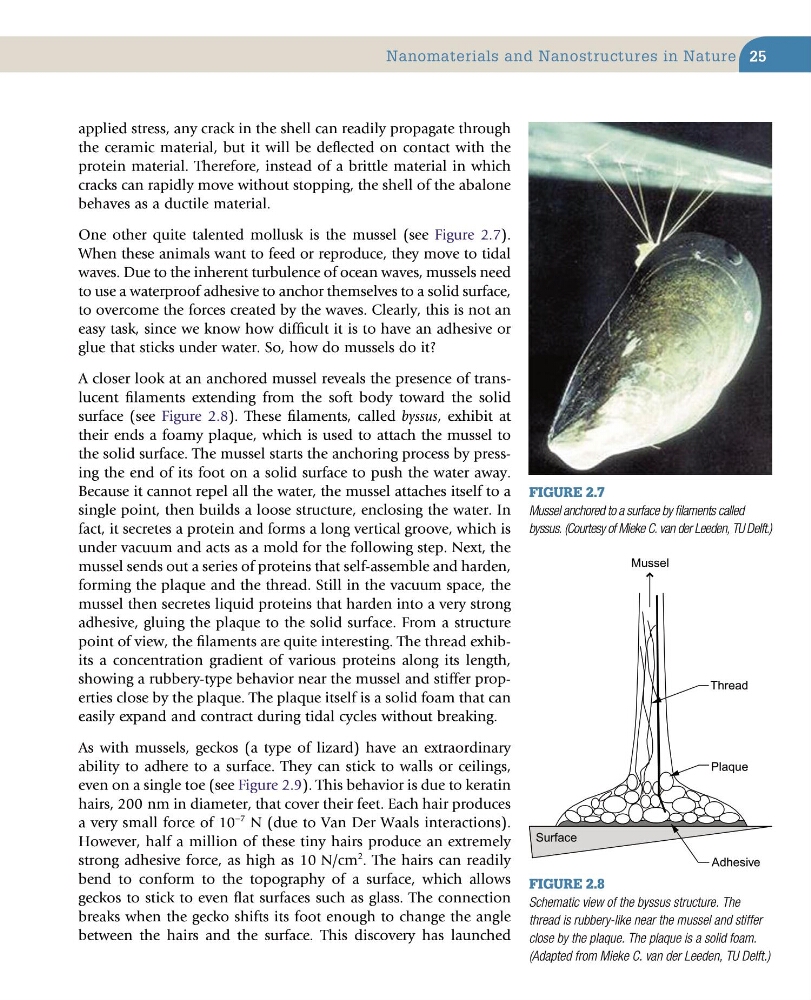
One other quite talented mollusk is the mussel (see Figure 2.7).
When these animals want to feed or reproduce, they move to tidal
waves. Due to the inherent turbulence of ocean waves, mussels need
to use a waterproof adhesive to anchor themselves to a solid surface,
to overcome the forces created by the waves. Clearly, this is not an
easy task, since we know how difficult it is to have an adhesive or
glue that sticks under water. So, how do mussels do it?
A closer look at an anchored mussel reveals the presence of translucent filaments extending from the soft body toward the solid
surface (see Figure 2.8). These filaments, called byssus, exhibit at
their ends a foamy plaque, which is used to attach the mussel to
the solid surface. The mussel starts the anchoring process by pressing the end of its foot on a solid surface to push the water away.
Because it cannot repel all the water, the mussel attaches itself to a
single point, then builds a loose structure, enclosing the water. In
fact, it secretes a protein and forms a long vertical groove, which is
under vacuum and acts as a mold for the following step. Next, the
mussel sends out a series of proteins that self-assemble and harden,
forming the plaque and the thread. Still in the vacuum space, the
mussel then secretes liquid proteins that harden into a very strong
adhesive, gluing the plaque to the solid surface. From a structure
point of view, the filaments are quite interesting. The thread exhibits a concentration gradient of various proteins along its length,
showing a rubbery-type behavior near the mussel and stiffer properties close by the plaque. The plaque itself is a solid foam that can
easily expand and contract during tidal cycles without breaking.
As with mussels, geckos (a type of lizard) have an extraordinary
ability to adhere to a surface. They can stick to walls or ceilings,
even on a single toe (see Figure 2.9). This behavior is due to keratin
hairs, 200 nm in diameter, that cover their feet. Each hair produces
a very small force of 10
−7 N (due to Van Der Waals interactions).
However, half a million of these tiny hairs produce an extremely
strong adhesive force, as high as 10 N/cm
2 . The hairs can readily
bend to conform to the topography of a surface, which allows
geckos to stick to even flat surfaces such as glass. The connection
breaks when the gecko shifts its foot enough to change the angle
between the hairs and the surface. This discovery has launched
Figure 2.7
Mussel anchored to a surface by filaments called
byssus. (Courtesy of Mieke C. van der Leeden, TU Delft.)
Nanomaterials and Nanostructures in Nature
Figure 2.8
Schematic view of the byssus structure. The
thread is rubbery-like near the mussel and stiffer
close by the plaque. The plaque is a solid foam.
(Adapted from Mieke C. van der Leeden, TU Delft.)
Plaque
Thread
Mussel
Surface
Adhesive
applied stress, any crack in the shell can readily propagate through
the ceramic material, but it will be deflected on contact with the
protein material. Therefore, instead of a brittle material in which
cracks can rapidly move without stopping, the shell of the abalone
behaves as a ductile material.
One other quite talented mollusk is the mussel (see Figure 2.7).
When these animals want to feed or reproduce, they move to tidal
waves. Due to the inherent turbulence of ocean waves, mussels need
to use a waterproof adhesive to anchor themselves to a solid surface,
to overcome the forces created by the waves. Clearly, this is not an
easy task, since we know how difficult it is to have an adhesive or
glue that sticks under water. So, how do mussels do it?
A closer look at an anchored mussel reveals the presence of translucent filaments extending from the soft body toward the solid
surface (see Figure 2.8). These filaments, called byssus, exhibit at
their ends a foamy plaque, which is used to attach the mussel to
the solid surface. The mussel starts the anchoring process by pressing the end of its foot on a solid surface to push the water away.
Because it cannot repel all the water, the mussel attaches itself to a
single point, then builds a loose structure, enclosing the water. In
fact, it secretes a protein and forms a long vertical groove, which is
under vacuum and acts as a mold for the following step. Next, the
mussel sends out a series of proteins that self-assemble and harden,
forming the plaque and the thread. Still in the vacuum space, the
mussel then secretes liquid proteins that harden into a very strong
adhesive, gluing the plaque to the solid surface. From a structure
point of view, the filaments are quite interesting. The thread exhibits a concentration gradient of various proteins along its length,
showing a rubbery-type behavior near the mussel and stiffer properties close by the plaque. The plaque itself is a solid foam that can
easily expand and contract during tidal cycles without breaking.
As with mussels, geckos (a type of lizard) have an extraordinary
ability to adhere to a surface. They can stick to walls or ceilings,
even on a single toe (see Figure 2.9). This behavior is due to keratin
hairs, 200 nm in diameter, that cover their feet. Each hair produces
a very small force of 10
−7 N (due to Van Der Waals interactions).
However, half a million of these tiny hairs produce an extremely
strong adhesive force, as high as 10 N/cm
2 . The hairs can readily
bend to conform to the topography of a surface, which allows
geckos to stick to even flat surfaces such as glass. The connection
breaks when the gecko shifts its foot enough to change the angle
between the hairs and the surface. This discovery has launched
Figure 2.7
Mussel anchored to a surface by filaments called
byssus. (Courtesy of Mieke C. van der Leeden, TU Delft.)
Nanomaterials and Nanostructures in Nature
Figure 2.8
Schematic view of the byssus structure. The
thread is rubbery-like near the mussel and stiffer
close by the plaque. The plaque is a solid foam.
(Adapted from Mieke C. van der Leeden, TU Delft.)
Plaque
Thread
Mussel
Surface
Adhesive