

CHApter 2 An evolutionary perspective
26
several research groups into developing tapes based on the
gecko adhesive force. In one example, the tape is made by microfabrication of dense arrays of flexible plastic pillars, the geometry
of which is optimized to ensure their collective adhesion (see
Section 10.4).
Now imagine a material capable of catching an airplane traveling
at cruise speed. Although at a very different scale, a spider web (see
Figure 2.10) has such energy-absorbing properties, enabling the
capture of flying insects at high speeds. It turns out that the secret
behind the combined strength and flexibility of a spider web lies
in the arrangement of nanocrystalline reinforcements embedded in
a polymer matrix. A closer look at the spider web microstructure
reveals the existence of strongly oriented nanocrystals, which adhere
to the stretchy protein that composes their surrounding polymeric
matrix. In other words, the spider web is a nanocomposite material
composed of relatively stiff nanocrystals dispersed within a stretchy
matrix that is now stronger and tougher.
The spider web starts as raw silk (a liquid protein) secreted by a
gland. The protein is then pushed through channels at the spider’s
back end. What emerges is a water-insoluble, highly ordered fiber
with outstanding mechanical properties. Although this process is
not fully understood, it is believed that the raw silk transforms into
a liquid crystal phase just before entering the channels, whereas the
passage through the channels aligns the molecules, which are
anisotropic in nature.
Following the properties exhibited by spider webs, several research
groups have been trying to develop materials capable of emulating
this nature’s marvel. Recently, a group at MIT has focused on
developing a commercial polyurethane elastomer (a rubbery substance) reinforced with nano-sized clay platelets. These molecular
nanocomposites are likely to be good candidates for lightweight
membranes and gas barriers due to the fact that the nano-sized
clay platelets enhance the mechanical and thermal properties. In
addition, materials based on the characteristics of spider webs are
suitable for body-armor components, thin and strong packaging
films, and biomedical devices.
If you’ve ever observed two rhinos fighting with each other, you
were probably impressed by the properties exhibited by their horns.
Despite the enormous forces involved when the animals clash, the
horns remain intact without fracturing. The reason for this is the
presence of keratin, a fibrous protein that is also present in hair and
fingernails and that is self-assembled into a very specific structure.
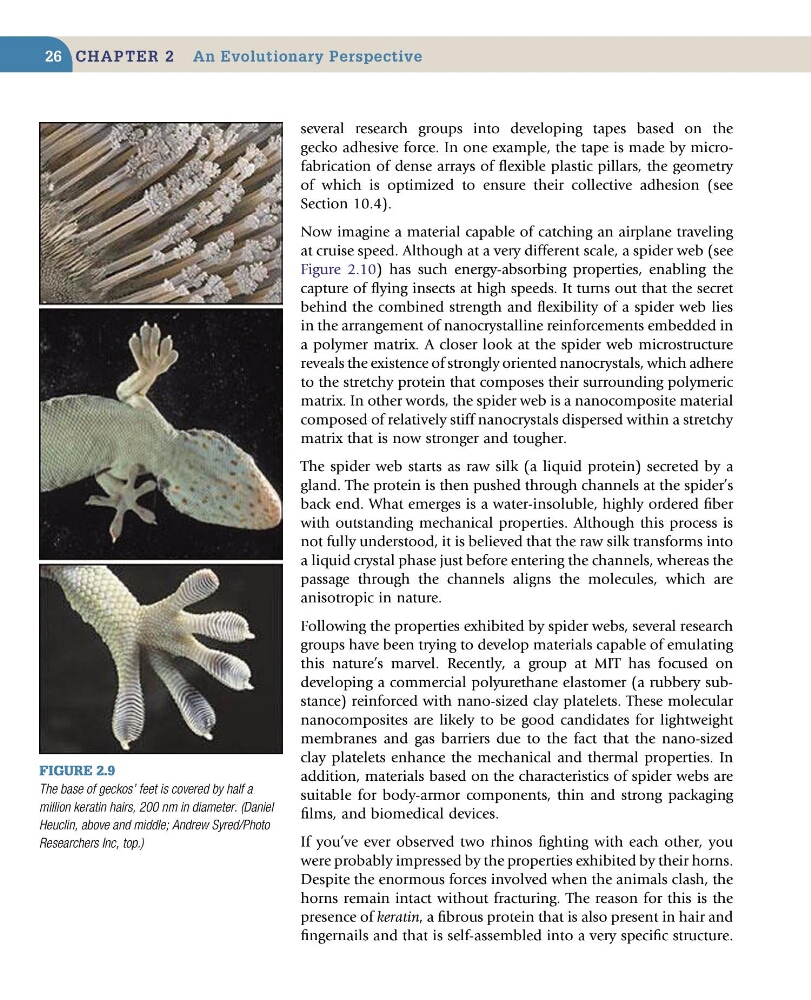
Figure 2.9
The base of geckos’ feet is covered by half a
million keratin hairs, 200 nm in diameter. (Daniel
Heuclin, above and middle; Andrew Syred/Photo
Researchers Inc, top.)
26
several research groups into developing tapes based on the
gecko adhesive force. In one example, the tape is made by microfabrication of dense arrays of flexible plastic pillars, the geometry
of which is optimized to ensure their collective adhesion (see
Section 10.4).
Now imagine a material capable of catching an airplane traveling
at cruise speed. Although at a very different scale, a spider web (see
Figure 2.10) has such energy-absorbing properties, enabling the
capture of flying insects at high speeds. It turns out that the secret
behind the combined strength and flexibility of a spider web lies
in the arrangement of nanocrystalline reinforcements embedded in
a polymer matrix. A closer look at the spider web microstructure
reveals the existence of strongly oriented nanocrystals, which adhere
to the stretchy protein that composes their surrounding polymeric
matrix. In other words, the spider web is a nanocomposite material
composed of relatively stiff nanocrystals dispersed within a stretchy
matrix that is now stronger and tougher.
The spider web starts as raw silk (a liquid protein) secreted by a
gland. The protein is then pushed through channels at the spider’s
back end. What emerges is a water-insoluble, highly ordered fiber
with outstanding mechanical properties. Although this process is
not fully understood, it is believed that the raw silk transforms into
a liquid crystal phase just before entering the channels, whereas the
passage through the channels aligns the molecules, which are
anisotropic in nature.
Following the properties exhibited by spider webs, several research
groups have been trying to develop materials capable of emulating
this nature’s marvel. Recently, a group at MIT has focused on
developing a commercial polyurethane elastomer (a rubbery substance) reinforced with nano-sized clay platelets. These molecular
nanocomposites are likely to be good candidates for lightweight
membranes and gas barriers due to the fact that the nano-sized
clay platelets enhance the mechanical and thermal properties. In
addition, materials based on the characteristics of spider webs are
suitable for body-armor components, thin and strong packaging
films, and biomedical devices.
If you’ve ever observed two rhinos fighting with each other, you
were probably impressed by the properties exhibited by their horns.
Despite the enormous forces involved when the animals clash, the
horns remain intact without fracturing. The reason for this is the
presence of keratin, a fibrous protein that is also present in hair and
fingernails and that is self-assembled into a very specific structure.
Figure 2.9
The base of geckos’ feet is covered by half a
million keratin hairs, 200 nm in diameter. (Daniel
Heuclin, above and middle; Andrew Syred/Photo
Researchers Inc, top.)