

CHApter 2 An evolutionary perspective
24
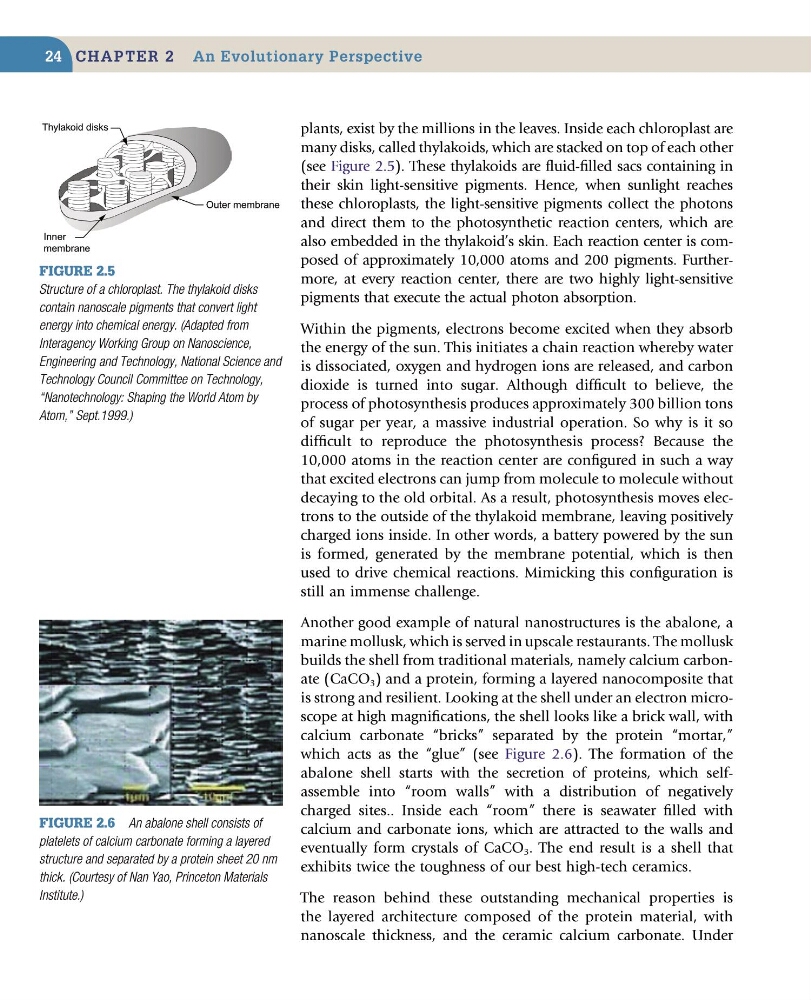
plants, exist by the millions in the leaves. Inside each chloroplast are
many disks, called thylakoids, which are stacked on top of each other
(see Figure 2.5). These thylakoids are fluid-filled sacs containing in
their skin light-sensitive pigments. Hence, when sunlight reaches
these chloroplasts, the light-sensitive pigments collect the photons
and direct them to the photosynthetic reaction centers, which are
also embedded in the thylakoid’s skin. Each reaction center is composed of approximately 10,000 atoms and 200 pigments. Furthermore, at every reaction center, there are two highly light-sensitive
pigments that execute the actual photon absorption.
Within the pigments, electrons become excited when they absorb
the energy of the sun. This initiates a chain reaction whereby water
is dissociated, oxygen and hydrogen ions are released, and carbon
dioxide is turned into sugar. Although difficult to believe, the
process of photosynthesis produces approximately 300 billion tons
of sugar per year, a massive industrial operation. So why is it so
difficult to reproduce the photosynthesis process? Because the
10,000 atoms in the reaction center are configured in such a way
that excited electrons can jump from molecule to molecule without
decaying to the old orbital. As a result, photosynthesis moves electrons to the outside of the thylakoid membrane, leaving positively
charged ions inside. In other words, a battery powered by the sun
is formed, generated by the membrane potential, which is then
used to drive chemical reactions. Mimicking this configuration is
still an immense challenge.
Another good example of natural nanostructures is the abalone, a
marine mollusk, which is served in upscale restaurants. The mollusk
builds the shell from traditional materials, namely calcium carbonate (CaCO 3 ) and a protein, forming a layered nanocomposite that
is strong and resilient. Looking at the shell under an electron microscope at high magnifications, the shell looks like a brick wall, with
calcium carbonate “bricks” separated by the protein “mortar,”
which acts as the “glue” (see Figure 2.6). The formation of the
abalone shell starts with the secretion of proteins, which selfassemble into “room walls” with a distribution of negatively
charged sites.. Inside each “room” there is seawater filled with
calcium and carbonate ions, which are attracted to the walls and
eventually form crystals of CaCO 3 . The end result is a shell that
exhibits twice the toughness of our best high-tech ceramics.
The reason behind these outstanding mechanical properties is
the layered architecture composed of the protein material, with
nanoscale thickness, and the ceramic calcium carbonate. Under
Figure 2.5
Structure of a chloroplast. The thylakoid disks
contain nanoscale pigments that convert light
energy into chemical energy. (Adapted from
Interagency Working Group on Nanoscience,
Engineering and Technology, National Science and
Technology Council Committee on Technology,
“Nanotechnology: Shaping the World Atom by
Atom,” Sept.1999.)
Inner
membrane
Thylakoid disks
Outer membrane
Figure 2.6 An abalone shell consists of
platelets of calcium carbonate forming a layered
structure and separated by a protein sheet 20 nm
thick. (Courtesy of Nan Yao, Princeton Materials
Institute.)
24
plants, exist by the millions in the leaves. Inside each chloroplast are
many disks, called thylakoids, which are stacked on top of each other
(see Figure 2.5). These thylakoids are fluid-filled sacs containing in
their skin light-sensitive pigments. Hence, when sunlight reaches
these chloroplasts, the light-sensitive pigments collect the photons
and direct them to the photosynthetic reaction centers, which are
also embedded in the thylakoid’s skin. Each reaction center is composed of approximately 10,000 atoms and 200 pigments. Furthermore, at every reaction center, there are two highly light-sensitive
pigments that execute the actual photon absorption.
Within the pigments, electrons become excited when they absorb
the energy of the sun. This initiates a chain reaction whereby water
is dissociated, oxygen and hydrogen ions are released, and carbon
dioxide is turned into sugar. Although difficult to believe, the
process of photosynthesis produces approximately 300 billion tons
of sugar per year, a massive industrial operation. So why is it so
difficult to reproduce the photosynthesis process? Because the
10,000 atoms in the reaction center are configured in such a way
that excited electrons can jump from molecule to molecule without
decaying to the old orbital. As a result, photosynthesis moves electrons to the outside of the thylakoid membrane, leaving positively
charged ions inside. In other words, a battery powered by the sun
is formed, generated by the membrane potential, which is then
used to drive chemical reactions. Mimicking this configuration is
still an immense challenge.
Another good example of natural nanostructures is the abalone, a
marine mollusk, which is served in upscale restaurants. The mollusk
builds the shell from traditional materials, namely calcium carbonate (CaCO 3 ) and a protein, forming a layered nanocomposite that
is strong and resilient. Looking at the shell under an electron microscope at high magnifications, the shell looks like a brick wall, with
calcium carbonate “bricks” separated by the protein “mortar,”
which acts as the “glue” (see Figure 2.6). The formation of the
abalone shell starts with the secretion of proteins, which selfassemble into “room walls” with a distribution of negatively
charged sites.. Inside each “room” there is seawater filled with
calcium and carbonate ions, which are attracted to the walls and
eventually form crystals of CaCO 3 . The end result is a shell that
exhibits twice the toughness of our best high-tech ceramics.
The reason behind these outstanding mechanical properties is
the layered architecture composed of the protein material, with
nanoscale thickness, and the ceramic calcium carbonate. Under
Figure 2.5
Structure of a chloroplast. The thylakoid disks
contain nanoscale pigments that convert light
energy into chemical energy. (Adapted from
Interagency Working Group on Nanoscience,
Engineering and Technology, National Science and
Technology Council Committee on Technology,
“Nanotechnology: Shaping the World Atom by
Atom,” Sept.1999.)
Inner
membrane
Thylakoid disks
Outer membrane
Figure 2.6 An abalone shell consists of
platelets of calcium carbonate forming a layered
structure and separated by a protein sheet 20 nm
thick. (Courtesy of Nan Yao, Princeton Materials
Institute.)