

C haptEr 9 design Environments and systems
326
These devices provide sources of heating or cooling without any
mechanical actions, nor do they involve any environmentally
harmful materials—characteristics that are of great fascination to
designers. Current devices, however, have severe limitations. With
current thermoelectric materials, devices are woefully inefficient
in terms of energy conversion (often less than 5%) to the extent
that using them in other than limited sizes for special purposes is
cost prohibitive. They remain relatively small in terms of size and
capacity. With current thermoelectric materials it is intrinsically difficult to make large devices because of inherent limitations with
deposition methods. Current depositions also have limited surface
geometry possibilities that are not always able to provide the most
efficient thermal gradients.
A commonly used measure to evaluate the efficiency of a thermoelectric device is called the Figure of Merit:
ZT
T
e
=
α
λ
κ
2
∆
where α is the Seebeck coefficient or thermal power, κ e is the electrical conductivity, ∆T is the temperature difference, and λ is the
thermal conductivity of the material.
Of importance here is that a high Figure of Merit represents an efficient device. For many years, the limit of this figure for typically
used materials remained about ZT = 1 for conversion efficiencies
of around 7% or 8%, but higher values of ZT (2 or 3) are needed
for improved efficiencies. Nanomaterials offer promising avenues
of development here. Nanomaterials in the form of nanotubes and
nanowires can potentially improve efficiencies due to quantum size
effects induced by nanoscale dimensions.
As seen from the Figure of Merit expression, desirable thermoelectric materials should have a large Seebeck coefficient, low thermal
conductivity, and low electrical resistivity (or high electrical conductivity). They should also be able to have shape variations. One
key approach is based on the fact that the Seebeck effect can be
enhanced through improvements in electrical conductivities. As
noted previously, nanomaterials transport both heat and electrical charge in a way quite different than conventional materials.
When at least one dimension is at the nanoscale, quantum confinement effects and the scattering of free electrons at surfaces change
the nature of the way that electricity and heat are carried. These
effects can be utilized to improve electrical conductivities. The use
of quantum dots or nanowire structures offer immediate interest,
since the kind of confinement present can enhance Seebeck effects.
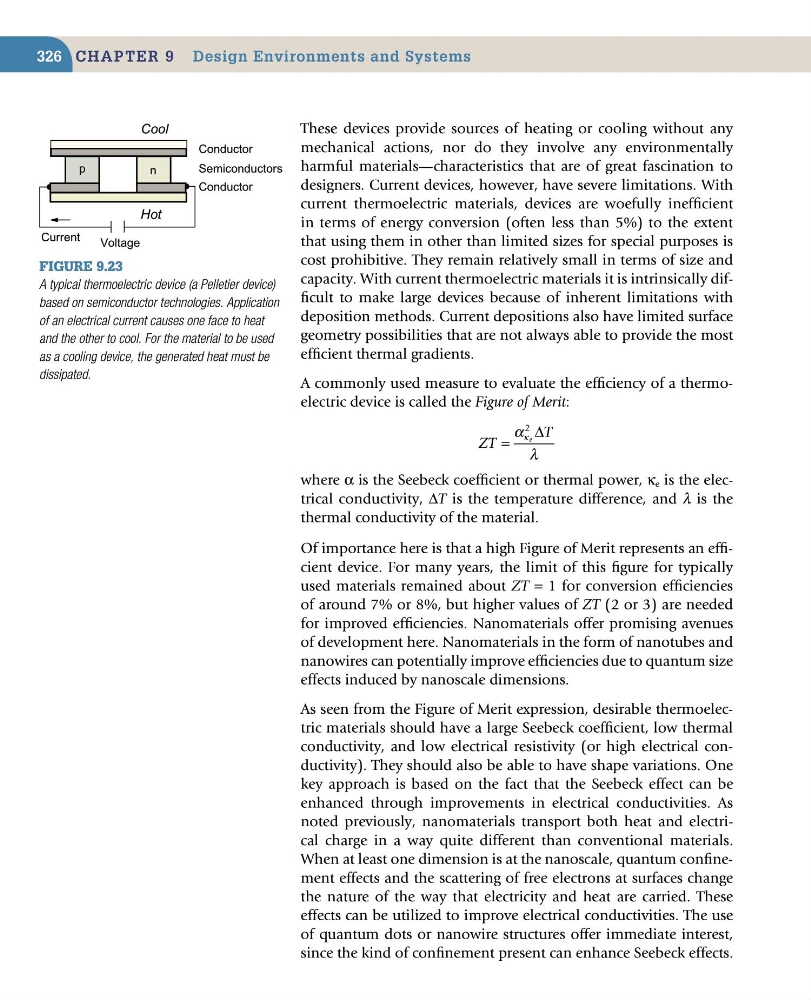
Figure 9.23
A typical thermoelectric device (a Pelletier device)
based on semiconductor technologies. Application
of an electrical current causes one face to heat
and the other to cool. For the material to be used
as a cooling device, the generated heat must be
dissipated.
Voltage
Current
Hot
p
n
Conductor
Conductor
Semiconductors
Cool
326
These devices provide sources of heating or cooling without any
mechanical actions, nor do they involve any environmentally
harmful materials—characteristics that are of great fascination to
designers. Current devices, however, have severe limitations. With
current thermoelectric materials, devices are woefully inefficient
in terms of energy conversion (often less than 5%) to the extent
that using them in other than limited sizes for special purposes is
cost prohibitive. They remain relatively small in terms of size and
capacity. With current thermoelectric materials it is intrinsically difficult to make large devices because of inherent limitations with
deposition methods. Current depositions also have limited surface
geometry possibilities that are not always able to provide the most
efficient thermal gradients.
A commonly used measure to evaluate the efficiency of a thermoelectric device is called the Figure of Merit:
ZT
T
e
=
α
λ
κ
2
∆
where α is the Seebeck coefficient or thermal power, κ e is the electrical conductivity, ∆T is the temperature difference, and λ is the
thermal conductivity of the material.
Of importance here is that a high Figure of Merit represents an efficient device. For many years, the limit of this figure for typically
used materials remained about ZT = 1 for conversion efficiencies
of around 7% or 8%, but higher values of ZT (2 or 3) are needed
for improved efficiencies. Nanomaterials offer promising avenues
of development here. Nanomaterials in the form of nanotubes and
nanowires can potentially improve efficiencies due to quantum size
effects induced by nanoscale dimensions.
As seen from the Figure of Merit expression, desirable thermoelectric materials should have a large Seebeck coefficient, low thermal
conductivity, and low electrical resistivity (or high electrical conductivity). They should also be able to have shape variations. One
key approach is based on the fact that the Seebeck effect can be
enhanced through improvements in electrical conductivities. As
noted previously, nanomaterials transport both heat and electrical charge in a way quite different than conventional materials.
When at least one dimension is at the nanoscale, quantum confinement effects and the scattering of free electrons at surfaces change
the nature of the way that electricity and heat are carried. These
effects can be utilized to improve electrical conductivities. The use
of quantum dots or nanowire structures offer immediate interest,
since the kind of confinement present can enhance Seebeck effects.
Figure 9.23
A typical thermoelectric device (a Pelletier device)
based on semiconductor technologies. Application
of an electrical current causes one face to heat
and the other to cool. For the material to be used
as a cooling device, the generated heat must be
dissipated.
Voltage
Current
Hot
p
n
Conductor
Conductor
Semiconductors
Cool