

325
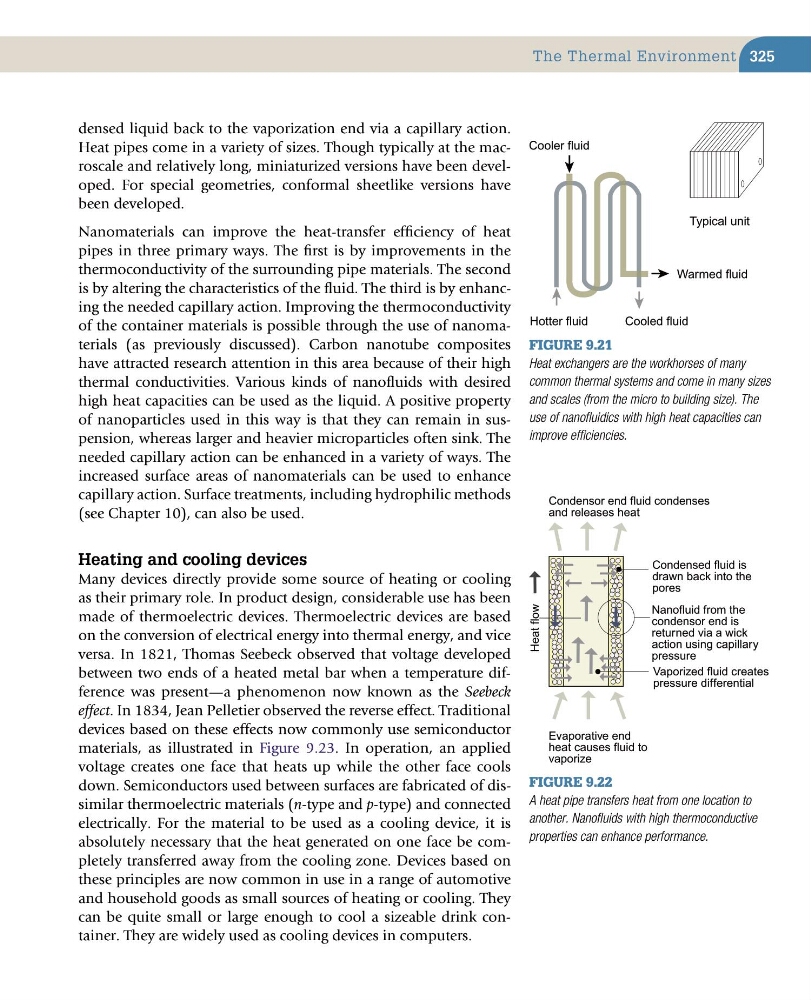
densed liquid back to the vaporization end via a capillary action.
Heat pipes come in a variety of sizes. Though typically at the macroscale and relatively long, miniaturized versions have been developed. For special geometries, conformal sheetlike versions have
been developed.
Nanomaterials can improve the heat-transfer efficiency of heat
pipes in three primary ways. The first is by improvements in the
thermoconductivity of the surrounding pipe materials. The second
is by altering the characteristics of the fluid. The third is by enhancing the needed capillary action. Improving the thermoconductivity
of the container materials is possible through the use of nanomaterials (as previously discussed). Carbon nanotube composites
have attracted research attention in this area because of their high
thermal conductivities. Various kinds of nanofluids with desired
high heat capacities can be used as the liquid. A positive property
of nanoparticles used in this way is that they can remain in suspension, whereas larger and heavier microparticles often sink. The
needed capillary action can be enhanced in a variety of ways. The
increased surface areas of nanomaterials can be used to enhance
capillary action. Surface treatments, including hydrophilic methods
(see Chapter 10), can also be used.
heating and cooling devices
Many devices directly provide some source of heating or cooling
as their primary role. In product design, considerable use has been
made of thermoelectric devices. Thermoelectric devices are based
on the conversion of electrical energy into thermal energy, and vice
versa. In 1821, Thomas Seebeck observed that voltage developed
between two ends of a heated metal bar when a temperature difference was present—a phenomenon now known as the Seebeck
effect. In 1834, Jean Pelletier observed the reverse effect. Traditional
devices based on these effects now commonly use semiconductor
materials, as illustrated in Figure 9.23. In operation, an applied
voltage creates one face that heats up while the other face cools
down. Semiconductors used between surfaces are fabricated of dissimilar thermoelectric materials (n-type and p-type) and connected
electrically. For the material to be used as a cooling device, it is
absolutely necessary that the heat generated on one face be completely transferred away from the cooling zone. Devices based on
these principles are now common in use in a range of automotive
and household goods as small sources of heating or cooling. They
can be quite small or large enough to cool a sizeable drink container. They are widely used as cooling devices in computers.
Figure 9.21
Heat exchangers are the workhorses of many
common thermal systems and come in many sizes
and scales (from the micro to building size). The
use of nanofluidics with high heat capacities can
improve efficiencies.
Cooler fluid
Hotter fluid
Typical unit
Warmed fluid
Cooled fluid
Figure 9.22
A heat pipe transfers heat from one location to
another. Nanofluids with high thermoconductive
properties can enhance performance.
Evaporative end
heat causes fluid to
vaporize
Nanofluid from the
condensor end is
returned via a wick
action using capillary
pressure
Condensor end fluid condenses
and releases heat
Condensed fluid is
drawn back into the
pores
Vaporized fluid creates
pressure differential
Heat flow
The Thermal Environment
densed liquid back to the vaporization end via a capillary action.
Heat pipes come in a variety of sizes. Though typically at the macroscale and relatively long, miniaturized versions have been developed. For special geometries, conformal sheetlike versions have
been developed.
Nanomaterials can improve the heat-transfer efficiency of heat
pipes in three primary ways. The first is by improvements in the
thermoconductivity of the surrounding pipe materials. The second
is by altering the characteristics of the fluid. The third is by enhancing the needed capillary action. Improving the thermoconductivity
of the container materials is possible through the use of nanomaterials (as previously discussed). Carbon nanotube composites
have attracted research attention in this area because of their high
thermal conductivities. Various kinds of nanofluids with desired
high heat capacities can be used as the liquid. A positive property
of nanoparticles used in this way is that they can remain in suspension, whereas larger and heavier microparticles often sink. The
needed capillary action can be enhanced in a variety of ways. The
increased surface areas of nanomaterials can be used to enhance
capillary action. Surface treatments, including hydrophilic methods
(see Chapter 10), can also be used.
heating and cooling devices
Many devices directly provide some source of heating or cooling
as their primary role. In product design, considerable use has been
made of thermoelectric devices. Thermoelectric devices are based
on the conversion of electrical energy into thermal energy, and vice
versa. In 1821, Thomas Seebeck observed that voltage developed
between two ends of a heated metal bar when a temperature difference was present—a phenomenon now known as the Seebeck
effect. In 1834, Jean Pelletier observed the reverse effect. Traditional
devices based on these effects now commonly use semiconductor
materials, as illustrated in Figure 9.23. In operation, an applied
voltage creates one face that heats up while the other face cools
down. Semiconductors used between surfaces are fabricated of dissimilar thermoelectric materials (n-type and p-type) and connected
electrically. For the material to be used as a cooling device, it is
absolutely necessary that the heat generated on one face be completely transferred away from the cooling zone. Devices based on
these principles are now common in use in a range of automotive
and household goods as small sources of heating or cooling. They
can be quite small or large enough to cool a sizeable drink container. They are widely used as cooling devices in computers.
Figure 9.21
Heat exchangers are the workhorses of many
common thermal systems and come in many sizes
and scales (from the micro to building size). The
use of nanofluidics with high heat capacities can
improve efficiencies.
Cooler fluid
Hotter fluid
Typical unit
Warmed fluid
Cooled fluid
Figure 9.22
A heat pipe transfers heat from one location to
another. Nanofluids with high thermoconductive
properties can enhance performance.
Evaporative end
heat causes fluid to
vaporize
Nanofluid from the
condensor end is
returned via a wick
action using capillary
pressure
Condensor end fluid condenses
and releases heat
Condensed fluid is
drawn back into the
pores
Vaporized fluid creates
pressure differential
Heat flow
The Thermal Environment