

C haptEr 9 design Environments and systems
324
Heat exchangers are in common use. These devices transfer heat
from a circulating fluid or gas on one side of a solid separator
to a fluid or gas on the other side, but without intermixing. The
fluids are separately channeled but adjacent to one another and
separated by a thermoconductive material (see Figure 9.21). Heat
from the hotter stream is transferred to the cooler stream, which
in turn carries it off to be dissipated elsewhere. These devices
can also be used as “heat recovery” systems. Heat exchangers
are widely used in products everywhere, certainly including the
automotive and building industries. Various types (plate, shell,
tube, and so on) exist, as do the fluid media used. These devices
can be on a massive scale for many building and industrial
operations, or they can be extremely small devices forming parts
of micro-sized products and use microfluidic techniques. Many
exchangers at the micro level are made via advanced micromachining techniques. Though most heat exchangers involve fluids,
metal-to-metal exchangers are also in use that are fundamentally
based on similar principles.
Critical considerations in heat exchangers include the temperature
differential present between adjacent media and their respective
thermal characteristics, the thermal conductivity of the separation
material for fluidic exchangers, and the relative surface-to-volume
contact areas that are present. Enhanced thermal conductivity of
the separation materials used can be achieved by any of the nanobased approaches previously discussed for improving thermal
conductivities. For many types of smaller heat exchangers, the possibility of using nanofluids with particular thermal properties has
been extensively explored. In general, the objective is to impart as
high a heat capacity to the adjacent fluids as is reasonably possible
so that effective heat transfers can take place. Hence many nanofluidic approaches use suspended nanoparticles with high heat capacities within a basic fluid. Since whether the fluid flow is laminar or
turbulent can affect heat-transfer rates, the ultimate viscosity of the
nanofluid must be carefully controlled.
Heat pipes are heat transfer devices used in many products, including common laptops, as a way of transferring heat away from microprocessors. These sealed containers effectively transmit heat from
one end of the pipe to its other end by an internal phase-change
evaporation and condensation cycle. Inside is a liquid and a wicklike capillary material. A partial vacuum is present. Heat transfer
occurs by heat being absorbed at one end by vaporization of the
internal fluid, then being released at the other end by condensation
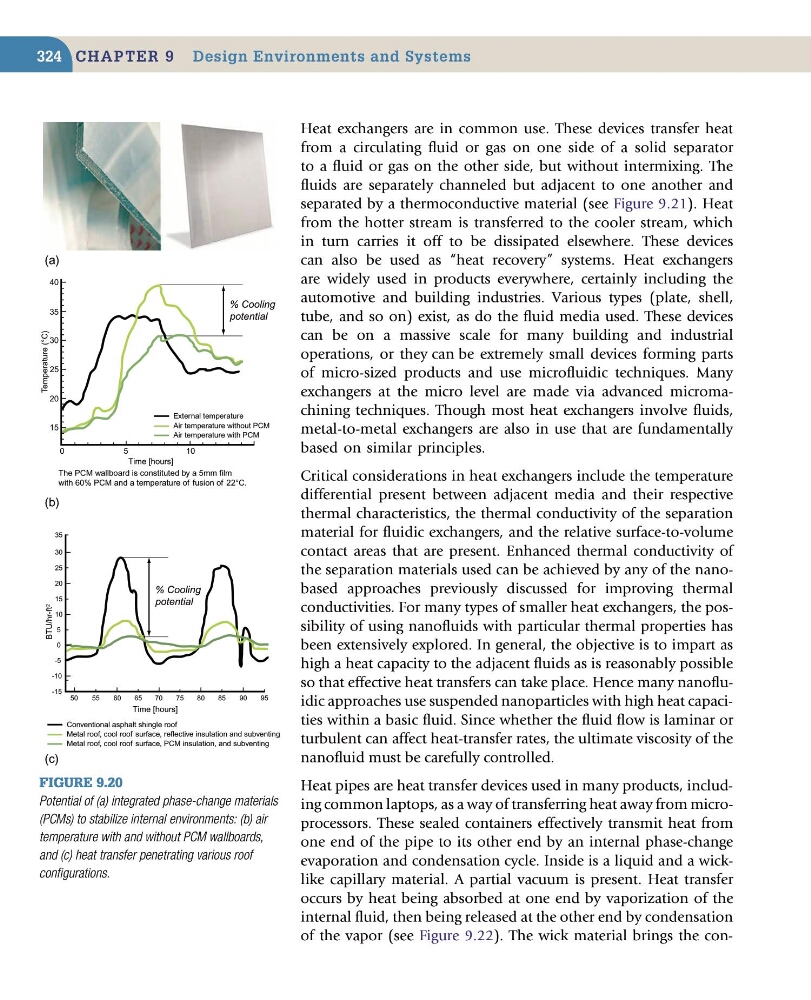
of the vapor (see Figure 9.22). The wick material brings the conFigure 9.20
Potential of (a) integrated phase-change materials
(PCMs) to stabilize internal environments: (b) air
temperature with and without PCM wallboards,
and (c) heat transfer penetrating various roof
configurations.
% Cooling
potential
% Cooling
potential
Time [hours]
External temperature
Air temperature without PCM
Air temperature with PCM
0
15
20
25
30
35
40
5
10
Temperature (°C)
(b)
(a)
(c)
The PCM wallboard is constituted by a 5mm film
with 60% PCM and a temperature of fusion of 22°C.
Conventional asphalt shingle roof
Time [hours]
85
80
75
70
65
60
55
50
10
15
20
25
30
0
5
-15
-10
-5
90
95
BTU/hr-ft 2
35
Metal roof, cool roof surface, reflective insulation and subventing
Metal roof, cool roof surface, PCM insulation, and subventing
324
Heat exchangers are in common use. These devices transfer heat
from a circulating fluid or gas on one side of a solid separator
to a fluid or gas on the other side, but without intermixing. The
fluids are separately channeled but adjacent to one another and
separated by a thermoconductive material (see Figure 9.21). Heat
from the hotter stream is transferred to the cooler stream, which
in turn carries it off to be dissipated elsewhere. These devices
can also be used as “heat recovery” systems. Heat exchangers
are widely used in products everywhere, certainly including the
automotive and building industries. Various types (plate, shell,
tube, and so on) exist, as do the fluid media used. These devices
can be on a massive scale for many building and industrial
operations, or they can be extremely small devices forming parts
of micro-sized products and use microfluidic techniques. Many
exchangers at the micro level are made via advanced micromachining techniques. Though most heat exchangers involve fluids,
metal-to-metal exchangers are also in use that are fundamentally
based on similar principles.
Critical considerations in heat exchangers include the temperature
differential present between adjacent media and their respective
thermal characteristics, the thermal conductivity of the separation
material for fluidic exchangers, and the relative surface-to-volume
contact areas that are present. Enhanced thermal conductivity of
the separation materials used can be achieved by any of the nanobased approaches previously discussed for improving thermal
conductivities. For many types of smaller heat exchangers, the possibility of using nanofluids with particular thermal properties has
been extensively explored. In general, the objective is to impart as
high a heat capacity to the adjacent fluids as is reasonably possible
so that effective heat transfers can take place. Hence many nanofluidic approaches use suspended nanoparticles with high heat capacities within a basic fluid. Since whether the fluid flow is laminar or
turbulent can affect heat-transfer rates, the ultimate viscosity of the
nanofluid must be carefully controlled.
Heat pipes are heat transfer devices used in many products, including common laptops, as a way of transferring heat away from microprocessors. These sealed containers effectively transmit heat from
one end of the pipe to its other end by an internal phase-change
evaporation and condensation cycle. Inside is a liquid and a wicklike capillary material. A partial vacuum is present. Heat transfer
occurs by heat being absorbed at one end by vaporization of the
internal fluid, then being released at the other end by condensation
of the vapor (see Figure 9.22). The wick material brings the conFigure 9.20
Potential of (a) integrated phase-change materials
(PCMs) to stabilize internal environments: (b) air
temperature with and without PCM wallboards,
and (c) heat transfer penetrating various roof
configurations.
% Cooling
potential
% Cooling
potential
Time [hours]
External temperature
Air temperature without PCM
Air temperature with PCM
0
15
20
25
30
35
40
5
10
Temperature (°C)
(b)
(a)
(c)
The PCM wallboard is constituted by a 5mm film
with 60% PCM and a temperature of fusion of 22°C.
Conventional asphalt shingle roof
Time [hours]
85
80
75
70
65
60
55
50
10
15
20
25
30
0
5
-15
-10
-5
90
95
BTU/hr-ft 2
35
Metal roof, cool roof surface, reflective insulation and subventing
Metal roof, cool roof surface, PCM insulation, and subventing