

323
from a solid to a liquid, from a liquid to a gas, or vice versa. Many
remarkable things happen at phase-change points, including
a change in structure of the material. Of interest here is that they
release or absorb the latent heat of fusion within the material at these
points without a change in temperature. As a material goes from a
solid to a liquid, it absorbs heat. A surprising amount of extra external energy input is required to make this solid-to-liquid conversion.
Conversely, as a material changes from a liquid to a solid, it releases
its latent heat of fusion. The amounts of energy released or absorbed
are surprisingly high. There are many nano-based approaches that
rely on phase-change characteristics. If intended to be reversible,
phase-change materials can be encapsulated or used to fill nanoscale
pores. Opportunities are particularly high with polymeric materials.
Polymer nanoparticles can be made of phase-change materials.
The general phase-change phenomenon has been repeatedly
exploited in several ways to control thermal environments. For
example, microencapsulated phase-changing materials with inherently high heats of fusion have been embedded in high-end sports
clothing, such as gloves, for uses in extremely cold environments.
On one hand, a nonactive user can be quite cold, but, on exercising,
the heat generated by a human during exercise can be problematic. The materials in this clothing are designed to undergo phase
changes at specific points. The excess heat generated during exercise
becomes absorbed by a phase change in the material as it transforms from a solid to a liquid. As the body cools, heat is released by
the material back into the body environment, thus warming it.
This same general need to have a boundary material absorb or
release heat under different circumstances is also quite common in
architecture. For example, even typical radiant floor-heating systems
made by burying hot-water pipes into a floor material can benefit
from the use of phase-change strategies. Used in typical heavy-mass
concrete floors, for example, the floors are slow to heat and slow to
cool with external temperature swings. A consequence is that heat
from the pipes is often released from the floor at the wrong time
because of the thermal lag. Phase-change materials in encapsulated
pellets can enable the radiant floor system to be much more responsive to rapid temperature variations. Figure 9.20 shows the effects of
using phase-change materials in common wall and roof situations.
heat-transfer devices: heat exchangers
and heat pipes
Many devices in common use are deliberately intended to transfer
heat from one point to another or from one medium to another.
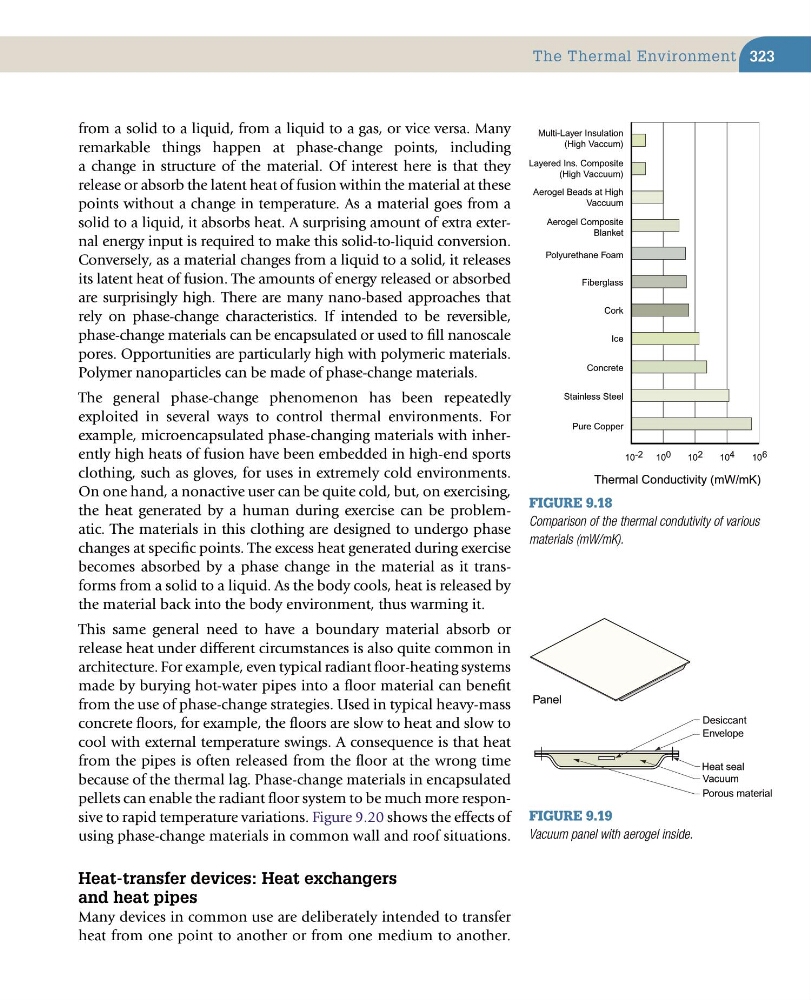
Figure 9.18
Comparison of the thermal condutivity of various
materials (mW/mK).
Figure 9.19
Vacuum panel with aerogel inside.
Multi-Layer Insulation
(High Vaccum)
Layered Ins. Composite
(High Vaccuum)
Aerogel Beads at High
Vaccuum
Aerogel Composite
Blanket
Polyurethane Foam
Fiberglass
Cork
Ice
Concrete
Stainless Steel
Pure Copper
Thermal Conductivity (mW/mK)
10 0
10 2
10 4
10 6
10 -2
Panel
Desiccant
Heat seal
Envelope
Vacuum
Porous material
The Thermal Environment
from a solid to a liquid, from a liquid to a gas, or vice versa. Many
remarkable things happen at phase-change points, including
a change in structure of the material. Of interest here is that they
release or absorb the latent heat of fusion within the material at these
points without a change in temperature. As a material goes from a
solid to a liquid, it absorbs heat. A surprising amount of extra external energy input is required to make this solid-to-liquid conversion.
Conversely, as a material changes from a liquid to a solid, it releases
its latent heat of fusion. The amounts of energy released or absorbed
are surprisingly high. There are many nano-based approaches that
rely on phase-change characteristics. If intended to be reversible,
phase-change materials can be encapsulated or used to fill nanoscale
pores. Opportunities are particularly high with polymeric materials.
Polymer nanoparticles can be made of phase-change materials.
The general phase-change phenomenon has been repeatedly
exploited in several ways to control thermal environments. For
example, microencapsulated phase-changing materials with inherently high heats of fusion have been embedded in high-end sports
clothing, such as gloves, for uses in extremely cold environments.
On one hand, a nonactive user can be quite cold, but, on exercising,
the heat generated by a human during exercise can be problematic. The materials in this clothing are designed to undergo phase
changes at specific points. The excess heat generated during exercise
becomes absorbed by a phase change in the material as it transforms from a solid to a liquid. As the body cools, heat is released by
the material back into the body environment, thus warming it.
This same general need to have a boundary material absorb or
release heat under different circumstances is also quite common in
architecture. For example, even typical radiant floor-heating systems
made by burying hot-water pipes into a floor material can benefit
from the use of phase-change strategies. Used in typical heavy-mass
concrete floors, for example, the floors are slow to heat and slow to
cool with external temperature swings. A consequence is that heat
from the pipes is often released from the floor at the wrong time
because of the thermal lag. Phase-change materials in encapsulated
pellets can enable the radiant floor system to be much more responsive to rapid temperature variations. Figure 9.20 shows the effects of
using phase-change materials in common wall and roof situations.
heat-transfer devices: heat exchangers
and heat pipes
Many devices in common use are deliberately intended to transfer
heat from one point to another or from one medium to another.
Figure 9.18
Comparison of the thermal condutivity of various
materials (mW/mK).
Figure 9.19
Vacuum panel with aerogel inside.
Multi-Layer Insulation
(High Vaccum)
Layered Ins. Composite
(High Vaccuum)
Aerogel Beads at High
Vaccuum
Aerogel Composite
Blanket
Polyurethane Foam
Fiberglass
Cork
Ice
Concrete
Stainless Steel
Pure Copper
Thermal Conductivity (mW/mK)
10 0
10 2
10 4
10 6
10 -2
Panel
Desiccant
Heat seal
Envelope
Vacuum
Porous material
The Thermal Environment