

C haptEr 9 design Environments and systems
322
between 20 and 38 years, which can be increased for few years by
adding drying agents to adsorb the water vapor. VIPs are also very
sensitive to mechanical damage, so they need to be handled carefully during transportation and installation in buildings.
thermal barriers
The insulative qualities of materials can also be increased by various
kinds of nanocoatings applied directly to external surfaces. Thermal
barrier coatings are often in the form of sprays. Thermal sprays are
thin coatings applied to the surface of a component that provide a
thermal insulation function. (They can also be used for corrosion
resistance.) Many are based on nano-titanium oxide (TiO 2 ) or zirconia (ZrO 2 ). Others are based on porous ceramic materials. Most
of these thermal barriers are used in extremely hostile high-temperature environments, as in blades for turbines. Several approaches
use multilayers. They are expensive and generally not appropriate
for use as insulation barriers when temperatures are relatively low
(as in typical building applications).
In making thermal sprays, typically heat-softened or melted metal
particles are sprayed onto a surface. A large number of application
technologies and material types are in common use. In a typical
spray, a flattened grain structure parallel to the surface normally
results that is both mechanically and diffusion bonded to the
surface. When applied in air, chemical interactions, including oxidation, can occur and an oxide shell can be formed. Strengths are
generally poor. Internal structures are normally fairly porous and
voids can be present, which in turn contributes to their insulating
capabilities. Different types of nanomaterial-based thermal sprays
and powders have been developed that provide nanograin coatings,
including ones based on alumina/titania. Nanocomposite polymers
with ceramic nanomaterials have been explored for applications in
which coating ductility is more important than strength.
Generally, adding nanoparticles to coatings improves bonds and
smoothness. These coatings are smoother and stronger than traditional coatings. However, though nanoparticles can normally
remain in suspension in a fluid, it is more difficult to actually spray
them because of their very low mass. Hence considerable attention
has been paid to developing effective spraying technologies.
thermal buffers: phase-change materials
An interesting approach to managing heat flow is through the use
of thermal buffers associated with temperature-dependent “phase
changes” in materials. Phase changes occur when materials change
0.0 1.0 2.0 3.0 4.0 5.0 6.0 7.0
Aerogel highly insulated
Triple-glazed low-SHGC Kr
Double low SHGC Kr
Double-glazed argon
Double-glazed clear
Single pane
Comparison of U-values (W/m 2 K)
0.0 0.5 1.0 1.5 2.0 2.5 3.0
Aerogel highly insulated
Triple-glazed low-SHGC Kr
Triple-glazed Kr
Double low SHGC Kr
Double krypton
Double clear low SHGC
Double-glazed clear
Comparison of U-values (W/m 2 K)
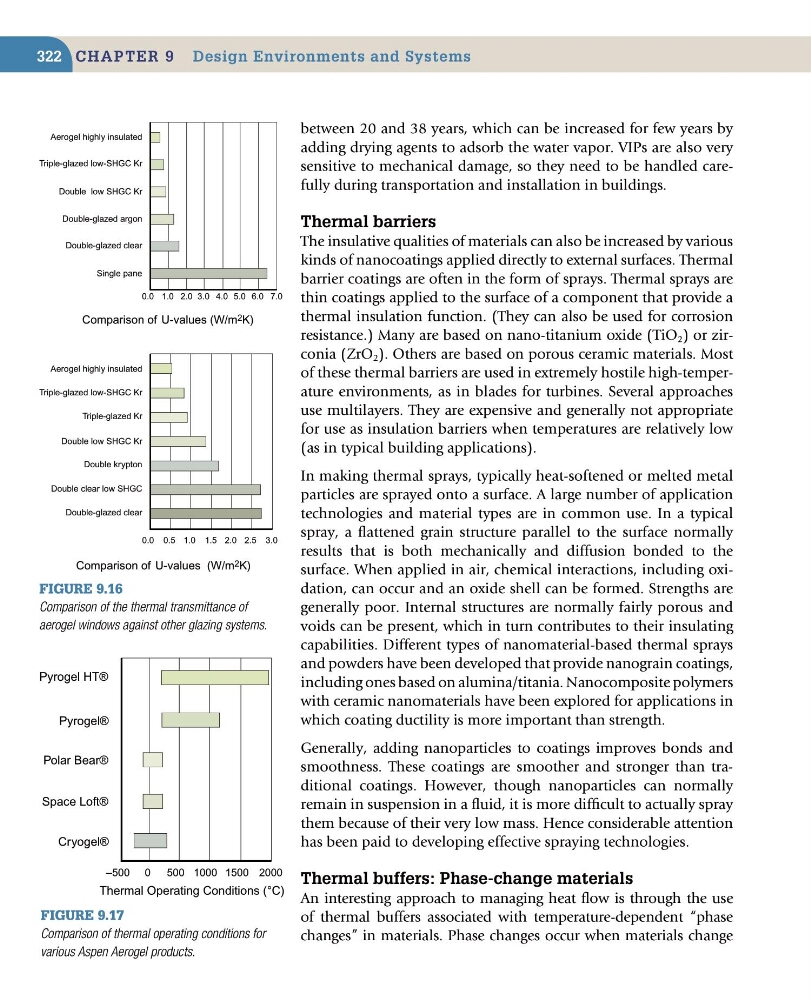
Figure 9.16
Comparison of the thermal transmittance of
aerogel windows against other glazing systems.
Figure 9.17
Comparison of thermal operating conditions for
various Aspen Aerogel products.
Cryogel®
Space Loft®
Polar Bear®
Pyrogel®
Pyrogel HT®
–500 0
500 1000 1500 2000
Thermal Operating Conditions (°C)
322
between 20 and 38 years, which can be increased for few years by
adding drying agents to adsorb the water vapor. VIPs are also very
sensitive to mechanical damage, so they need to be handled carefully during transportation and installation in buildings.
thermal barriers
The insulative qualities of materials can also be increased by various
kinds of nanocoatings applied directly to external surfaces. Thermal
barrier coatings are often in the form of sprays. Thermal sprays are
thin coatings applied to the surface of a component that provide a
thermal insulation function. (They can also be used for corrosion
resistance.) Many are based on nano-titanium oxide (TiO 2 ) or zirconia (ZrO 2 ). Others are based on porous ceramic materials. Most
of these thermal barriers are used in extremely hostile high-temperature environments, as in blades for turbines. Several approaches
use multilayers. They are expensive and generally not appropriate
for use as insulation barriers when temperatures are relatively low
(as in typical building applications).
In making thermal sprays, typically heat-softened or melted metal
particles are sprayed onto a surface. A large number of application
technologies and material types are in common use. In a typical
spray, a flattened grain structure parallel to the surface normally
results that is both mechanically and diffusion bonded to the
surface. When applied in air, chemical interactions, including oxidation, can occur and an oxide shell can be formed. Strengths are
generally poor. Internal structures are normally fairly porous and
voids can be present, which in turn contributes to their insulating
capabilities. Different types of nanomaterial-based thermal sprays
and powders have been developed that provide nanograin coatings,
including ones based on alumina/titania. Nanocomposite polymers
with ceramic nanomaterials have been explored for applications in
which coating ductility is more important than strength.
Generally, adding nanoparticles to coatings improves bonds and
smoothness. These coatings are smoother and stronger than traditional coatings. However, though nanoparticles can normally
remain in suspension in a fluid, it is more difficult to actually spray
them because of their very low mass. Hence considerable attention
has been paid to developing effective spraying technologies.
thermal buffers: phase-change materials
An interesting approach to managing heat flow is through the use
of thermal buffers associated with temperature-dependent “phase
changes” in materials. Phase changes occur when materials change
0.0 1.0 2.0 3.0 4.0 5.0 6.0 7.0
Aerogel highly insulated
Triple-glazed low-SHGC Kr
Double low SHGC Kr
Double-glazed argon
Double-glazed clear
Single pane
Comparison of U-values (W/m 2 K)
0.0 0.5 1.0 1.5 2.0 2.5 3.0
Aerogel highly insulated
Triple-glazed low-SHGC Kr
Triple-glazed Kr
Double low SHGC Kr
Double krypton
Double clear low SHGC
Double-glazed clear
Comparison of U-values (W/m 2 K)
Figure 9.16
Comparison of the thermal transmittance of
aerogel windows against other glazing systems.
Figure 9.17
Comparison of thermal operating conditions for
various Aspen Aerogel products.
Cryogel®
Space Loft®
Polar Bear®
Pyrogel®
Pyrogel HT®
–500 0
500 1000 1500 2000
Thermal Operating Conditions (°C)