

321
Figures 9.16–9.18 illustrate a general comparison of several conventional materials and various aerogel products with respect to their
insulating properties within a normal building context. Aerogels
have particularly good thermal operating condition ranges, making
them very valuable in many product and building situations.
Recall that the pressure state in the pores is also an important factor
in reducing the conductivity of a porous material, in addition to
pore size reductions obtained through materials such as aerogels.
New vacuum-insulated panels (VIPs) have been produced that use
aerogels or other highly porous nano- or microscale material within
a vacuum (see Figure 9.19). These remarkable panels can have up to
10 times smaller thermal conductivity than conventional insulation
panels (0.004 W/(mK) versus 0.037 W/(mK) for mineral fiber insulation or 0.024 W/(mK) for polyurethane foam). This efficiency, in
turn, decreases insulation thickness needs. Panels can be made quite
large, and are suitable for either product applications or in large-scale
buildings where they are typically used as parts of exterior enclosure
systems.
For example, in designing a passive house, there might be around
300 mm of conventional insulation panel plus thickness of other elements (about 500 mm in all). If vacuum-insulated panels were used so
that the same U-value would be obtained, about 40 mm in thickness
would be needed for the panel, plus the thickness of other elements,
for a total of about 200 mm. Thickness reductions are remarkable,
albeit costs are quite high. Materials usually used as the core materials of vacuum-insulated panels are aerogels or fumed silica. Those
materials have very low thermal conductivity, do not burn, and have
very good acoustic properties. A big problem with these sealed panels,
however, is the penetration of gases (especially water vapor) from the
environment into the material, which leads to degradation of the
panels’ thermal resistance (often referred to as aging). Permeation is
forced by the difference of environment pressure and the pressure
inside the pores, which is considerably smaller. Gases go from the
higher pressure regions to the lower one, which means from the environment to pores, and this results in an increase of pressure inside
the pores. As the pressure and the percentage of water vapor increase
with time, the thermal conductivity of material increases. This aging
mechanism depends on temperature, relative humidity, the kind of
building envelope, and the type of panel core material.
The outer layer has the important role of preventing gases from entering the panel. With a high-quality final layer (aluminum layers or
metallized polymer films), the service life of these panels is usually
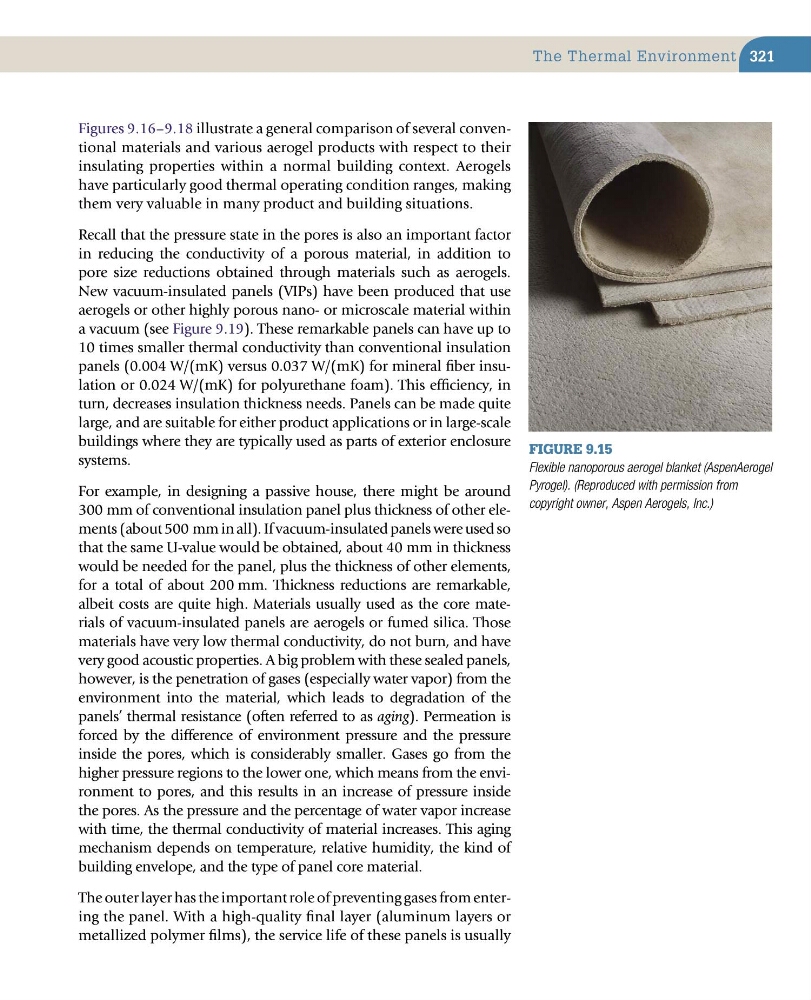
Figure 9.15
Flexible nanoporous aerogel blanket (AspenAerogel
Pyrogel). (Reproduced with permission from
copyright owner, Aspen Aerogels, Inc.)
The Thermal Environment
Figures 9.16–9.18 illustrate a general comparison of several conventional materials and various aerogel products with respect to their
insulating properties within a normal building context. Aerogels
have particularly good thermal operating condition ranges, making
them very valuable in many product and building situations.
Recall that the pressure state in the pores is also an important factor
in reducing the conductivity of a porous material, in addition to
pore size reductions obtained through materials such as aerogels.
New vacuum-insulated panels (VIPs) have been produced that use
aerogels or other highly porous nano- or microscale material within
a vacuum (see Figure 9.19). These remarkable panels can have up to
10 times smaller thermal conductivity than conventional insulation
panels (0.004 W/(mK) versus 0.037 W/(mK) for mineral fiber insulation or 0.024 W/(mK) for polyurethane foam). This efficiency, in
turn, decreases insulation thickness needs. Panels can be made quite
large, and are suitable for either product applications or in large-scale
buildings where they are typically used as parts of exterior enclosure
systems.
For example, in designing a passive house, there might be around
300 mm of conventional insulation panel plus thickness of other elements (about 500 mm in all). If vacuum-insulated panels were used so
that the same U-value would be obtained, about 40 mm in thickness
would be needed for the panel, plus the thickness of other elements,
for a total of about 200 mm. Thickness reductions are remarkable,
albeit costs are quite high. Materials usually used as the core materials of vacuum-insulated panels are aerogels or fumed silica. Those
materials have very low thermal conductivity, do not burn, and have
very good acoustic properties. A big problem with these sealed panels,
however, is the penetration of gases (especially water vapor) from the
environment into the material, which leads to degradation of the
panels’ thermal resistance (often referred to as aging). Permeation is
forced by the difference of environment pressure and the pressure
inside the pores, which is considerably smaller. Gases go from the
higher pressure regions to the lower one, which means from the environment to pores, and this results in an increase of pressure inside
the pores. As the pressure and the percentage of water vapor increase
with time, the thermal conductivity of material increases. This aging
mechanism depends on temperature, relative humidity, the kind of
building envelope, and the type of panel core material.
The outer layer has the important role of preventing gases from entering the panel. With a high-quality final layer (aluminum layers or
metallized polymer films), the service life of these panels is usually
Figure 9.15
Flexible nanoporous aerogel blanket (AspenAerogel
Pyrogel). (Reproduced with permission from
copyright owner, Aspen Aerogels, Inc.)
The Thermal Environment