

C haptEr 9 design Environments and systems
320
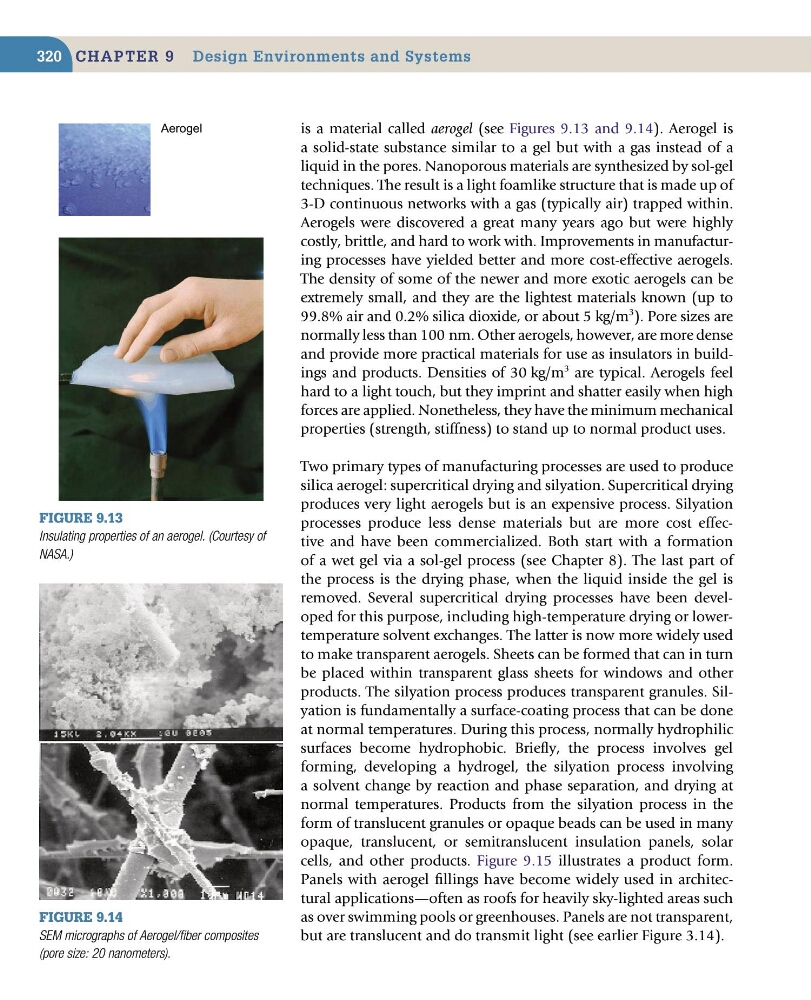
is a material called aerogel (see Figures 9.13 and 9.14). Aerogel is
a solid-state substance similar to a gel but with a gas instead of a
liquid in the pores. Nanoporous materials are synthesized by sol-gel
techniques. The result is a light foamlike structure that is made up of
3-D continuous networks with a gas (typically air) trapped within.
Aerogels were discovered a great many years ago but were highly
costly, brittle, and hard to work with. Improvements in manufacturing processes have yielded better and more cost-effective aerogels.
The density of some of the newer and more exotic aerogels can be
extremely small, and they are the lightest materials known (up to
99.8% air and 0.2% silica dioxide, or about 5 kg/m
3
). Pore sizes are
normally less than 100 nm. Other aerogels, however, are more dense
and provide more practical materials for use as insulators in buildings and products. Densities of 30 kg/m
3 are typical. Aerogels feel
hard to a light touch, but they imprint and shatter easily when high
forces are applied. Nonetheless, they have the minimum mechanical
properties (strength, stiffness) to stand up to normal product uses.
Two primary types of manufacturing processes are used to produce
silica aerogel: supercritical drying and silyation. Supercritical drying
produces very light aerogels but is an expensive process. Silyation
processes produce less dense materials but are more cost effective and have been commercialized. Both start with a formation
of a wet gel via a sol-gel process (see Chapter 8). The last part of
the process is the drying phase, when the liquid inside the gel is
removed. Several supercritical drying processes have been developed for this purpose, including high-temperature drying or lowertemperature solvent exchanges. The latter is now more widely used
to make transparent aerogels. Sheets can be formed that can in turn
be placed within transparent glass sheets for windows and other
products. The silyation process produces transparent granules. Silyation is fundamentally a surface-coating process that can be done
at normal temperatures. During this process, normally hydrophilic
surfaces become hydrophobic. Briefly, the process involves gel
forming, developing a hydrogel, the silyation process involving
a solvent change by reaction and phase separation, and drying at
normal temperatures. Products from the silyation process in the
form of translucent granules or opaque beads can be used in many
opaque, translucent, or semitranslucent insulation panels, solar
cells, and other products. Figure 9.15 illustrates a product form.
Panels with aerogel fillings have become widely used in architectural applications—often as roofs for heavily sky-lighted areas such
as over swimming pools or greenhouses. Panels are not transparent,
but are translucent and do transmit light (see earlier Figure 3.14).
Figure 9.13
Insulating properties of an aerogel. (Courtesy of
NASA.)
Aerogel
Figure 9.14
SEM micrographs of Aerogel/fiber composites
(pore size: 20 nanometers).
320
is a material called aerogel (see Figures 9.13 and 9.14). Aerogel is
a solid-state substance similar to a gel but with a gas instead of a
liquid in the pores. Nanoporous materials are synthesized by sol-gel
techniques. The result is a light foamlike structure that is made up of
3-D continuous networks with a gas (typically air) trapped within.
Aerogels were discovered a great many years ago but were highly
costly, brittle, and hard to work with. Improvements in manufacturing processes have yielded better and more cost-effective aerogels.
The density of some of the newer and more exotic aerogels can be
extremely small, and they are the lightest materials known (up to
99.8% air and 0.2% silica dioxide, or about 5 kg/m
3
). Pore sizes are
normally less than 100 nm. Other aerogels, however, are more dense
and provide more practical materials for use as insulators in buildings and products. Densities of 30 kg/m
3 are typical. Aerogels feel
hard to a light touch, but they imprint and shatter easily when high
forces are applied. Nonetheless, they have the minimum mechanical
properties (strength, stiffness) to stand up to normal product uses.
Two primary types of manufacturing processes are used to produce
silica aerogel: supercritical drying and silyation. Supercritical drying
produces very light aerogels but is an expensive process. Silyation
processes produce less dense materials but are more cost effective and have been commercialized. Both start with a formation
of a wet gel via a sol-gel process (see Chapter 8). The last part of
the process is the drying phase, when the liquid inside the gel is
removed. Several supercritical drying processes have been developed for this purpose, including high-temperature drying or lowertemperature solvent exchanges. The latter is now more widely used
to make transparent aerogels. Sheets can be formed that can in turn
be placed within transparent glass sheets for windows and other
products. The silyation process produces transparent granules. Silyation is fundamentally a surface-coating process that can be done
at normal temperatures. During this process, normally hydrophilic
surfaces become hydrophobic. Briefly, the process involves gel
forming, developing a hydrogel, the silyation process involving
a solvent change by reaction and phase separation, and drying at
normal temperatures. Products from the silyation process in the
form of translucent granules or opaque beads can be used in many
opaque, translucent, or semitranslucent insulation panels, solar
cells, and other products. Figure 9.15 illustrates a product form.
Panels with aerogel fillings have become widely used in architectural applications—often as roofs for heavily sky-lighted areas such
as over swimming pools or greenhouses. Panels are not transparent,
but are translucent and do transmit light (see earlier Figure 3.14).
Figure 9.13
Insulating properties of an aerogel. (Courtesy of
NASA.)
Aerogel
Figure 9.14
SEM micrographs of Aerogel/fiber composites
(pore size: 20 nanometers).