

327
Here the proposal is to have a huge matrix of quantum dots held
together by molecular bonding to replace the solid p-n materials
normally used in thermoelectric devices. Electrical conductivities
are reportedly increased while thermal conductivities are decreased.
Other effects, notably increases in the Seebeck coefficient, can possibly occur by altering the density of states (see Chapter 6). Section
9.7 describes uses of carbon nanotubes, nanowires, and other
approaches in more detail.
Developments with nanomaterials in relation to multilayer film
structures or other conformal deposition processes may help in
relation to shape issues. In multilayered films, enhancement to
the Seebeck effect might not uniformly occur, however, and their
use still has its problems. Other approaches suitable to larger thermoelectric material areas with controllable nanomaterial sizes and
shapes may be possible as well. Material densities that contribute
to the Seebeck effect can also be changed. Synthesis methods suitable for making really large thermoelectric areas, however, remain
problematic.
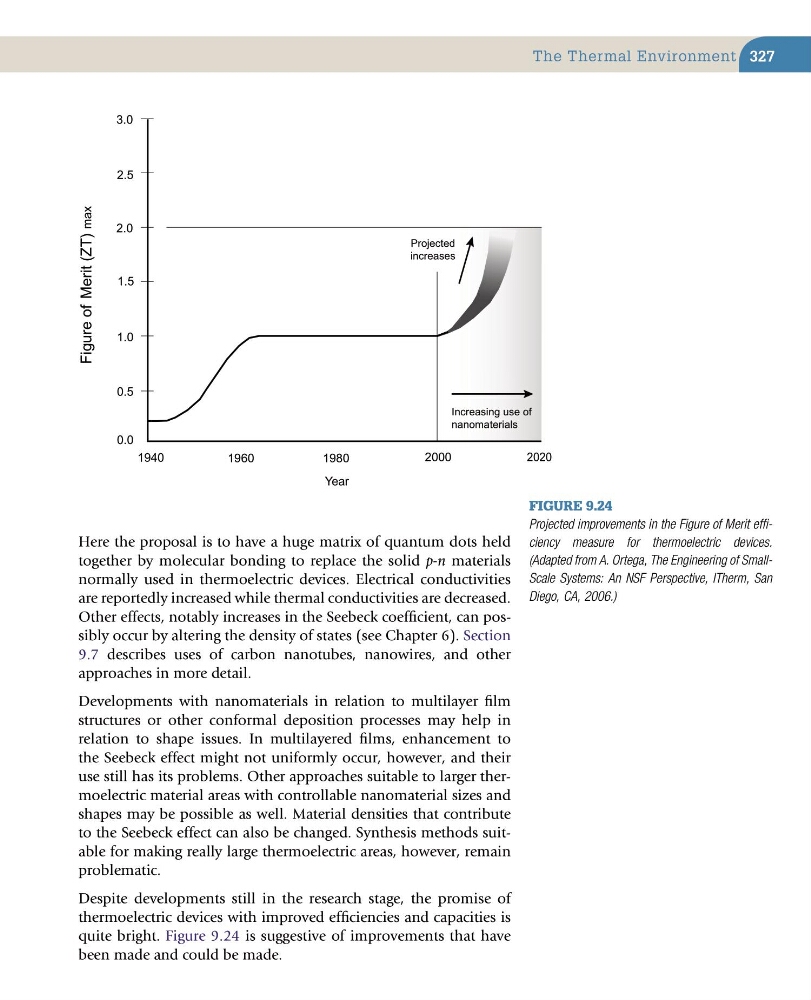
Despite developments still in the research stage, the promise of
thermoelectric devices with improved efficiencies and capacities is
quite bright. Figure 9.24 is suggestive of improvements that have
been made and could be made.
The Thermal Environment
0.0
1940
2000
1.5
Figure of Merit (ZT) max
0.5
1.0
2.0
2.5
3.0
1960
1980
Year
2020
Projected
increases
Increasing use of
nanomaterials
Figure 9.24
Projected improvements in the Figure of Merit efficiency measure for thermoelectric devices.
(Adapted from A. Ortega, The Engineering of SmallScale Systems: An NSF Perspective, ITherm, San
Diego, CA, 2006.)
Here the proposal is to have a huge matrix of quantum dots held
together by molecular bonding to replace the solid p-n materials
normally used in thermoelectric devices. Electrical conductivities
are reportedly increased while thermal conductivities are decreased.
Other effects, notably increases in the Seebeck coefficient, can possibly occur by altering the density of states (see Chapter 6). Section
9.7 describes uses of carbon nanotubes, nanowires, and other
approaches in more detail.
Developments with nanomaterials in relation to multilayer film
structures or other conformal deposition processes may help in
relation to shape issues. In multilayered films, enhancement to
the Seebeck effect might not uniformly occur, however, and their
use still has its problems. Other approaches suitable to larger thermoelectric material areas with controllable nanomaterial sizes and
shapes may be possible as well. Material densities that contribute
to the Seebeck effect can also be changed. Synthesis methods suitable for making really large thermoelectric areas, however, remain
problematic.
Despite developments still in the research stage, the promise of
thermoelectric devices with improved efficiencies and capacities is
quite bright. Figure 9.24 is suggestive of improvements that have
been made and could be made.
The Thermal Environment
0.0
1940
2000
1.5
Figure of Merit (ZT) max
0.5
1.0
2.0
2.5
3.0
1960
1980
Year
2020
Projected
increases
Increasing use of
nanomaterials
Figure 9.24
Projected improvements in the Figure of Merit efficiency measure for thermoelectric devices.
(Adapted from A. Ortega, The Engineering of SmallScale Systems: An NSF Perspective, ITherm, San
Diego, CA, 2006.)